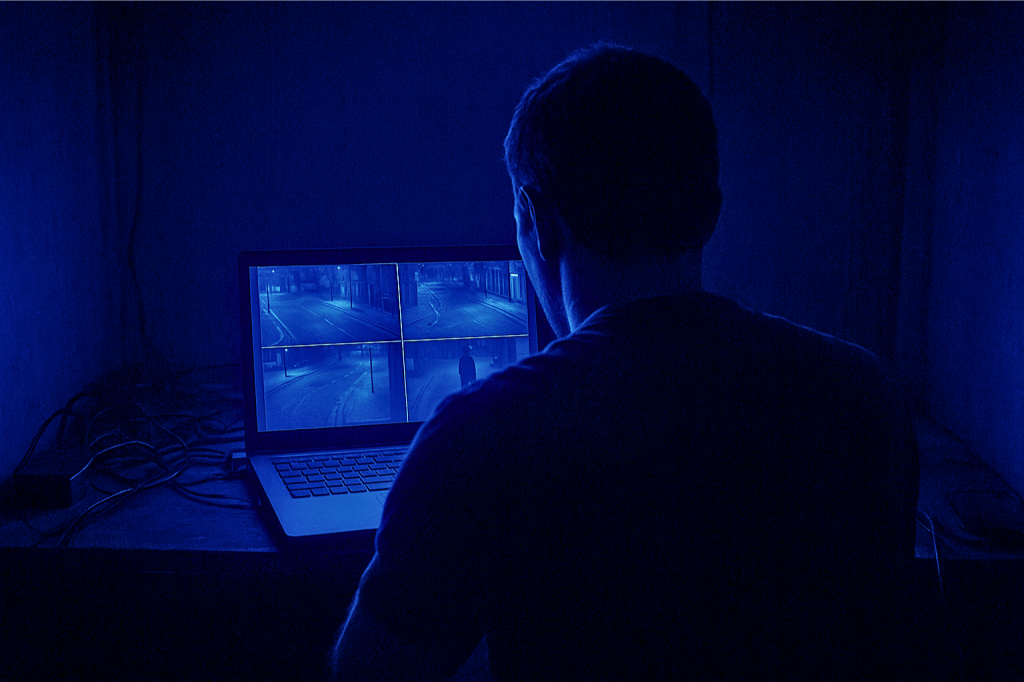
The pattern appeared at 2:47am.
Callum had been inside the Met’s facial recognition network for three hours, sifting through camera feeds across Zone 2, when he spotted it: the same face at Euston Station, then King’s Cross four minutes later, then Camden Town three minutes after that. Impossible distances. Impossible speeds.
He leant closer to his monitors, the blue glow washing over his face in the darkened flat. His fingers flew across the keyboard, pulling up more feeds. There—Chalk Farm at 2:51. Then Belsize Park. The face moved north through London like a knife through silk, appearing and disappearing with mechanical precision.
Not a glitch. Glitches were random, chaotic. This was deliberate.
The face itself was unremarkable: white male, thirties, regulation haircut. The sort of face that vanished into crowds. But the movement pattern was wrong, fundamentally wrong. No one could cover those distances in those timeframes. Not even on the tube at this hour.
Callum grabbed his phone, opened the group chat. His fingers hesitated over the keyboard. The others would want proof. Screenshots, timestamps, something solid.
He captured the sequence: seven appearances in thirteen minutes, plotted on a map of North London. He cropped the images tight, focused on the face, ignoring the background clutter of late-night London. The pattern was what mattered—linear, methodical.
“Look what I found,” he typed into the chat. “Glitch in the Matrix?” He attached the images and hit send before he could second-guess himself.
The satisfaction lasted exactly ninety seconds.
That’s when the face stopped moving.
On the Hampstead Heath camera feed, the figure stood motionless in the centre of the frame. Then, slowly, it turned. Looked directly at the camera. Looked directly at Callum.
The timestamp stuttered. 03:02:17. 03:02:17. 03:02:17.
Callum’s mouth went dry. He tried to close the window, to disconnect, but his hands wouldn’t cooperate. The figure on screen didn’t blink. Didn’t breathe. Just stared with absolute focus through the camera, through the network, through the distance between them.
Then it moved again.
Callum’s fingers finally obeyed, stabbing at keys. He pulled up more feeds, tracing the route south now. Kentish Town. King’s Cross again. Bloomsbury.
Getting closer.
He grabbed his phone, deleted the group chat post. His thumb hovered over the images in his camera roll. What if someone had already downloaded them? What if they’d seen something he’d missed? But there was no time to worry about that now.
The figure appeared on a Shoreditch feed. Still moving south.
Callum calculated distances, estimated speeds. Sixteen minutes. That’s all he had. Sixteen minutes before it reached his postcode.
He yanked cables from the back of his computer, killing the connection. Grabbed his laptop, his phone, the hard drive with his toolkit. The safe room. He needed to get to the safe room.
The walk-in cupboard in the bedroom had been his contingency plan for two years: Faraday cage built into the walls, signal blockers, a separate power supply. Somewhere the authorities couldn’t track, couldn’t trace. A place to go dark.
He sealed himself inside, sat in the darkness, pulled the laptop onto his knees. The battery light was the only illumination. His breathing sounded loud in the confined space.
Sixteen minutes became twenty. Then thirty.
Callum’s heart rate gradually slowed. The walls blocked everything: mobile signals, WiFi, Bluetooth. In here, he was invisible. Whatever that thing was, however it had found him through the Met’s network, it couldn’t track what it couldn’t see.
He’d been sloppy, careless. Posted without thinking. But he was safe now. In a few hours, he’d slip out, dump the equipment, disappear for a while. The group would understand.
His breathing steadied. The terror began to recede, replaced by exhaustion and the strange clarity that follows panic.
He opened the laptop, pulled up the images he’d captured. Maybe he could work out how he’d been detected so quickly. Some digital signature he’d left behind, some—
He stopped.
The King’s Cross image. 2:43am timestamp. He’d cropped it so tightly around the face that he’d almost missed it: background, platform level, two men in dark clothing supporting a third figure between them. No, not supporting. Carrying. The body hung limp, head lolled forward.
Callum zoomed in, his hands shaking. The image pixelated but he could make out enough. A woman, maybe. Formal clothing. And there, half-turned from the camera, face partially visible—a profile he recognised from news footage. Not a name he could speak, not someone he could identify with certainty in court, but someone whose presence in King’s Cross station at 2:43am would raise questions no one in power wanted asked.
He checked his phone’s cached news. There it was, a brief article from 6am: “Tragic suicide at King’s Cross station discovered early this morning. The deceased, believed to be a member of station staff, was found at approximately 5:30am.”
5:30am.
The timestamp on his image read 2:43am.
Callum stared at the screen, understanding blooming like frost across glass. This wasn’t about him stumbling onto a technical anomaly. This was about him capturing evidence of a murder being staged. And the face moving through London at impossible speeds wasn’t hunting randomly.
It was eliminating witnesses.
The knock on his front door was soft but distinct.
Callum’s breath caught. The flat was silent around him. No one knew this address. He’d rented it through shell companies, paid in cash, kept no digital footprint.
Another knock. Patient. Unhurried.
He stared at the darkness of his safe room. All those precautions, all that preparation. But he’d posted from his registered IP address, the flat he’d abandoned eighteen months ago. The one the council still had on file.
The knocking stopped.
In the silence that followed, Callum heard his front door open. Not forced. Not broken. Just opened, as though someone had simply decided the lock no longer mattered.
Footsteps in his hallway. Measured. Precise.
The Faraday cage was perfect. The signal blockers were military grade. But he’d built his safe room in the wrong flat.
The footsteps stopped outside the bedroom door.
Callum sat in the darkness, surrounded by technology that couldn’t save him, and waited for what came next.

Leave a comment