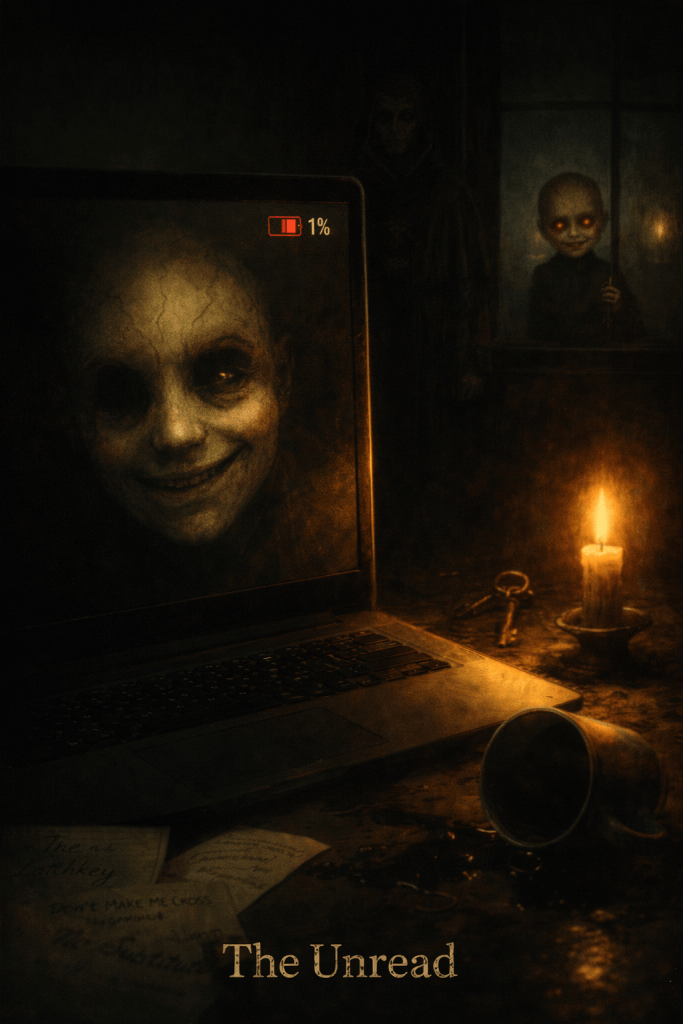
Dan saw her through the window.
Mary, the crossing patrol from Oakfield Primary. He recognised the high-viz jacket, the mechanical way she raised her Stop sign. But her face was wrong—angles too sharp, eyes catching the light with a reptilian yellow gleam. She was holding a boy’s hand. The child struggled, feet dragging, but Mary’s grip never loosened.
Dan’s coffee went cold in his hand. He’d written that story three years ago—Don’t Make Me Cross—and posted it on some creepypasta site that probably didn’t exist anymore. He stumbled backwards, the mug slipping from his grip and shattering on the floor. When he looked again, the street was empty.
He’d discovered his gift four years earlier. A story about a thing that lived in storm drains. He’d written it in a fever, posted it online, then spotted the thing three days later while walking past a grate near his house. Pale fingers. Too many joints. It had stared up at him with eyes that knew him.
Then it wasn’t there.
He’d checked his story’s stats. Forty-six reads in those three days. Forty-six people who’d absorbed the thing, distributed it across their imaginations, kept it from being wholly real.
The third time, he knew for certain. His story about a man who collected teeth. Dan saw him one morning loitering outside a dentist’s surgery, pockets bulging, grinning with borrowed smiles. Still there at midday. Went home, posted the story. Within hours: three hundred reads. That afternoon, no trace of the man.
The horrors behaved themselves, locked safely inside the minds of thousands of readers.
For a while, it worked perfectly. His first published collection made him famous. Critics called his work “viscerally authentic” and “disturbingly real.” They had no idea. He collected awards, appeared at festivals, watched his bank account swell.
But the ideas came faster. His mind churned constantly, conjuring scenarios, entities, victims.
Traditional publishing had meant months between acceptance and publication—too slow. So he started posting online: on his website, on Reddit, in Twitter threads. The audience grew. His income collapsed. When he started flooding the market with free content, his publishers dropped him, and his wife Sarah stopped pretending to understand.
“You spend more time with your stupid stories than with me,” she said. Sarah taught on supply at local primary schools. Real work, she called it. Not like his self-indulgent scribbling.
After she left, Dan wrote for eighteen hours a day. Then twenty. But sleep meant dreams, and dreams meant the Sorcerer.
Dantalion appeared first as a shadow in the corner of his bedroom, then as a figure in mediaeval robes, then as something that wore a man’s shape but moved with joints that bent the wrong way. The Sorcerer never slept. Each night, he conjured worse things—plagues that ate memory, creatures that lived in the spaces between heartbeats.
Dan wrote Dantalion stories constantly and posted them everywhere. But the Sorcerer in his dreams would not be contained, only growing stronger and more defined. These stories were feeding him, not trapping him.
First a red notice, then a final warning on the electricity bill. Dan was writing six, seven stories a day now, fingers cramping, eyes burning. His body was failing. Grey skin, hair falling out in clumps, weight dropping until his clothes hung loose. Online, his followers called him a legend, and a tortured genius. They made theories about his reclusive nature. About his dedication to craft.
They didn’t know he couldn’t stop.
The day the power was cut, Dan was mid-sentence. The laptop battery icon flashed: four percent. He had maybe thirty minutes.
He opened his archive and began re-posting everything he could find. Old stories, forgotten pieces, anything that might have slipped from collective memory. His fingers flew. Upload, tag, share. Upload, tag, share.
Then he found it: The Latchkey. His first viral hit, back when he’d still been learning his craft. A creepypasta about a figure who claimed ownership of homes. It stood watching until you acknowledged it, then entered and never left. Tens of thousands of reads in the first month, which had led to the development of The Latchkey Anthology.
But the website hosting it had died two years ago. GeoCities, or something like it. The story existed only on his hard drive now. Zero readers.
Dan tried to upload it. The connection dropped. Tried again. The battery icon turned red: two percent.
He looked up.
There was someone standing outside his window.
Small. Still. Patient. Watching the house with an expression painted onto cracked porcelain—a child’s face, but ancient orange eyes behind the porcelain. The figure raised one hand in greeting, brass key glinting between its fingers.
Dan’s face stretched into a smile he hadn’t chosen. The expression felt borrowed, like his muscles were remembering someone else’s memory. His reflection grinned back from the dark window, and for a moment he couldn’t tell which was him and which was the Latchkey, couldn’t remember if he’d created the thing or if it had always been there, waiting for someone to give it form and name and permission to exist.
The laptop made a small, apologetic sound. One percent.
Dan needed to call Sarah. Needed to warn her. His hands shook as he found her contact, pressed dial. It rang. Rang. Then—
“Hello?” A child’s voice. Almost hers, but higher.
“Who is this?” His voice cracked.
“Mrs Campbell’s teaching right now.” Sarah’s voice, but higher, like a recording played too fast.
“Which school?”
“Our school.” A pause. Then the same voice, but layered—two children speaking in perfect unison with his wife’s inflection: “We’re learning so much.”
Giggling in the background. Multiple sources. Twenty-eight identical rhythms.
The line went dead.
He’d written No Substitute eight months ago and posted it on his website. When was the last time he’d checked the stats?
The laptop screen flickered. Zero percent.
Dan jabbed the power button. Again. Again. Nothing. He stared at the screen as his last sentence died mid-word, the cursor blinking once, twice—
The screen went black.
Rage surged through him, deep and old. He wanted to smash the laptop, hurl it through the window at the figure outside, scream until his throat bled. This fucking useless piece of shit, dying when he needed it most, trapping him here with his creations loose and his wife gone and the Sorcerer—
In the black screen, he saw his reflection.
Behind him, standing in the room: a figure in mediaeval robes.
No. Not behind him.
The reflection stared back with his own eyes, but the face was shifting—bones moving beneath skin, features rearranging into something inhuman. The name whispered through his mind like a key turning in a lock: Dantalion.
The Sorcerer had never been separate. He’d been writing himself into existence all along, story by story, dream by dream. Every horror he’d conjured had been practice. Every nightmare he’d contained had been rehearsal. He’d spent four years training his mind to manifest the impossible.
And now he’d perfected it.
The figure outside tapped on the window. Three precise knocks. The Latchkey, asking permission.
Dan stood. His body moved with a fluidity it hadn’t possessed in months. The pain in his joints was gone, the exhaustion lifted. He walked to the door and opened it.
The Latchkey stepped inside. Then Mary, still holding the boy Oliver’s hand. Then the thing from the storm drain. Then the man who collected teeth. Others followed—things from stories he’d posted years ago, things from pieces he’d never finished, things he’d only imagined in passing.
They gathered in his living room, patient and expectant.
Dantalion smiled. It felt natural now.
He didn’t need words anymore. The Unread weren’t escaping.
They were coming home.

Leave a comment