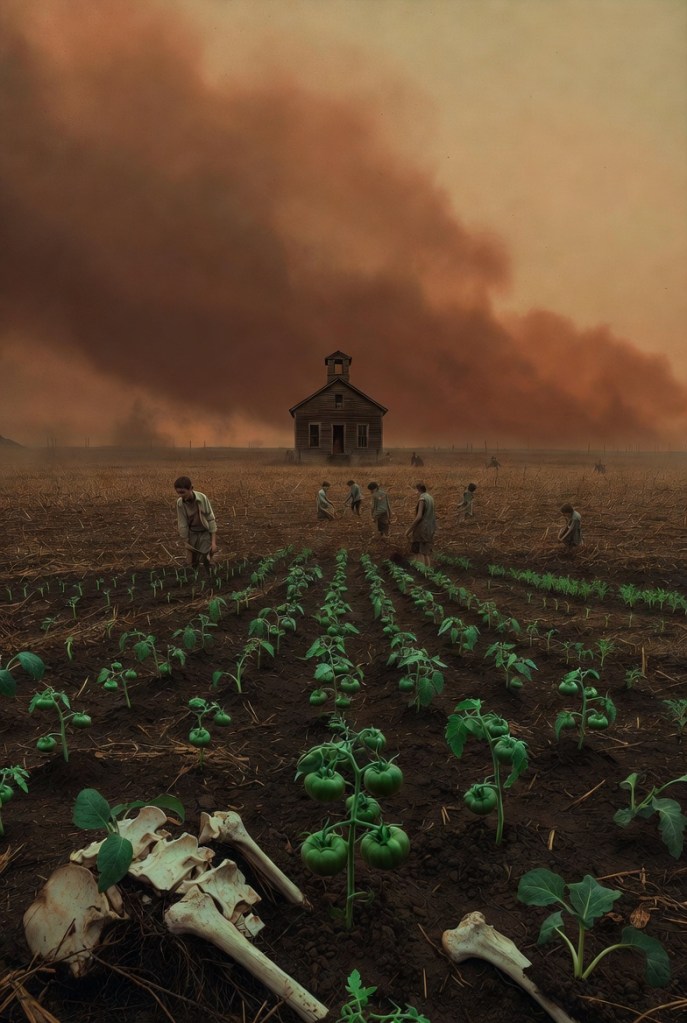
The classroom smelt of damp earth and hunger.
Sarah Brennan stood before eleven children, their faces pinched and grey in the weak afternoon light that filtered through windows filmed with years of contamination. Outside, the world was the colour of rust and ash, the soil poisoned by whatever had fallen from the sky three years ago. Three years since anything green had grown straight and true. Three years since anyone had enough to eat.
“Who can tell me,” Sarah said, keeping her voice steady and bright, “what made soil fertile before the Fall?”
Tommy’s hand shot up, eager as always despite the hunger that made his wrist bones prominent. “Decomposition, miss. Dead things feeding new life.”
“Exactly right.” Sarah wrote the word on the salvaged whiteboard, the marker almost dry. “Nature’s cycle. Everything returns to the earth, and the earth gives back.”
Lily, small for her eight years, raised a tentative hand. “But nothing gives back anymore, miss. The earth is dead.”
Sarah met the child’s eyes—ancient eyes in a child’s face, eyes that had seen too much.
“Not dead,” Sarah said quietly. “Sleeping. Poisoned. But maybe not beyond healing.”
Her smile felt tight. The children smiled back anyway, wanting to believe her.
The lesson continued—water purification, protein from insects, which fungi were safe—until the sun began its descent behind the dead hills. The children filed out into the dying light, clutching their worn notebooks, their too-large clothes hanging from skeletal frames. Tommy lingered over a picture of a tomato in a salvaged gardening book, his finger tracing the bright red fruit with a reverence usually reserved for holy relics.
Sarah stayed behind, straightening desks that didn’t need straightening, erasing boards that barely showed the marks. She picked up the gardening book. Closed it. Opened it again to the tomato picture. Her hand moved to the door handle three times before she finally locked the schoolhouse and walked home through streets that grew emptier each month.
The community that once numbered two hundred now held perhaps sixty souls, scattered across houses too large for their diminished population. They’d lost the Hendersons last week—packed up what they could carry and headed south, chasing rumours of clean land.
At home, she boiled water for tea made from dried nettle and forced herself to eat half a tin of beans gone soft with age. Tomorrow she’d teach the children about food preservation. The day after, water collection. She pulled her father’s journal from the shelf, ran her fingers over his handwriting. Instructions for planting, for crop rotation, for soil enrichment. All useless now. All memories of a world that worked.
The empty chair across from her seemed to grow larger in the lamplight. Six weeks since he’d sat there, coughing into a cloth that came away spotted with blood. Six weeks since she’d felt his pulse grow thready under her fingertips while she promised him things would get better.
She closed the journal and went to wash her plate.
The tomato plant on the windowsill caught her eye.
Sarah stopped, the plate dangling from her hand.
Two green shoots pushed through the soil’s surface. True green, not the sickly yellow-brown of contamination. Perfect, healthy, impossible green.
The plate hit the counter with a clatter.
She crossed to the window in three strides, her hands hovering over the leaves, afraid to touch them in case they vanished. Real. Solid. Growing.
But how?
Three weeks she’d tended this pot. Three weeks of dead soil, boiled water, whispered encouragements copied from her father’s habit of talking to his crops. Nothing had changed except—
Her breath caught.
Last week. Pepper.
The old cat had been seventeen when the Fall came, ancient and arthritic, surviving on scraps and sheer will until age finally won. Sarah had wrapped the small body in cloth and placed it in the garden, in the barren rectangle where her father had once grown roses.
The garden she could see from this window.
Where small green shoots now emerged from the soil.
Right where she’d buried Pepper.
Sarah grabbed her father’s work boots, shoved her feet in without lacing them, and stumbled outside. The evening air was cool and tasted of metal. She knelt beside the grave, her fingers brushing the tender shoots.
Tomatoes. Seeds must have blown over from the pot during one of the dust storms.
Growing. In soil that had been dead for three years.
In soil mixed with bones.
Her hands trembled as she dug at the earth around the shoots. Found a small bone, white and clean. Another. The plants’ roots wrapped around them, drawing sustenance.
Bone meal. Before the Fall, gardeners used bone meal. Calcium, phosphorus, minerals.
Pepper’s body, decomposing beneath the surface. Providing exactly that.
Sarah sat back on her heels, dirt under her fingernails, her pulse hammering in her throat. Her gaze moved to the old cemetery on the hill. Generations buried in soil now poisoned beyond use.
Unless it could be healed.
Unless the dead could feed the living.
Her father’s face rose in her mind—the soft-spoken man who’d taught her to prune roses, to test soil pH, to read the weather in the clouds. He’d be horrified.
Her father was dead. The children were starving. And here before her was proof that life could return.
She stood and walked to the cemetery.
The gates hung crooked on rusted hinges. Inside, headstones leaned at drunken angles, the grass between them brown and brittle. Her father’s grave sat in the far corner, marked by a simple wooden cross she’d carved herself.
Sarah stood before it until the last light faded, her hands clenched at her sides.
Then she went home and didn’t sleep.
Over the next week, Sarah became something she’d never imagined. She found the Henderson’s dog, buried hastily before they’d fled. Dug it up in the pre-dawn darkness, her shoulders aching, her stomach churning. She found old bones from abandoned houses—pets, livestock, anything that had been interred in those first chaotic months.
At home, she ground some to powder in her father’s mortar and pestle, the sound like teeth grinding. Left others whole. Mixed them carefully into pots of dead soil and planted seeds she’d hoarded for three years.
Every pot sprouted.
Every single one.
Green pushed through dead soil like a resurrection. The contamination couldn’t touch it. The poison meant nothing. Life surged up from bone-fed earth, the mineral concentration creating some kind of barrier, a pocket of purity in the wasteland.
Sarah stood in her kitchen, surrounded by growing things, her hands covering her mouth. She wept.
Then she washed her face, tied her hair back, and went to teach the children.
The lesson was on soil composition, on nutrients and minerals. She wrote the words on the board in careful letters. Nitrogen. Phosphorus. Calcium.
“Before the Fall,” she said, her voice steady despite her racing heart, “farmers used something called bone meal to help crops grow. Ground bones from animals. Rich in everything plants need.”
Tommy’s hand went up. “Do we have any, miss?”
“No commercial supply, no.” She turned to face them. Eleven pairs of eyes watched her, bright with hunger and hope. “But nature provides. If you know where to look.”
“Any animal bones?” Lily asked softly.
Sarah’s hand tightened on the chalk. “Any.”
The children leaned forward in their seats.
“Properly processed, properly used, they can make dead soil live again.”
Understanding bloomed on their faces—the same impossible green she’d seen pushing through dead soil. Hunger transformed into resolve, into hope, into a fierce need that might save them all.
She turned back to the board and continued the lesson.
Tommy arrived at her door three days later, cradling a small bundle wrapped in cloth. His face glowed.
“Miss Brennan? I found some. For growing.”
Sarah unwrapped the cloth. Bones, small and delicate. A jaw with tiny teeth still attached.
“My dog,” Tommy said. “Rex. He died in the first year. Mum buried him in the garden. I dug him up last night.”
The bones felt smooth in Sarah’s hands. Clean. Dead for three years. She opened her mouth. Closed it. Tommy’s shining eyes met hers, hope written across his gaunt face.
“Let’s get them processed.”
They ground the bones together in her father’s old mortar and pestle, the sound filling the kitchen. Tommy never looked away from the bowl, willing the transformation through sheer attention.
“Will it really work, miss?”
Sarah poured the bone meal into a pot of dead soil. “Yes. I promise you, Tommy. It will work.”
Within days, green shoots emerged. Within two weeks, Tommy had a tomato plant growing in a world where nothing should grow. He brought his mother, who pressed both hands to her mouth and wept. Brought the other children, who crowded around with wondering faces, reaching out to touch the leaves like they were made of gold.
“How?” Marcus demanded, tall for eleven and always hungry. “How did you do it?”
Tommy glanced at Sarah. She nodded.
“Bones,” Tommy said. “Miss Brennan taught us. You mix bones with the soil and things grow again. Real things. Good things.”
The children stared at the plant. At Sarah. At Tommy. Hunger transformed into understanding, understanding into purpose.
“Any bones?” Marcus asked.
Sarah’s mouth was dry. “Any bones.”
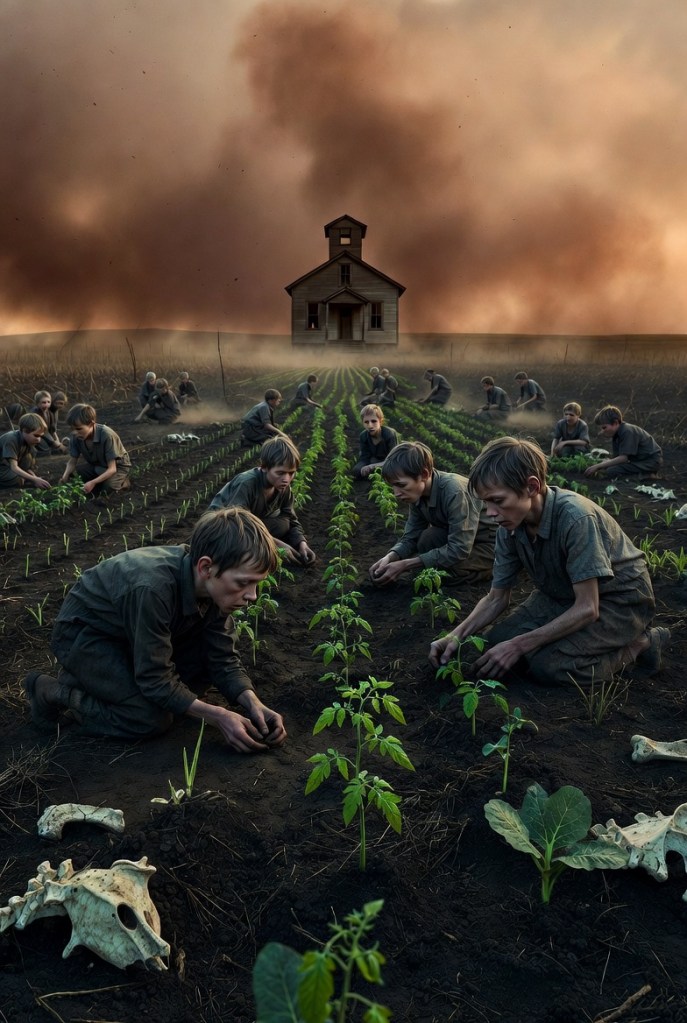
Within a week, every child had brought something.
Lily brought her grandmother’s canary. Marcus brought a cat. Others brought hamsters, chickens, a rabbit that had been someone’s pet before the Fall. They came to Sarah’s house after school, grave and purposeful, and she helped them process the remains, mix them with soil, plant seeds.
They worked in silence, passing the mortar and pestle between them, measuring soil with careful hands. No one laughed. No one joked. They moved with the solemnity of people performing a sacred rite.
The gardens sprouted everywhere. Small pots on windowsills at first, then larger containers, then patches of actual earth in yards and gardens that had been dead for three years. The community watched as green returned, as tomatoes swelled on vines, as lettuce and beans and carrots pushed up from soil that had rejected all life.
Food. Real food. Growing.
Parents who’d been gaunt and desperate smiled again. Children who’d known only hunger ate fresh vegetables and their faces filled out, colour returning to grey cheeks. The town council called it a miracle. Three elderly people who’d refused to abandon their homes now spoke of providence, of salvation.
Mrs. Patterson hugged Sarah in the street, tears streaming down her weathered face. “You’ve saved us. You’ve saved us all.”
Sarah smiled and accepted the gratitude and went home to her kitchen full of growing things and stared at her hands.
Only David Porter seemed troubled.
He found Sarah in her garden two weeks after the first harvest, watching her plants sway in the evening breeze. He was lean, like everyone, his doctor’s hands too large for his wasted wrists.
“Where are the bones coming from?” he asked.
Sarah glanced up from her tomatoes. “Pets. Old livestock. Things that were already dead and buried.”
“All of them?”
“Yes.”
“Because I’ve been asking around. A lot of graves have been disturbed. The old cemetery looks like it’s been visited by every child in town.”
She couldn’t quite catch her breath. “They’re using what’s already dead, David. Creating life from death. Isn’t that what nature’s always done?”
“These are children digging up graves in the middle of the night. Grinding up bones.” He stepped closer. “Doesn’t that disturb you?”
Her hands clenched. “You know what disturbs me? Watching them starve.”
“So we compromise what makes us human? Desecrate the dead? Where does it end?”
“It ends with survival.”
“Does it?” David’s voice dropped. “Or does it end with us becoming something else entirely?”
He left before she could answer. Sarah stood in her garden, surrounded by plants fed by death, and couldn’t force words past her throat.
The changes started small.
Tommy, who brought his dog’s bones, tilted his head when people spoke, listening to sounds beneath their words. His mother laughed about it, called him her little bloodhound. Sarah noticed him track a scent across the schoolyard, his nose lifted, his movements fluid and strange. His gaze was animal now.
Lily, who’d brought her grandmother’s canary, sang during lessons. Old songs, pre-Fall melodies that made the other children stop and stare. Her voice had a quality that raised the hair on Sarah’s arms.
Marcus developed muscle that shouldn’t exist on their diet. He won every game, every contest. When he gripped another boy’s wrist during an argument, the boy cried out and Marcus smiled, his eyes flat and cold.
Sarah told herself it was better nutrition. Recovery from malnutrition. Nothing more.
But she’d seen Tommy’s eyes when he tracked a scent—too focused, pupils too wide. A predator’s focus.
She’d heard Lily humming late one evening, a tune from a century ago, lyrics about harvest and blood that she couldn’t possibly know.
She’d watched Marcus lift things he shouldn’t have been able to lift, move with a violence that belonged to someone much older.
Over the following days, Sarah noticed more changes. A girl who’d brought her aunt’s bones suddenly knew how to knit, though she’d never been taught. A boy spoke in his sleep in a language his parents didn’t recognise. Another child recoiled from mirrors, as if frightened by his own reflection.
One month after the first harvest, David Porter found Sarah at the schoolhouse after hours.
“Tommy’s mother is concerned.” His voice was tight. “Tommy’s been having dreams. About being a dog. About running on four legs. He wakes up trying to walk on his hands and feet.”
Her stomach plummeted. “Children have nightmares—”
“And Lily? Who suddenly speaks French? Her grandmother didn’t speak French, Sarah. But the woman buried three plots over from the canary did. Native speaker. Died five years ago.”
“That’s—”
“Look at Marcus. Really look at him.” David’s hands shook. “That boy brought bones from the old juvenile detention centre. The kids who died in the riots. The violence. And now Marcus acts like them. Moves like them. That cold look in his eyes—”
“Stop.”
“He’s changing. They’re all changing. Taking on traits, memories, pieces of what those bones used to be. And you taught them this. You showed them how.”
Sarah gripped the desk edge. She thought of folklore, of traditions that said the dead weren’t truly gone while their remains endured. Of cultures that believed souls resided in bones.
“What do you want me to do?”
“Tell them to stop. Explain the danger—”
“There is no other way!” Her voice cracked. “The earth is dead, David. Poisoned. This is all we have. The only thing keeping us alive.”
“At what cost?”
She had no answer.
That night, her father sang to her.
Sarah jerked awake at the kitchen table, her neck stiff, the lamp burnt down to nothing. A sound drifted through the window. Soft. Rhythmic. Familiar.
Humming.
Her heart stopped.
The tune floated on the night air. A folk melody, old and melancholic. The song her father used to sing when she was small, the one he’d claimed was centuries old.
That’s Sarah’s song. Just for you.
The melody twisted something in Sarah’s chest.
She ran.
She ran through dark streets, her father’s boots thundering against cracked pavement, her breath coming in gasps that tasted of ash. The cemetery gates stood open. The children glanced up as she arrived, their faces pale in the moonlight, their hands dark with earth.
“Miss Brennan!” Tommy’s voice held neither shame nor hesitation. “You’re just in time. We found—”
“Where did you learn that song?”
The children exchanged glances. Lily spoke, her voice that odd, bright thing.
“We don’t know, miss. It just… came to us. While we were working.”
“Came from where?”
Lily gestured at the earth, at the disturbed grave with its simple marker: William Brennan. Beloved Father.
Sarah’s knees buckled. She caught herself on a headstone.
“We were careful,” Marcus said. His voice had deepened over the weeks, adult tones in a child’s throat. “We processed it right, like you taught us. Mixed it proper. The plants are already coming up strong—”
“You dug up my father.”
“He knew so much, miss.” Tommy stepped forward, earnest. “About growing things. About the land. We could feel it, soon as we opened—”
“You had no right!” The scream tore from her throat. “He was mine. Mine to—”
“You said any bones,” Marcus interrupted. “You said nature provides. You said everything returns to the earth and the earth gives back.”
“I didn’t mean—”
“What didn’t you mean?” Marcus moved closer. His posture had shifted—shoulders set differently, head tilted at a new angle. “Didn’t mean we should survive? Didn’t mean we should use what’s available? You can’t teach us this and then decide there are rules. Either we survive or we don’t.”
“There have to be limits.” Her voice wavered.
“Why?” Lily’s voice was soft, curious. “The dead don’t need their bones anymore. And we need them so much.”
Sarah studied the children. The children’s transformation into something new. Saw years stretching ahead—all the graves emptied, all the dead consumed, these children taking on traits and memories and essences of everyone they’d harvested.
Becoming hybrids. Becoming something that wasn’t quite human anymore.
“Please,” she whispered. “Please stop.”
“We can’t stop,” Tommy said simply. “You taught us we can’t stop. Survival, remember?”
They left her standing in the cemetery, standing by her father’s desecrated grave, as they carried their prizes home.
Sarah stood there until dawn, staring at the empty earth.
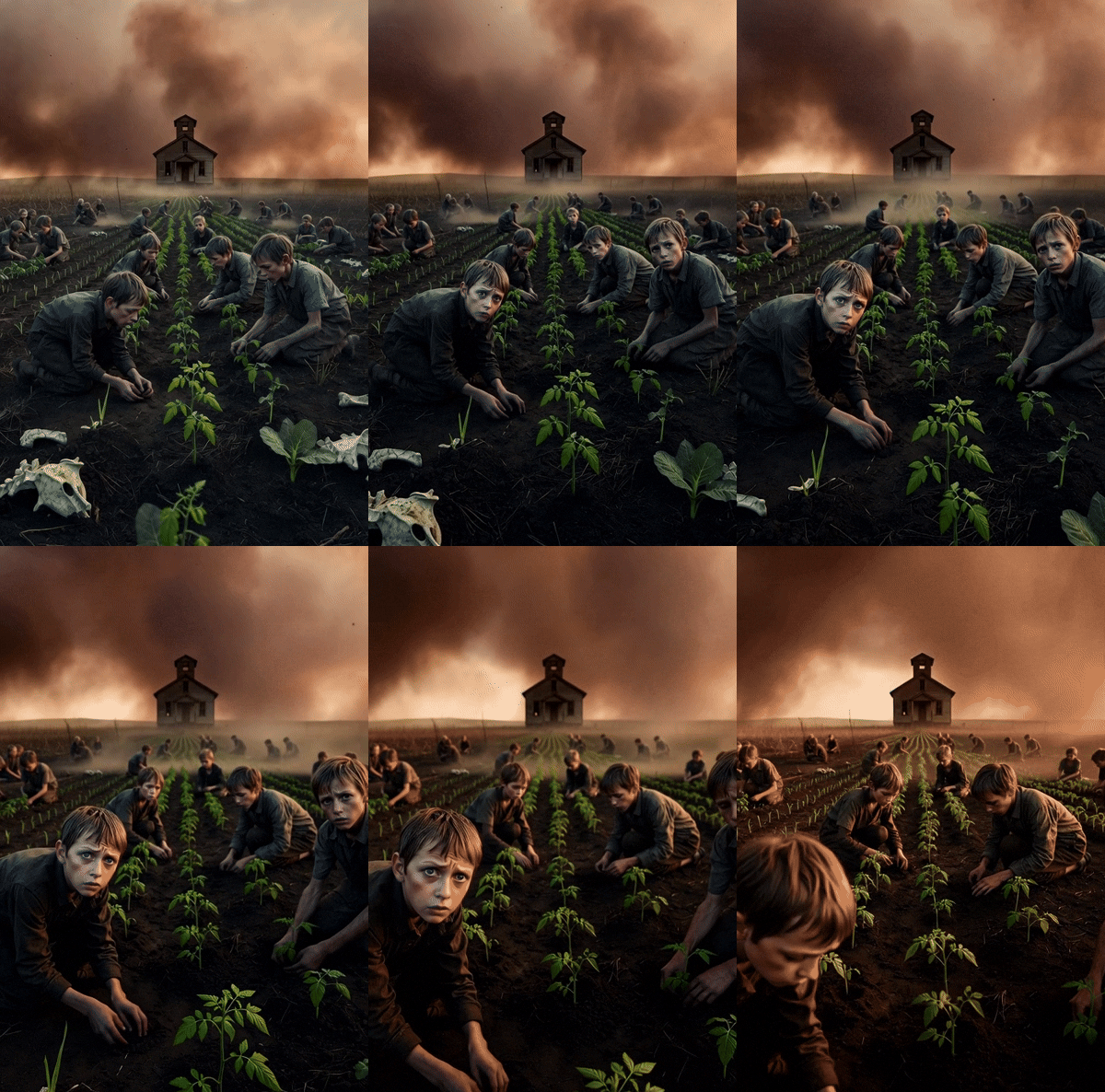
Three weeks later, David Porter knocked on her door.
She’d stopped going to school. Stopped leaving the house except for water. Her garden flourished but she couldn’t bring herself to eat from it. She’d taken to gathering certain plants from the dead zone beyond the town limits—foxglove, oleander, other things her father had taught her to recognise. Poisonous things. She dried them carefully, ground them to powder when no one was watching.
Just in case.
“Marcus.” David’s face was ashen. “He’s been in two fights this week. Really hurt someone. That Harrison boy from the south end. Broke his arm in three places.”
“Where did Marcus get his bones?” Sarah’s voice sounded distant to her own ears.
“The detention centre. I checked the old records. Three kids died there. Violent offenders. One was in for attempted murder.”
Sarah closed her eyes.
“He’s taking on their traits. More than traits. Personalities. Urges.” David gripped the doorframe. “Sarah, he’s becoming dangerous.”
“What do you want me to do?”
“Stop this. Tell them it has to end.”
“The cost of stopping is starvation.”
“The cost of continuing—” David’s voice broke. “They’re not just eating plants fed by the dead. They’re becoming the dead. Every bone they consume, they take on a piece of who that person was. And some of those people were terrible.”
“I’ll talk to them.”
“When?”
“Tomorrow. I’ll—”
The scream cut through the evening air.
They ran.
The old community garden. A cluster of people gathered, their faces white. In the centre, Marcus held Lily by her bony wrist, his other hand gripping a shovel. Blood ran down Lily’s arm where the shovel had cut.
“Let her go.” Sarah’s voice came out steady somehow.
Marcus met her gaze. His eyes were flat, empty.
“Can’t. She’s sick. Getting sicker. Won’t last another month.”
“That doesn’t—”
“Fresh is better.” Marcus’s voice was matter-of-fact. “You said so. The fresher the bones, the better they work. She’s dying anyway. Why wait?”
Sarah stepped forward. “Marcus—”
“I’m listening to everything you taught us. Survival. Pragmatism. Using what’s available. She’s available.”
“She’s a child!”
“So am I.” His grip tightened on Lily’s wrist. She whimpered. “But I’m a child who wants to live. Who’s strong enough to live. That’s what you taught us. The strong survive.”
David moved to flank him. “Marcus, you’re better than this—”
“Not the scared, hungry kid I used to be? You’re right. I’m not. I’m stronger now. Smarter. I know what needs to be done.”
He raised the shovel.
Sarah threw herself forward, knocking Lily aside and catching Marcus’s wrist before the shovel could descend. They struggled—a teacher and her student, locked together.
Marcus met her eyes. Smiled.
“You too, miss. You’re getting older. Weaker. All that knowledge. Imagine what we could learn if—”
Sarah slapped him.
The crack echoed across the garden. Marcus stumbled back, touching his cheek.
“Get out,” Sarah said. “All of you. Get away from here.”
The children scattered. Marcus went last, walking backward, his eyes never leaving Sarah’s face.
David helped Lily to her feet, wrapping his shirt around her bleeding arm. The girl trembled.
“He was going to kill me,” Lily whispered. “Marcus was going to kill me and plant me.”
“I know.”
That night, Sarah sat in her father’s room and stared at her hands.
She’d taught them survival. She’d taught them to use the dead. She’d taught them that some sacrifices were acceptable.
And they’d learned the lesson perfectly.
Marcus looked at Lily and saw resources. Saw flesh and bone that could feed the earth, feed the community. He’d learned to think in terms of utility, efficiency, what needed to be done to survive.
He’d learned it from Sarah.
Sarah was forty-three. The malnutrition had taken its toll—she was weaker, slower, more fragile than she’d been.
But she had knowledge. Years of education, of reading, of learning. Her father’s lessons. Everything she’d taught the children and more.
If bones carried essence, carried memory—how much could they learn from her?
They’re going to come for me.
Sarah spent the following days watching the children through her window.
They’d stopped coming to her. Stopped asking for help. They worked independently now, in small groups, efficient and organized. Marcus led them, Tommy scouted, Lily kept records in a notebook filled with drawings of human skeletons labelled with names.
The gardens flourished. The community thrived. People had colour in their cheeks, strength in their limbs. They praised Sarah’s discovery, her innovation, her teaching.
They didn’t see the children moving with the wrong rhythm, speaking with the wrong voices, eyes that measured the living like crops to be harvested.
David visited twice. Each time, he looked worse—gaunt, hands shaking.
“They asked me about the old hospital,” he said on the second visit. “About where bodies would be kept. Sarah, they’re planning something.”
“I know.”
“We have to leave. Get out before—”
“Before they decide we’re more valuable dead than alive?” Sarah’s laugh was bitter. “Where would we go? The next town over is doing the same thing by now. They’d have heard about our success.”
“Then what do we do?”
“We accept it.” Her voice was flat. “This is what survival costs.”
He left. She never saw him again.
The day Marcus came for her, Sarah had been ready for a week.
She’d written letters no one would read. Made lists no one would need. Visited her father’s grave one last time, stood before the disturbed earth as the sun set.
I’m sorry, Dad.
Now she sat in the kitchen, hands folded on the table, as the clock ticked toward midnight. The powder from the toxic plants sat in a jar in the cupboard. She’d been taking small doses for three days now, building the concentration in her bones, in her marrow. Enough to sicken. Enough to kill.
The knock came. Soft. Almost respectful.
“Miss Brennan? We need to talk to you.”
Sarah stood and walked to the door. Through the window: all eleven children from her class, plus a dozen more from the younger grades. Twenty-three children, their faces grave in the moonlight, their hands empty but their intent unmistakable.
She opened the door.
Marcus stood at the front, Tommy beside him, Lily behind them both. The girl’s arm was bandaged. She wouldn’t meet Sarah’s eyes.
“Miss Brennan,” Marcus said, his voice formal, “we’ve been talking. About what you said. About limits.”
“Have you?”
“Yes. We disagree.”
“I know.”
“We think you’re right that there should be rules. Some order. We shouldn’t just take whoever we want, whenever we want.” He paused. “But when people get old, when they get sick, when they don’t have much time left anyway…”
“You want to use them.”
“We want to learn from them. Really learn. Everything they know. And then let them become part of something bigger. Something that feeds everyone.”
Sarah studied the other children. Tommy’s predator focus, Lily’s splintered mind, the darkness behind Marcus’s eyes that came from boys who’d died violent deaths.
This was her legacy.
“And you’ve decided I qualify?” Her voice was steady. “Old enough? Sick enough?”
Marcus shifted his weight. “You’re tired, miss. We can see it. And you know so much. About teaching, about survival, about…” He gestured helplessly. “Everything. It seems wrong to let all that just… disappear.”
“When I could feed it to the earth instead. Feed it to you.”
“Yes.”
Sarah was quiet. She thought of her father, of his bones ground to powder and mixed with soil. Thought of herself joining him, becoming nutrients and essence and memory distributed among hungry children.
Thought of Tommy gaining her teaching skills. Lily inheriting her love of books. Marcus absorbing her knowledge.
Grotesque. Efficient. The world she’d created.
“I won’t fight you,” she said. “But I want one thing first.”
“What?”
“I want to hear the song. The one my father taught me. The one that’s just for me.”
The children exchanged glances. Then, softly, hesitantly, they hummed.
The melody rose in the night air, that old folk tune. It started with Tommy, who’d consumed the most of William Brennan’s remains. But the others picked it up too, each adding their voice, until all twenty-three children sang together.
That’s Sarah’s song. Just for you.
Sarah closed her eyes. Heard her father in their voices. Knew he was still here in some way. Still teaching, still growing things, still part of something larger.
Perhaps that was enough.
When the song ended, she opened her eyes.
“All right. I’m ready.”
She didn’t tell them about the poison she’d been taking for three days, the toxic compounds now saturating her bones, her marrow. Didn’t tell them that her bones would carry not just knowledge but death, that anyone who consumed what she became would sicken and die.
Her last lesson. Her final act of teaching.
Some prices were too high. Some survival came at too great a cost.
And sometimes, the only way to stop what you’d started was to poison it at the source.
The children led her into the garden, to the plot of earth they had prepared in advance. The soil was rich and dark, carefully turned, fed by her father, fed by all the dead. Everything was ready. They moved with the quiet focus she’d always praised in them, standing where she indicated, waiting without being told.
Behind her, the children sang, ready to learn.

Leave a comment