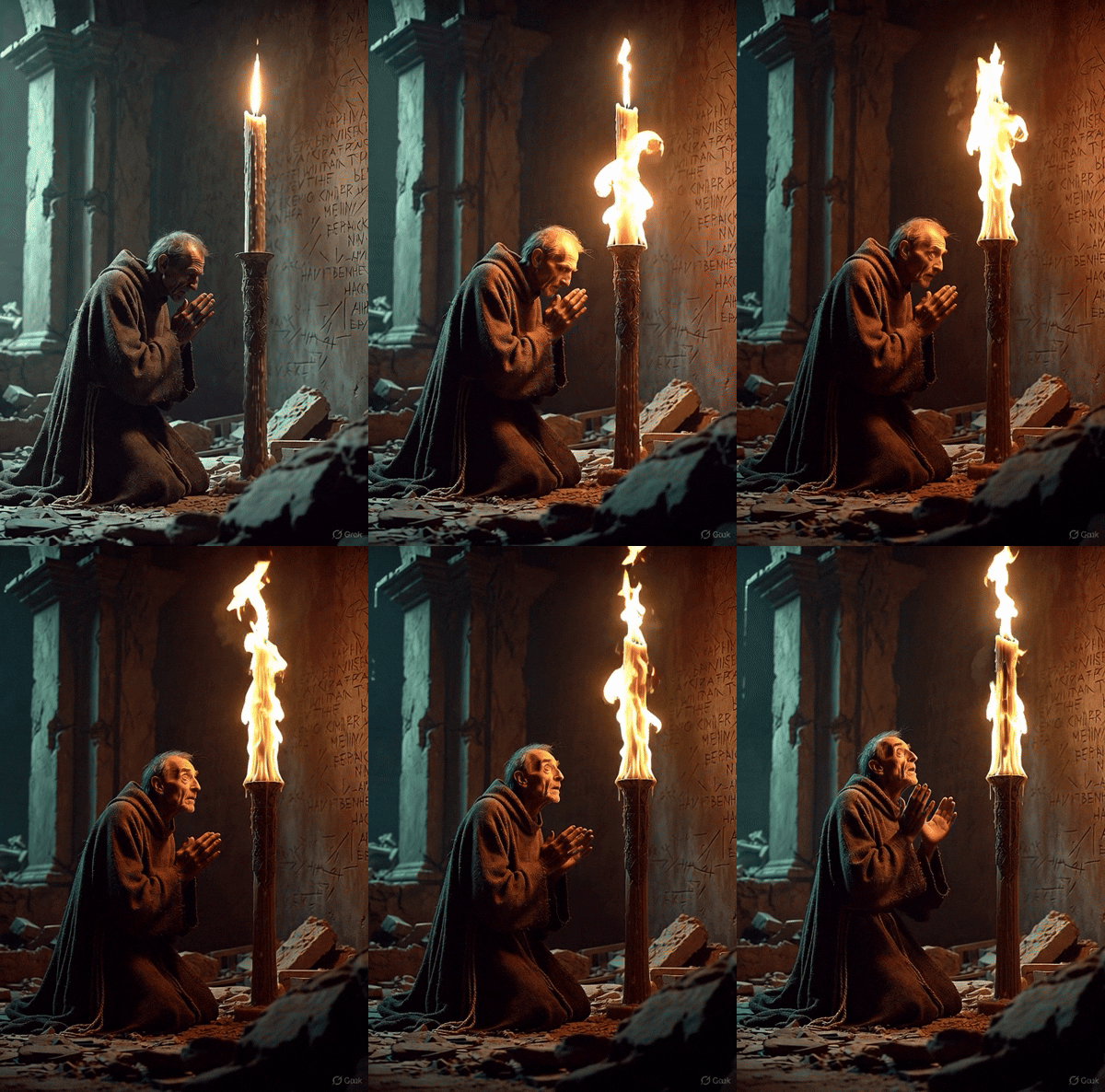
The parchment fell from between two stones like a whispered confession. Brother Osric had been checking the eastern wall—the autumn rains had loosened the mortar again—when the yellowed sheet tumbled to the flagstones. He picked it up with trembling fingers, though whether from cold or age or something else, he could not say.
Music. Four lines of notation, the symbols still dark against vellum gone brittle as bone. No words accompanied the melody, but in the margin, written in a hand far older than his own: To open the way.
He should have burnt it immediately. His vow permitted no speech, no song, no breaking of the silence that had guarded this place since its founding. The Rule was absolute. He had kept it faithfully for forty-three years, the last of an order that had once numbered in the dozens. Now there was only him, the candle, and the tomb-quiet of the abandoned chapel.
The candle.
It stood in the sanctuary as it had always stood, its flame unwavering in the still air. Every morning he trimmed the wick. Every evening he cleared the wax that pooled at its base. The tallow never diminished, never failed, though he had long since ceased to question this miracle. It was his charge, as the silence was his charge, as the very stones of this valley were his charge.
But what was the purpose of guardianship if the vigil passed unwitnessed into oblivion?
The question had grown louder in recent months, a voice more insistent than any he had heard in four decades. When he died—and he felt winter’s approach in his joints, in the labour of each breath—who would tend the flame? Who would maintain the silence? The tradition would die with him, unmourned and unremembered, in this forgotten valley where even the shepherds no longer came.
Unless.
He studied the notation again. To open the way. What way? To where? The abbey’s history had been lost generations ago, the old brothers taking their knowledge to their graves. He knew only the Rule: tend the flame, keep the silence, guard the threshold. But guard it against what? And for whom?
The melody haunted him through his daily rounds. As he swept the nave, his mind sang it. As he drew water from the well, the notes cascaded through his thoughts like the bucket’s chain. He had not realised his mind could grow so crowded in the quiet.
On the seventh night, he sought the sanctuary.
The candle burnt as it had always burnt, steady and eternal. He knelt before it, the parchment in his hands, and considered what he was about to do. To break his vow was to break faith with every brother who had gone before, every guardian who had kept the trust. It was pride, perhaps. Or desperation. Or simply the human need to know that one’s life had served some greater purpose than passing forgotten from this world.
He began to sing.
The melody was simple, almost childlike, but it resonated in the ancient stones as though the abbey itself had been hungering for it. The flame leapt, grew bright, and for a moment Osric felt a joy so profound he wept. This was right. This was holy. The music offered salvation: a bridge to preserve the knowledge before it vanished entirely.
The air thickened. The shadows in the corners seemed to draw inward, listening.
And then, from somewhere beyond the veil of centuries, a voice answered his.
“Brother,” it said, and the word carried such warmth, such recognition, that Osric wept. “Brother, I have waited so long.”
“Who are you?” he whispered, his own voice strange and cracked from disuse.
“A guardian, as you are. The first to tend the flame, before the silence was ordained. I have called across the years, hoping one would finally hear.”
Relief surged in his chest. He had been right. “I am the last,” Osric said. “There are no others. I feared the tradition would die with me.”
“It need not,” the voice said, gentle as a benediction. “Sing again, brother. Complete the melody, and I shall guide you. I will show you what the flame truly guards. Together, we can ensure the duty continues.”
Osric’s hands shook as he raised the parchment. He turned it over. A second verse, almost invisible, the ink so faded it seemed part of the vellum itself. He brought it close to the candle’s light.
The notation was different here. Discordant. The symbols seemed to twist as he looked at them, configurations that his mind rejected.
“Sing,” the voice urged, and there was something beneath the warmth now, something vast and patient and very, very old. “Let me return, brother. Let me take up my vigil once more.”
The flame stretched upward, impossibly tall, and in its light Osric saw what he had not seen before: the stone bore countless scratches, thousands upon thousands of them, as though something had clawed at the walls from the inside for centuries. The marks formed words in a language he did not know, but their meaning crashed through him with terrible clarity.
Keep out. Keep out. Keep out.
“The flame serves no holy purpose,” he whispered, understanding at last. “It imprisons.”
“Sing, brother.”
The voice was no longer warm. It filled the abbey like smoke, pressing against the stones, seeking entrance. The candle’s flame bent sideways, drawn toward something that pressed against the fabric of the world, something that had been pressing for centuries, waiting for the barrier to weaken.
Waiting for someone foolish enough, lonely enough, faithful enough to open the way.
Osric’s voice failed him. The parchment fell from his hands. But the damage was done—the first verse sung, the seal cracked, the silence broken. The flame flickered for the first time in his memory, and in that flicker, he saw the shadow behind the voice beginning to take shape.
He had not been the guardian.
He had been the lock.
And in his loneliness, his pride, his desperate need to matter, he had finally, fatally, turned the key.

Leave a comment