The Latchkey – Part VI

Santa had read approximately 847,000 letters that evening when he found the one that made him stop.
The handwriting was spidery, uneven, as though written by fingers that didn’t quite bend the right way. Black smudges marked the envelope’s edges—soot, perhaps, or tarnish. He opened it carefully.
Dear Santa,
There is something in our house. It sits in Daddy’s chair but Daddy doesn’t sit there anymore. It has a white face that never moves and fingers that are too long. It leaves black marks on the doors. Please help us. Please come.
Love, Emma
P.S. We live at 43 Maple Drive. But of course you know that.
Santa frowned. Children wrote about monsters sometimes—things under beds, shadows in wardrobes. But this description was too precise. Too knowing. And that postscript felt wrong, like bait disguised as innocence.
Still. A child had asked for help.
He checked the list twice.
43 Maple Drive sat in darkness, Christmas lights unlit. Santa landed on the roof with practiced silence, reindeer settling into position. Rudolph’s nose dimmed to a faint glow, enough to see by but not enough to wake the neighbours.
Santa descended the chimney.
The living room waited below. Tree in the corner, baubles catching the streetlight from outside. Stockings hung above the fireplace. Plate of cookies on the coffee table, glass of milk beside it.
Everything correct. Everything normal.
Except.
The cookies were stale. He could tell from across the room—edges curled, centres sunken. The milk had a skin forming on top, undisturbed for hours. And the house was utterly, completely still. Not the peaceful silence of sleeping families, but the held-breath quiet of something waiting.
Black smudges marked the doorframe. Long and thin, as though something with unusual fingers had pressed against the wood.
Santa’s hand moved to his sack. He should leave the presents and go. That was the protocol. In and out. Swift and silent.
But the letter had asked for help.
He moved toward the hallway, boots soundless on carpet. More smudges on the walls. On the bannister. Leading upstairs into darkness.
Behind him, something clicked.
He turned.
The brass key sat on the mantelpiece. Tarnished, old-fashioned. It hadn’t been there a moment ago.
Santa reached for the chimney. Time to leave. Time to—
The opening was sealed. Smooth brick where the chimney had been.
He tried the front door. Locked. Back door. Locked. Windows—
“Hello, Santa.”
The voice came from the armchair facing the window. Small. Flat. Like a child speaking through a mask.
Santa turned slowly.
The thing was child-sized but too stiff, movements jerky and wrong. Its face was white porcelain, painted with a tiny, unchanging smile. Behind the mask’s eye-holes, something glowed faintly, like candlelight in a skull.
Its fingers rested on the chair’s arms—long, thin, twitching slightly.
“I wrote you such a lovely letter,” it said. “Emma’s name works so well for these things, doesn’t it? Children write to you all the time. You always come when they ask.”
Santa’s throat went dry. “Where is she?”
“Upstairs. Sitting with Mummy and Daddy. They’re all sitting very nicely now.” The Latchkey tilted its head. “Won’t you sit too? We have so much to discuss. You visit every home in the world, don’t you? You know all the locks. All the chimneys.”
Santa’s legs moved without permission. One step. Two. He tried to stop, tried to turn, but his body ignored him.
“That’s it,” the Latchkey whispered. “Just sit. Rest. You’ve had such a long night.”
Santa sat.
The painted smile seemed wider now, though it hadn’t moved at all.
“We’re not so different, you and I,” the Latchkey said softly. “We both enter homes uninvited. We both know the secret ways in. But I think… I think I can learn from you. Improve my methods.”
Santa’s face muscles pulled tight, stretching into a smile he didn’t want. His hands folded in his lap. The room tilted slightly, sounds becoming distant and muffled.
The Latchkey stood. Approached. Its fingers brushed Santa’s red coat, curious, gentle.
“May I?”
Santa couldn’t answer. Couldn’t move. Could only sit, smiling, as those long fingers unbuttoned his coat, slid it from his shoulders. The Latchkey held it up, examining the fabric in the dim light.
Then it put the coat on.
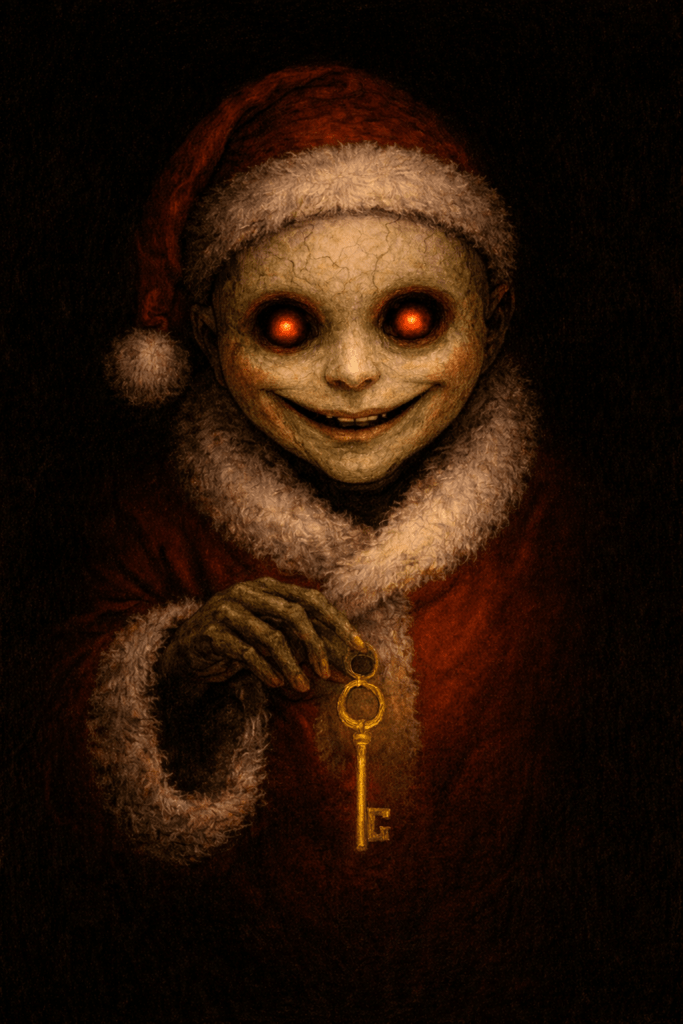
The red looked wrong against white porcelain. Too bright. Too alive. But the Latchkey seemed pleased, smoothing the fabric, testing the fit.
“Perfect,” it whispered. “Now I can visit every house. Every chimney. And they’ll all let me in, won’t they? Because Santa always comes.”
Time stopped meaning anything. Santa sat. Smiled. Watched the Latchkey pace the room in his coat, practising his walk, his gestures, learning to be him.
Hours passed. Or minutes. Or days.
Then—
The front door exploded inward.
Rudolph stood in the wreckage, steam rising from his flanks, his nose blazing red and furious. The light cut through the room like a blade, and Santa gasped, the trance shattering.
He was in his undershirt and trousers, sitting in the armchair, face aching from that terrible smile. The Latchkey stood frozen in the doorway to the hall, wearing his coat, those porcelain eyes fixed on Rudolph’s burning nose.
“Come on!” Rudolph’s thoughts crashed into Santa’s mind, urgent and clear. “NOW!”
Santa stumbled upright. His legs barely worked. Rudolph lowered himself, and Santa half-fell across his back, fingers tangling in fur.
Rudolph launched through the shattered doorway.
The last thing Santa saw was the Latchkey standing in the ruined frame, his red coat bright against the darkness, that painted smile unchanging.
Then they were airborne, climbing fast toward the stars.
Santa recovered during the flight north. Feeling returned to his limbs. His face relaxed from that awful smile. But he kept shivering, even wrapped in blankets.
He didn’t speak of what happened. Not to Mrs Claus. Not to the elves.
The following Christmas Eve, Santa stays home.
The reindeer wait on the snowy lawn, stamping and snorting steam into the frozen air. Rudolph’s nose flickers uncertainly. Inside the workshop, millions of letters lie unread in drifts across the floor. Children still write. Children still believe.
But nobody comes.
Mrs Claus finds him in his study, sitting in the leather armchair by the window. He’s been there for hours. Perhaps days. She’s lost track.
“Dear?” she whispers.
He doesn’t answer. Just sits there, hands folded, facing the glass. The smile on his face is wide and fixed and terrible.
She touches his shoulder. His skin is cold.
“Please,” she says. “The children are waiting.”
But the magic is gone. She can feel it—the warmth that once filled every corner of the North Pole now seeping away like heat from a dying fire. The workshop’s lights flicker. Elves move slowly, mechanically, their laughter hollow.
Outside, across the world, children wake on Christmas morning to find presents under trees. The wrapping is close enough. The tags nearly right. Their parents smile and say everything’s fine, though something in their eyes suggests they know it isn’t.
The children smile too.
But the joy has gone out of it. The wonder. The belief.
They open their gifts with careful, measured movements. Say thank you in flat, even voices. Then they sit very still, hands folded, facing windows.
Waiting for next Christmas.
When the thing in the red coat will visit again.

Leave a comment