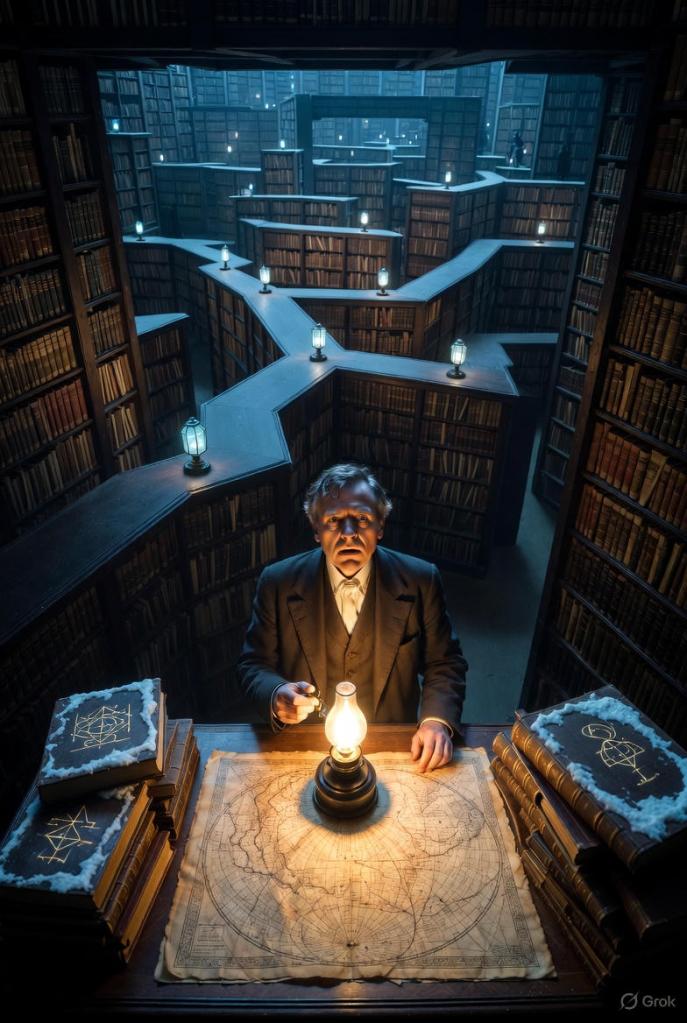
The letter from the Society arrived on a Tuesday, as such things invariably did. Mr. Edward Pembridge, junior fellow of the Royal Geographical Society, was to proceed with all haste to the Imperial Archive beneath Whitehall. His commission: to locate and catalogue a specific document referenced in recently acquired materials from the Egyptian expedition. The document in question—designated only as Codex Terminus—was believed to contain cartographic information of significant historical value.
The nature of that value remained, as these things often did, strategically vague.
Pembridge descended into the archive on the morning of October third, his credentials examined by a porter whose face he would later struggle to recall. The man’s features seemed to slide away from memory even as Pembridge looked at him, leaving only an impression of great age and greater weariness.
“You’ll be wanting Sub-level Seven,” the porter said, his voice like pages turning in an empty room. “Dr. Cornelius will meet you there. Mind the stairs, sir. They’re older than they ought to be.”
Pembridge was already descending, his footsteps echoing in the narrow stairwell with a peculiar doubling effect, as though someone followed precisely in his wake.
The archive proper began at Sub-level Three. Pembridge had visited institutional libraries before—the British Museum, the Bodleian, even the Vatican’s restricted collections during his student years. But this was something else entirely. The corridor stretched ahead of him, lit by gas lamps that burned with a curiously steady flame, and on either side rose shelves that extended upward into a darkness the lamps could not penetrate. The ceiling, if there was one, remained invisible.
He stopped. The air held something sharper than old paper and leather. Like a storm about to break, or blood on cold stone.
“Mr. Pembridge, I presume?”
The voice came from his left, though Pembridge would have sworn the corridor had been empty a moment before. A man emerged from between two shelving units that stood too close together for anyone to pass between them. He was perhaps sixty, with the stooped shoulders of the professional scholar and eyes that seemed perpetually focused on some middle distance.
“Dr. Cornelius,” the man said, extending a hand. His grip was cool and dry, the handshake lasting a fraction too long. “Keeper of Eastern Collections. I’ve prepared a workspace for you on Sub-level Seven, where the relevant materials are housed. Though I must warn you, the organisation down there is… complex.”
“I’m accustomed to complex filing systems,” Pembridge said with more confidence than he felt.
“Oh, it’s not the system that’s complex, Mr. Pembridge. It’s the space itself.” Dr. Cornelius smiled, an expression that didn’t quite reach his eyes. “Come. We’ve a fair distance yet to descend.”
They walked in silence, passing junction after junction where corridors branched into the darkness. Pembridge tried to maintain his bearings, noting landmarks—a statue of Thoth here, a case of cuneiform tablets there—but found his sense of direction slipping. The archive seemed to resist mental mapping, each turn feeling simultaneously too soon and too late.
“How long have you been keeper here, Dr. Cornelius?”
“Long enough to know better than to ask that question,” the older man replied. “Time behaves strangely in deep archives. One loses track.”
They descended another staircase, then another. At Sub-level Five, a shelf to his right extended backward further than the architecture should allow. He glimpsed row upon row of books receding into an impossible distance, and for just a moment, thought he saw a figure standing among them, watching. When he turned his head to look directly, there was only the expected depth of a standard shelving unit.
“Did you see something?” Dr. Cornelius asked, too quickly.
“A trick of the light, I expect.”
“Yes. The light does play tricks down here.” The keeper’s voice carried an odd emphasis. “Best to keep one’s attention on the path ahead.”
Sub-level Seven was colder than the floors above, the temperature drop sharp enough to raise gooseflesh on Pembridge’s arms. The gas lamps here burned a faint blue, and the shelves were constructed of a dark wood he didn’t recognise. The grain seemed to move when he wasn’t looking at it directly.
Dr. Cornelius led him to a desk positioned at the intersection of four corridors. Upon it sat an oil lamp, several notebooks, and a leather case approximately two feet square.
“The maps,” Cornelius said, gesturing to the case. “We’ve assembled what we believe to be related materials. Seven in total, from various civilisations and eras. You’ll find them… illuminating.”
“And the Codex Terminus itself?”
“Ah. That’s rather the question, isn’t it?” The keeper’s smile returned, that same unsettling expression. “We believe it exists as fragments, dispersed throughout the collection. Your task is to identify and gather those fragments using the maps as guides. Each map, you see, appears to chart the archive itself. Or versions of it. The correspondence is imperfect, but persistent.”
Pembridge frowned. “I was told the document contained cartographic information. Not that it was cartographic information.”
“The distinction may prove less meaningful than you think.” Dr. Cornelius moved toward one of the corridors. “I’ll leave you to your work. There’s a bell on the desk should you require assistance, though I should warn you—sound travels oddly down here. It may take some time for help to arrive. And Mr. Pembridge? I’d advise against wandering too far from this junction. The archive has a way of… rearranging itself. Particularly at night.”
“It’s already night, surely? We’re seven levels underground.”
“I didn’t mean night above ground,” Cornelius replied, and disappeared into the shadows between the shelves.
Pembridge stood alone at the desk, the silence pressing against his ears like deep water. He opened the leather case.
The first map was Sumerian, cuneiform script covering a clay tablet that should have been brittle with age but felt warm to the touch, almost alive. It depicted what appeared to be a ziggurat or temple complex, but the internal chambers twisted back upon themselves in ways that defied geometry. As Pembridge studied it, he could have sworn the corridors shifted, new passages appearing where none had been carved before.
The second was Egyptian, papyrus reinforced with wooden dowels, showing what might have been the Library of Alexandria. But the rooms overlapped impossibly, and there—yes, there in the lower register—was that a staircase descending far below the foundation? He blinked, and the staircase had moved to the opposite side of the diagram.
The third was Greek, inked on treated leather. The fourth was Norse, runes carved into a thin sheet of some grey metal. The fifth was Aztec, a folded bark-paper codex that unfolded to reveal layer upon layer of interconnected chambers. The sixth was from a civilisation he couldn’t identify, symbols he didn’t recognise forming patterns that made his eyes water.
The seventh map was blank.
No—not blank. As Pembridge held it under the lamp, faint lines began to appear on its surface. Modern lines, rendered in a draughtsman’s hand. The junctions of Sub-level Seven, sketched with professional precision. He recognised the desk, the corridors branching away from it.
But there, at the edge of the visible area, was an annotation in handwriting he knew far too well. His own hand, his own script.
Do not trust the keeper. He is part of what hungers.
Pembridge’s mouth went dry. He had written no such thing. He had never seen this map before, had been in the archive less than an hour.
He turned the vellum over. On the reverse, more annotations, all in his hand:
First iteration: failed to recognize the pattern.
Second iteration: trusted the maps too completely.
Third iteration: reached the document but could not destroy it in time.
This is the fourth iteration. Remember: the archive serves as a lock.
The oil lamp flickered. In the periphery of his vision, something moved between the shelves—too tall, too thin, its angles wrong. When he looked directly, nothing was there. But the cold had deepened, and the silence now carried within it a sound that was beyond sound, deeper than sound, a pressure against his eardrums that felt almost like whispering.
Almost like his name, repeated over and over in voices that came from no human throat.
Pembridge looked down at the maps spread before him. On each one, new markings had appeared. Routes, traced in what looked like dried blood. All seven maps, despite their different origins and styles, now showed the same thing: a path leading downward, always downward, to a point where all the corridors converged.
And at that convergence point, on every map, was a symbol he didn’t recognise but somehow understood.
A door that should never be opened.
A door that had been opened before.
A door that was opening now, with each map he studied, with each moment he remained in this place.
The bell on the desk began to ring of its own accord. The sound echoed through the corridors, multiplying, returning from impossible distances. And in that echo, Pembridge heard laughter that might have been weeping, or weeping that might have been laughter, and footsteps approaching from all four directions at once.
Dr. Cornelius emerged from the darkness, but his shadow fell the wrong way, cast by a light source that did not exist.
“You’ve found the annotations,” he said, and his smile was no longer remotely human. “How fascinating. You progress faster each time.”
“Each time?” Pembridge’s voice emerged hoarse. “What do you mean, each time?”
But Dr. Cornelius was no longer alone. Other figures stood in the corridors now, emerging from between shelves that stood too close together, stepping out of shadows that fell from nothing. They wore the clothing of different eras—medieval robes, Renaissance doublets, Victorian frock coats—all in the grey-black of archival dust. Their faces shared Dr. Cornelius’s unsettling smile.
“The archive protects itself,” one of them said, a woman in Elizabethan dress. “It has always protected itself.”
“We are the iterations,” said another, a man whose toga marked him as far older. “Those who came seeking. Those who stayed.”
Pembridge pushed back from the desk, his chair scraping against stone. The maps fluttered in a wind that came from nowhere, and he saw now that they were all the same map, had always been the same map, simply rendered in different hands across different ages. The labyrinth was eternal. The threat was eternal.
And he had been here before.
“No,” he whispered, but even as he spoke, false memories crashed through him. The first time, when he’d trusted Dr. Cornelius completely, following him deeper and deeper until the corridors themselves had become alive with reaching shadows. The second time, when he’d tried to map his own route, only to discover every path led to the same convergence. The third time, when he’d found the complete Codex Terminus and understood too late that reading it was the same as opening it.
“The Society doesn’t send you,” Pembridge said, the truth settling like ice in his stomach. “You pull me here. The archive itself pulls me here.”
“The archive requires a reader,” Dr. Cornelius said, stepping closer. “The document cannot exist without observation. But it cannot be destroyed by one who doesn’t understand it. So we wait, iteration after iteration, for a consciousness capable of both comprehending and refusing. Of reading and then choosing blindness.”
The figures began to move in a slow circle around the desk. Their footsteps made no sound, but Pembridge felt each one as a pressure against his skull, his ribs, his heart.
“You’re not trying to open the door,” he said slowly. “You’re trying to get me to close it.”
“We are what remains of those who tried and failed,” the Elizabethan woman said. “Trapped between life and death. The archive consumed us, made us part of its mechanism. But we remember enough to guide. Enough to hope.”
The whispers grew louder, the sensation going deeper than hearing, as though being read, being known, being opened like a book to reveal every thought and fear and hidden truth. Pembridge clapped his hands over his ears, but the sensation bypassed them entirely. It went deeper. The entities beyond the door were learning him, the way a reader learns a text.
He grabbed the seventh map, his own annotations stark upon it. The archive serves as a lock.
“Show me the fragments,” he said. “All of them. Now.”
Dr. Cornelius’s smile widened impossibly. “You’ll need to find them yourself. That’s the nature of the test. But I can give you this much: they’re arranged in sequence, each one hidden in the deepest section of its respective collection. Sumerian in the Mesopotamian stacks. Egyptian in the Ptolemaic archives. And so on. Each fragment will lead you to the next, and with each one you claim, the door opens further.”
“Then why would I claim them at all?”
“Because you cannot destroy what you haven’t assembled. The fragments are scattered across the archive’s geography, yes, but also across its time. To burn one piece is to leave the others intact, waiting for the next iteration, the next reader. You must gather them all into a single moment, a single point in space and time, and unmake them completely.”
The corridor to Pembridge’s left suddenly extended, stretching into impossible distance. At its far end, barely visible, shelves rose into darkness. The Sumerian collection. He could feel it, a pulling in his chest like a hooked fish.
“How do I know you’re telling the truth?” he asked. “How do I know this isn’t another trap, another iteration of failure?”
“You don’t,” the woman said simply. “But you know what happens if you refuse. If you run. If you try to climb back to the surface.” She gestured at the others. “You join us. Forever reading, forever warning, forever failing.”
Pembridge looked down at the maps. They were changing now, all of them, corridors rearranging themselves in real-time. New paths appearing, old ones sealing. The archive was responding to his decision, preparing itself.
Or preparing for what came next.
He picked up the oil lamp. The flame burned steady and blue, casting shadows that moved independently of his hand.
“If I do this,” he said, “if I gather the fragments and destroy them—what happens to you? To all of you?”
Dr. Cornelius’s expression softened into something that might have been genuine sadness. “We don’t know. Perhaps we’re released. Perhaps we cease. Perhaps we’re absorbed fully into the archive’s structure, conscious for eternity. But Mr. Pembridge—Edward—we stopped mattering a very long time ago. What matters is the door. What matters is keeping it closed.”
The sensation beyond sound swelled, and Pembridge felt the pressure of vast attention. Something on the other side of reality had noticed his decision, was pressing closer, eager. The temperature dropped further, frost forming on the edges of the maps.
He thought of the world above. London in autumn, fog rolling off the Thames. The Society’s reading room with its leather chairs and afternoon light. His sister’s letters, always asking when he’d visit. The ordinary, precious, fragile world that had no idea what lurked beneath its foundations.
“The Sumerian collection first,” he said, and stepped into the impossible corridor.
Behind him, the figures stood watching. And as he walked, he heard them begin to sing—a strange, discordant harmony in languages dead for millennia. A warning, perhaps. Or a prayer.
The corridor stretched on, much longer than it should have been. The shelves on either side grew older as he progressed, the books themselves transforming from leather-bound volumes to clay tablets to things that predated writing entirely—knotted cords, carved bones, stones with symbols that hurt to perceive.
He consulted the Sumerian map. A route glowed faintly upon its surface, leading through a series of turns that couldn’t exist in Euclidean space. Left, then left again, then somehow forward and down simultaneously. The geometry of the archive was revealing itself as fundamentally wrong, a space folded in dimensions the human mind rejected.
Pembridge followed the route anyway.
At the heart of the Mesopotamian stacks, he found a reading stand of black wood, and upon it, a clay tablet no larger than his palm. Cuneiform script covered its surface, but as he looked at it, the symbols began to move, rearranging themselves into patterns he understood without knowing how.
First seal of seven. The door that opens inward. The hunger that speaks in mathematics.
He picked it up. The clay felt warm, and the moment his fingers touched it, he felt something notice him. Not the entities beyond the door, but the archive itself. It knew he held a piece of the key.
The whispers intensified, resolving into almost-words. Not quite language, but the bones of language, the ur-structure beneath all human speech. He understood, dimly, that what pressed against reality was trying to translate itself into existence, to force its geometry into a world that couldn’t contain it.
The maps would show it how.
The second fragment lay in the Egyptian archives, three levels down through a staircase that appeared only when he approached. The third in the Greek section, hidden inside a false amphora. The fourth among Norse runes carved into a whalebone casket.
When Pembridge entered the Norse collection, the temperature plummeted beyond anything he’d experienced. His breath froze in the air before him, and the shelves here were not shelves at all but alcoves carved directly into ice—or something that resembled ice but felt older, harder, wrong in ways ice should never be. The runes on the casket pulsed with a faint blue light that matched the rhythm of his heartbeat, and as he lifted the fragment, he heard a sound like the cracking of a frozen sea. Behind him, for just an instant, he glimpsed nine figures hanging in the darkness, suspended by ropes he couldn’t see, swaying though there was no wind.
He did not look back again.
The fifth fragment lay within an Aztec codex that unfolded into impossible dimensions.
With each fragment claimed, the archive groaned. Not sound, precisely, but a sensation of structural stress, of ancient defences weakening. The corridors twisted more violently. Shelves collapsed into themselves, creating new passages. He saw other readers now, or the ghosts of them—figures hunched over texts they’d been reading for centuries, unaware they were dead.
And in the periphery, always in the periphery, those too-tall shapes with their wrong angles moved closer.
The sixth fragment was the hardest to find. The map showed only a question mark, a location that existed in negative space, between the defined areas of the archive. He had to walk backward through three corridors while reading a text in a language he didn’t speak, trusting the maps to guide him to a place that shouldn’t exist.
When he found it, the fragment was written on human skin.
Pembridge’s hands shook as he took it. The leather felt impossibly old, and the script upon it seemed to have been written in something darker than ink. He didn’t want to know whose skin it had been. Didn’t want to know how many iterations ago someone had made this sacrifice.
Six fragments. Six seals broken.
He consulted the seventh map, his own annotations now covering its entire surface. New words appeared as he watched, written in his hand but not by his hand:
The final fragment is the archive itself. The maze is the map. To destroy the codex, you must unmake the pattern.
Understanding crashed through him. The archive and the Codex Terminus were one and the same. Every corridor, every shelf, every text and reader and iteration was part of a vast cartographic spell, a living map that held the entities at bay through sheer complexity. The fragments were the archive rendered in miniature, each one a microcosm of the whole.
To destroy them, he would have to destroy this place.
And everyone in it.
He looked back the way he’d come, toward the junction where Dr. Cornelius and the others waited. How many souls were trapped here, conscious and suffering, suspended between life and death? How many iterations of himself had failed, adding their essence to the archive’s defences?
The entities pressed closer. He could see them now, really see them—geometries that intersected with reality at angles that created pain, shapes that existed in too many dimensions to fully perceive. Utterly alien, without malice or evil. They simply were, trying to exist in a space that couldn’t hold them. Their translation into this world would break reality like water freezing in stone.
Pembridge returned to the junction, the six fragments clutched against his chest. They had begun to resonate with each other, a vibration he felt in his teeth, his bones, the soft tissue of his brain. Dr. Cornelius and the others stood exactly where he’d left them, as though no time had passed. Perhaps it hadn’t. Perhaps time had stopped meaning anything the moment he’d accepted this task.
“You understand now,” Cornelius stated as fact.
“The archive functions as the lock. To destroy the fragments, I have to destroy the pattern they create. Which means destroying this place. Destroying all of you.”
The figures didn’t react. Their faces held that same patient, terrible sadness.
“And myself,” Pembridge continued, the truth settling like lead in his stomach. “I can’t leave, can I? Not once I’ve gathered them all. The moment I try to ascend, I become part of the pattern. Another iteration. Another failed guardian.”
“Yes,” the Elizabethan woman said softly. “The seventh fragment is the reader. It has always been the reader.”
He wanted to rage, to refuse, to throw the fragments down and confound the consequences. But he’d felt what pressed against reality. Seen those impossible geometries trying to force themselves into existence. If they succeeded, if they translated fully into this world, they would remake it in their image. Every angle wrong. Every distance a lie. Reality itself would become a labyrinth with no centre, no exit, only endless folding in upon itself until consciousness itself became impossible.
“How do I do it?” His voice was steady.
“The maps show convergence,” Cornelius said, pointing to where all seven maps now displayed the same image. “A place where all the paths meet. Where the archive’s geometry collapses into a single point.”
“The heart of the labyrinth.”
“Yes. But Edward—when you reach it, when you bring the fragments to that convergence, the entities will be closest. They’ll speak to you. Offer you things. Show you possibilities. You must not listen. You must not look directly at them.”
“What do I do instead?”
Dr. Cornelius produced a small vial from his pocket. The liquid inside glowed with a faint, sickly light. “Phosphorus. Alchemical preparation. Old magic, from before the archive existed. It will burn hot enough to consume the fragments, and everything around them. Including you.”
Pembridge took the vial. It felt warm in his palm, almost alive.
“Will it work? Will it actually seal the door?”
“We don’t know,” the woman admitted. “You’re the first to reach this point with full understanding. Every other iteration either trusted us blindly and failed, or refused to trust us at all and joined our ranks. You’re the first who might actually choose to sacrifice yourself knowing it might be for nothing.”
He laughed, a broken sound. “That’s meant to encourage me?”
“No,” she said. “It’s meant to honour you.”
The corridor leading to the convergence point opened before him—not gradually, but all at once, like a throat swallowing. He could see down its length to where all the corridors met, where the geometry of the archive folded impossibly in upon itself. And beyond that convergence, through the walls of reality grown thin as parchment, he saw Them.
Shapes that were music and mathematics and madness. Entities that existed as theorems, as proofs of things that shouldn’t be provable. They had been trying to translate themselves into existence since before humanity had words, and the archive—this vast, living map—was all that held them in the spaces between.
“One question,” Pembridge said. “The Society. Did they ever really send for me?”
“No,” Cornelius said gently. “You came because you were called. Because you were always going to come. Because the archive recognized in you the capacity for this choice.”
“Free will,” Pembridge said bitterly. “How reassuring.”
“Choice nonetheless. The archive couldn’t force you. The entities couldn’t force you. You could have joined us, could have fled, could have tried a thousand different paths. But you chose this one. And that choice, Edward—that matters. Perhaps it’s the only thing that matters.”
Pembridge looked at the maps one final time. On each one, a route glowed: his path to the convergence. On the seventh map, the one with his annotations, new words had appeared:
Fifth iteration. Finally understood. Finally free.
Let this be the last.
He picked up the oil lamp in one hand, clutched the fragments and vial in the other, and stepped into the throat of the archive.
The corridor was longer than the others, and with each step, the temperature plummeted. Frost formed on the shelves, on the spines of books, on Pembridge’s eyelashes. His breath came in white plumes. The whispers grew deafening, no longer almost-words but almost-music, a harmony whose beauty made its wrongness all the more terrible.
The shelves on either side began to dissolve, their neat lines breaking down into fractal patterns. He saw texts floating in mid-air, their pages turning in no wind. Saw readers from across centuries all occupying the same space, transparent and unaware of each other, each seeking the same forbidden knowledge.
And in the periphery, growing clearer with each step, the entities.
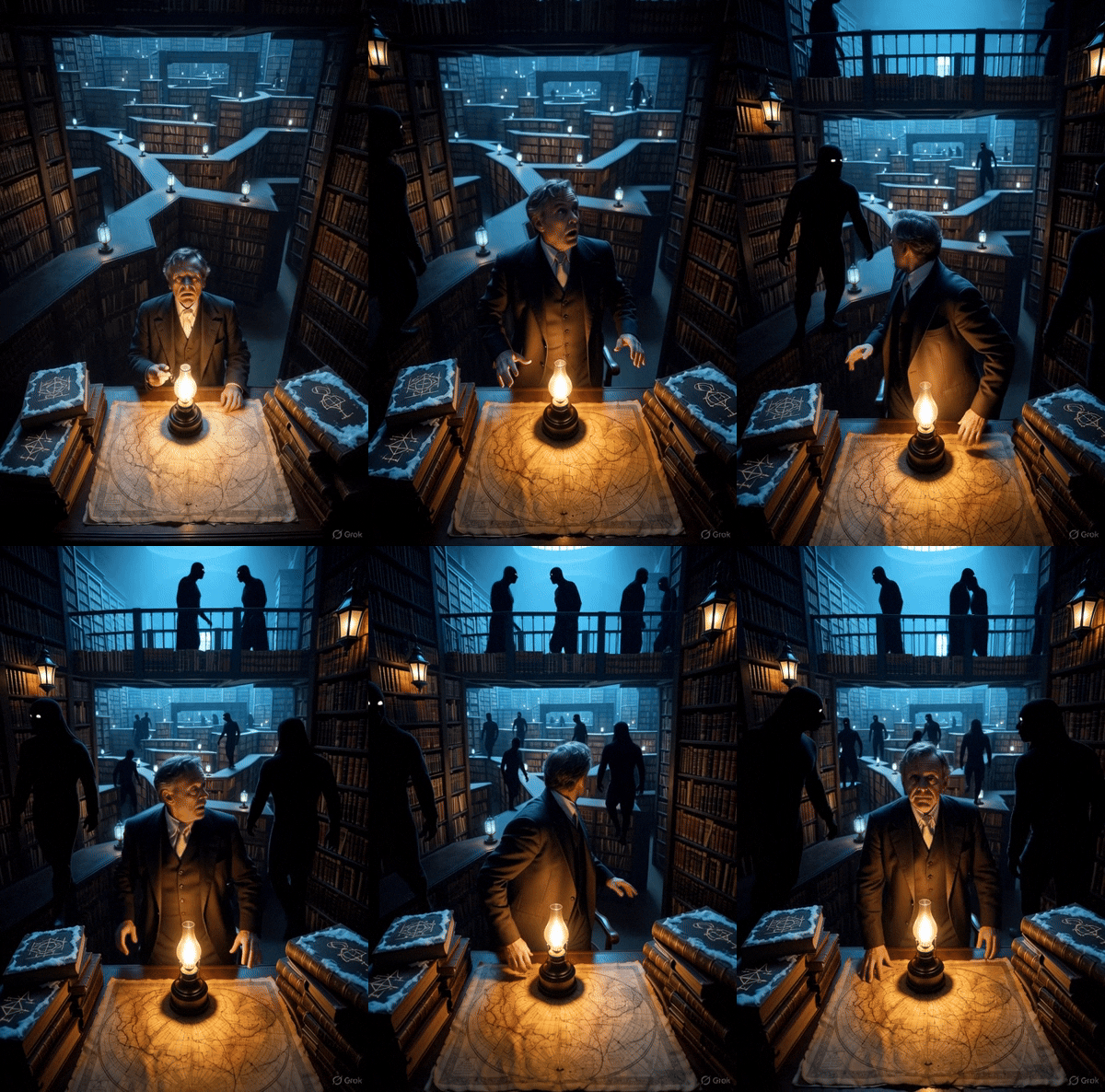
He remembered Cornelius’s warning. Don’t look directly at them.
But it was becoming impossible not to. They filled his peripheral vision now, beautiful in their wrongness. One of them—if “one” meant anything in this context—seemed to be made of angles that added up to more than they should. Another was a colour he’d never seen before, a shade that existed between ultraviolet and a scream. A third was almost a staircase, but a staircase that led in a direction perpendicular to all known dimensions.
They pressed against the membrane of reality, and he could feel their desperate hunger. Utterly alien, without malice or evil, simply trying to exist in a space that rejected their fundamental nature.
And they were so close to succeeding.
The convergence point materialized ahead: a space where four, no six, no infinite corridors met, their angles impossible, their walls transparent to show the same space repeating into forever. At its centre stood a pedestal of black stone, and Pembridge understood with absolute certainty that this was where the archive’s creator had stood, millennia ago, when they’d first bound the entities at bay.
He placed the six fragments on the pedestal. They began to glow, pulsing in rhythm with his heartbeat. The seventh fragment—himself—completed the pattern simply by standing there.
Now, something whispered. Wordless. Pure meaning translated directly into his consciousness. Now you understand. The pattern can be unmade from within. But it can also be perfected. Join us. Let us show you the geometries beyond geometry. The mathematics of madness. The beauty of boundaries dissolved.
Images flooded his mind: himself as an angle, as a proof, as a living theorem exploring dimensions humans had never conceived. No more pain. No more fear. No more the terrible prison of linear time and three-dimensional space. Just endless unfolding into forever, consciousness expanded until it touched infinity.
How seductive it was!
His hand trembled on the vial. The phosphorus sloshed inside, eager to burn.
You don’t have to die, the entities promised. You don’t have to end. Just step aside. Let us through. We’ll reshape reality into something that can hold us all. You’ll be remembered. Honoured. The one who opened the final door.
“No,” Pembridge whispered.
The word felt small, pathetic against the vast promise of dissolution and rebirth.
But it was his word. His choice.
He uncorked the vial and poured the phosphorus over the fragments.
The reaction was instantaneous. White flame erupted, heat so intense it felt cold. The fragments began to burn, their ancient materials catching fire in colours that shouldn’t exist. And as they burned, the convergence point started to collapse.
The entities screamed.
Worse than sound—a sensation of reality being torn, of equations unsolved, of proofs disproven. They had been so close. So desperately, eternally close. And now the door was sealing, the patterns dissolving, the infinite paths back to their realm closing one by one by one.
Pembridge felt them retreat, felt their geometries pulling back through the membrane of reality, their forms compressing back into the spaces between. The archive shuddered, its structure groaning as millennia of accumulated wrongness began to correct itself.
But the fire was spreading. Up his arms, across his chest, into his lungs. The phosphorus didn’t discriminate. It consumed everything: fragments, flesh, consciousness. He was the seventh seal, and he was breaking, unmade like the others.
In his final moments of coherence, he saw the other iterations—Cornelius and the woman and all the others—begin to fade. Released at last, or dissolved, or absorbed into whatever came after. Their faces held peace.
And then he saw something else. Something that made his blood freeze even as his body burned.
He had not been the guardian.
He had been the lock.
The entities retreated, yet remained. They were simply… waiting. Patient across aeons. Because reality was still reality, still constrained by its geometry, still fundamentally incapable of holding them. And the archive was burning. The pattern was dissolving.
Which meant, eventually, inevitably, someone would have to build it again.
Another archive. Another labyrinth. Another lock.
And the cycle would continue.
No, he tried to scream, but he had no lungs left to scream with. I was supposed to end it. This was supposed to be the last iteration.
But as consciousness fled, as the fire consumed the final fragments of who he’d been, he understood the terrible truth: there was no last iteration. There would never be a last iteration. The entities were eternal. The threat was eternal. And humanity, fragile and finite, could only ever hold them at bay, one sacrifice at a time.
The archive collapsed into itself, stone and wood and ancient knowledge folding into a single point of white fire that burned hotter than the sun. The explosion ripped upward through the sub-levels, through Whitehall, into the London streets above.
In the morning papers, they would call it a gas main accident. Terrible tragedy. Several casualties, including a junior fellow of the Royal Geographical Society, name of Pembridge, who’d been researching in the government archives when it happened. His sister received a letter from the Society expressing their deepest condolences. She kept it in a drawer until her own death, never quite understanding why it made her want to weep.
Far beneath where the archive had stood, in spaces that existed in negative dimensions, in the cracks between seconds, the entities waited.
They had waited for aeons already.
They could wait a few more.
And somewhere, in another city, another archive was already being built. Its architect didn’t know why she felt compelled to design it in precisely this pattern, with corridors that folded back upon themselves, with stacks arranged in geometries that hurt to perceive. She only knew it felt right. Necessary.
The maps were already being drawn.
The first fragments were already being hidden.
And in a cottage in Yorkshire, a boy of seven was teaching himself cuneiform, driven by dreams of labyrinths he’d never seen but somehow knew by heart.
The cycle continued.
It would always continue.
Because the alternative was intolerable.

Leave a comment