The Art of Misdirection
O. Henry’s The Last Leaf is a masterclass in narrative sleight of hand. Published in 1907, this deceptively simple tale demonstrates how a skilled writer can make readers care desperately about the wrong thing, only to reveal they’ve been watching the real story unfold in their peripheral vision all along.
If you’ve not read The Last Leaf, I’d urge you to do so. I’ll be giving spoilers in this discussion. At less than 2500 words, the story will only take 10-15 minutes to complete, and I pretty much guarantee you’ll enjoy it.
The Decoy Narrative
The setup is beautifully straightforward. Johnsy, a young artist in Greenwich Village, has developed pneumonia and convinced herself she’ll die when the last leaf falls from the ivy vine outside her window. Her roommate Sue watches helplessly as autumn strips the vine bare, one leaf at a time. O. Henry ratchets up the tension perfectly, as three leaves become two, two become one. We find ourselves genuinely anxious about foliage.
This is absurd, of course. Leaves fall. People don’t die because of symbolic coincidences, yet O. Henry makes us believe in Johnsy’s belief, and that’s enough. Her conviction becomes our dramatic focus. Will the last leaf fall before she recovers her will to live? The story seems to hinge entirely on this question.
Meanwhile, old Behrman lurks in the background. He’s a failed artist who’s spent forty years talking about the masterpiece he’ll paint one day. He’s gruff, protective and dismissive of Johnsy’s “foolishness”. We seem him as supporting colour, a Greenwich Village character sketch to flesh out the bohemian setting.
The Reveal That Recontextualises Everything
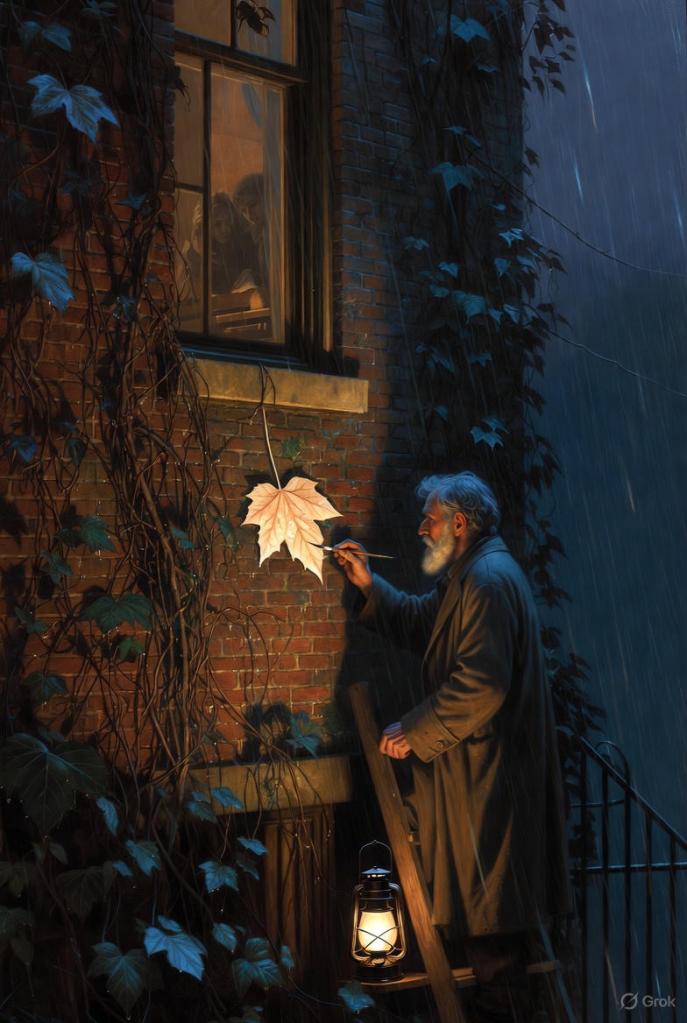
Then comes the twist: that last leaf never falls. It clings to the vine through wind and rain, and Johnsy, seeing its stubborn persistence, finds her will to live. Only after her recovery do we learn the truth: Behrman painted the leaf on the wall the night the real last leaf fell. Alas, he caught pneumonia in the storm and died two days later.
Suddenly the entire story shifts beneath us. The real battle with death belongs to Behrman. The “foolish” artist who never painted his masterpiece finally created it: an anonymous work that saved a life. His magnum opus took the form of a single painted leaf on a brick wall, so perfect in its ordinariness that nobody recognised it as art.
The Wrong Story
Lesser writers would make Behrman’s sacrifice obvious, telegraphing his intentions or giving him a noble speech about what he’s planning. O. Henry does the opposite. Behrman simply calls Johnsy’s fixation “foolishness”, goes out in the storm and dies. We only learn what he did after the fact, through Sue’s brief explanation.
This restraint is crucial. The story focuses on quiet heroism that happens offstage. Behrman paints his masterpiece because a young woman will die without it, and he’s the only one with the skill to fool her into living.
The misdirection serves the theme perfectly. While we’re busy looking at the wrong story, Behrman’s masterpiece succeeds because nobody recognises it as art. Its power lies in its deception, its anonymity. The moment anyone knew it was painted, it would lose its life-saving magic.
Art That Matters
There’s something profoundly moving about Behrman’s trajectory. For forty years he’s been the cliché of the failed artist: all talk, no output, growing old in obscurity whilst protecting younger artists from his own cynicism. He’s a tragic figure, except he isn’t. When it matters, he creates something that literally saves a life.
O. Henry suggests that perhaps Behrman was never meant to paint for galleries. His masterpiece required four decades of skill-building, a specific stormy night, a desperate need, and the willingness to die for his art. The painting exists for an audience of one, viewed from a sickbed, and its success depends on remaining invisible as art.
This is O. Henry at his best: using misdirection to examine what we value and why, going beyond clever plotting. We think we’re reading about Johnsy’s poetic connection between falling leaves and fading life. We’re actually reading about an old man finally understanding what his art is for, and paying everything to create it.
In the end, the last leaf holds on. Not by chance, but because someone climbed a ladder in the storm and refused to let it fall. That’s the real story. Everything else was just a beautiful, heartbreaking trick.

Leave a comment