Ralph Dawson heard his name.
Clear and certain, cutting through the hammering of his heart and Freddie’s ragged breathing beside him. Not a shout or a threat. Just his name.
They’d stopped running fifty metres from the quarry fence, bent double, hands on knees. Amber had already disappeared down the path toward town, her footsteps fading into the long Saturday evening. The summer solstice stretched the day impossibly thin, sunlight clinging to everything despite the hour.
“Did you hear that?” Ralph straightened, looking back toward the old mine workings.
“Hear what?” Freddie wiped sweat from his forehead. “Mate, can we just go? That was too close.”
It had been too close! Old Man Turner’s truck had appeared from nowhere, engine growling as it bounced across the scrubland toward them. They’d seen him climb out, moving with surprising speed for someone his age, and they’d run. Everyone knew about Turner. Everyone knew to stay away.
“He called my name,” Ralph said, half to himself.
“Yeah, well, everyone knows everyone round here. Come on.”
But Ralph stood there, replaying it. The chase had been strange. Turner had been fast, far faster than they’d expected, and he’d been close. Close enough to grab Freddie’s shoulder if he’d wanted to. Close enough to catch any of them.
But he hadn’t.
He’d been shouting something too, words lost in their panic and the wind across the quarry. Threats and warnings, Ralph had assumed. The usual stuff adults yelled when they caught you somewhere you shouldn’t be. But now, heart rate settling, he wondered.
“I’m going back,” he said.
“You’re mental.”
“Just for a minute, Fred. Something’s not right.”
Freddie shook his head. “I’m not getting killed because you’ve got a death wish. I’ll see you tomorrow.”
Ralph watched his friend jog away down the track, then turned back towards the quarry. The evening sun painted everything gold and red, shadows stretching long across the scrubland. It should have felt safe with all that light. It didn’t.
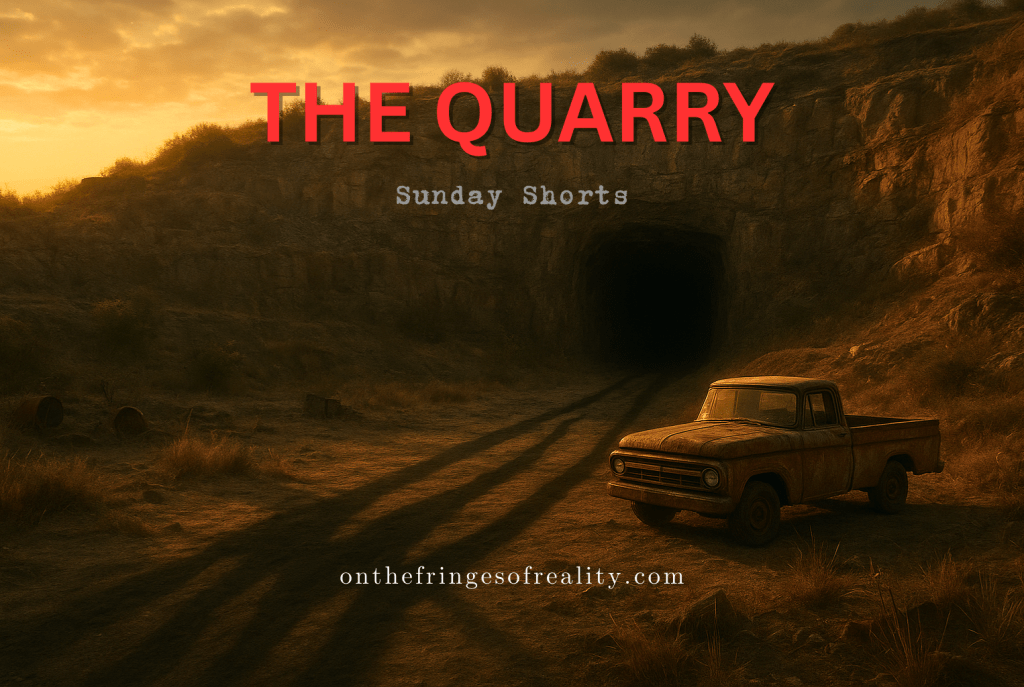
The fence came back into view, the warning signs faded and peeling. DANGER. DEEP WATER. UNSTABLE GROUND. The kind of signs that had been there so long nobody read them anymore. Beyond the fence, the land dropped away into the old workings, a maze of exposed rock faces and flooded pits. At the far end, the main shaft descended into darkness, its entrance a black wound in the hillside.
Turner’s truck was still there, thirty metres from the shaft. Ralph approached, staying close to the fence line. His phone buzzed in his pocket—probably Freddie checking he was still alive—but he ignored it.
The quarry felt different now. The air had weight to it, pressure building like before a storm. Ralph’s ears popped. He climbed through a gap in the fence, feet finding the worn path that led down into the workings.
That was when he heard it.
Something felt in his chest rather than heard with his ears. A low vibration that made his teeth ache and his vision blur at the edges.
The shadows near the shaft entrance were moving.
He stopped. The shadows shouldn’t be moving. The sun was setting behind him, which meant the shadows should be growing, stretching away from the shaft, not reaching toward him like—
Like fingers.
The darkness extended across the ground, ignoring the angle of the light, spreading in ways that broke every rule of physics Ralph’s brain tried to apply. This thing had taken the shape of shadow the way a person might wear a coat.
Ralph tried to step backward. His foot wouldn’t move.
The ground had changed. The slight downward slope toward the shaft had become steep, then steeper, as if the earth itself was tilting beneath him. He tried to run back up the path but his feet skidded on loose stone. The angle kept increasing. Forty-five degrees. Sixty. He was falling forward, scrambling with his hands now, fingernails scraping rock, but gravity had chosen a new direction and that direction was down, toward the shaft, toward the reaching darkness that had grown arms and intention.
He tried to scream but his breath had stopped working.
The shadow touched his ankle.
Cold. So cold it burned. Ralph felt himself sliding faster, the world tilting further, the shaft entrance growing larger. Something moved inside the darkness, vast and patient, and Ralph could sense its size the way you sense a cliff edge in fog. It was ancient, and it was hungry; and it was certain he belonged to it now.
The vibration in his chest intensified. His vision blurred. The edges of the world started to grey out.
An engine roared.
Ralph managed to turn his head, fighting against the pull. Turner’s truck was racing across the scrubland, bouncing over rocks, heading straight for them. The old man’s face was visible through the windscreen, set with grim determination.
Their eyes met for a fraction of a second.
Turner’s hand shot out of the window, something white fluttering from his fingers. Then the truck accelerated, engine screaming, and aimed directly at the shaft entrance.
Ralph was three metres from the darkness now, close enough to see shapes moving inside, close enough to hear sounds that weren’t sounds—whispers that bypassed his ears and spoke directly into his skull. The cold had spread up his leg, into his chest, wrapping around his ribs like wire.
The truck hit the entrance at full speed.
The impact was enormous. Metal screamed as the vehicle plunged into the shaft, and for a moment Ralph saw it disappear into that impossible darkness, headlights swallowed whole. Then the rocks around the entrance began to crack.
The pull on Ralph stopped.
Gravity returned so suddenly he slammed face-first into the ground, tasting blood and dust. The cold vanished from his body. He gasped, pulling air into lungs that had forgotten how to work.
The shaft entrance was collapsing.
Tons of rock tumbled inward, following the truck down into darkness. The sound was like the earth breaking, deep booms that Ralph felt through the ground beneath him. Dust exploded outward in a grey cloud that rolled across the quarry, and somewhere far below came a sound like thunder echoing through caverns that shouldn’t exist.
The shadow retreated like wind through a tunnel, pulled back into the shaft as the rocks buried it.
Then silence.
Ralph lay on the ground, every muscle shaking, his heart hammering so hard it hurt. The world came back into focus slowly—the golden evening light, the warm air, birds calling from the scrubland.
He pushed himself up onto his hands and knees, then saw it.
The piece of paper had landed a short distance away, caught against a rock. Ralph crawled toward it, his hands shaking so badly he could barely pick it up. The paper was old, its edges soft with handling, deep creases from being folded and unfolded many times. Carried for years, waiting.
The handwriting was careful and deliberate.
To whoever reads this—
I know what you’re thinking because I thought it too. You’ll want to tell someone. Don’t. They won’t believe you, and it makes the watching harder when people think you’re mad.
Old Man Hewitt saved me on this day in 1968. Now, hopefully, I’ve saved you. And I’m sorry for that. The burden should have died with me, but it doesn’t seem to work that way.
The entity comes through on the solstice. Every year. Always looking for a child. I don’t know why. I stopped trying to understand it decades ago. All that matters is keeping people away from the shaft on this day, every year. Until you’re too old and someone younger has to take your place.
You’ll become like me. Feared. Avoided. They’ll tell stories about you. Let them. It’s better than the truth.
Watch the quarry. Keep the children safe. I’m sorry.
—Turner
He read it three times. The first time, the words made no sense. The second time, they made too much sense. After the third time, Ralph folded it carefully along its existing creases and put it in his pocket.
Sirens approached in the distance. Someone had heard the crash, called it in.
The dust was still settling when the first emergency vehicles arrived.
The shaft stayed sealed through the rest of that summer. Ralph returned there several times to check, always finding the entrance buried under tons of collapsed rock. By August, his mum received a letter from the council reminding residents that the old mine workings remained dangerous and unstable, and under no circumstances should anyone approach them.
The letter held a different meaning to Ralph than it did to his mum.
He started finding excuses not to see Freddie and Amber as much. Not immediately, but gradually, over weeks and months. They noticed. Asked if he was okay. He said he was fine, just busy, just thinking about stuff. They stopped asking eventually.
He used to tell them everything. Now he couldn’t tell them anything.
The summer solstice fell on a Saturday again.
Old Man Dawson sat in his truck overlooking the quarry, engine idling, hands resting on the wheel. Late afternoon sun turned the scrubland bronze, shadows already reaching toward the shaft. It should have felt safe with all that light. It didn’t.
It never did.
The letter was in his pocket. He’d rewritten it a few times over the years, trying to find better words, kinder words, some way to make the burden less terrible. He’d given up eventually and copied out Turner’s version word for word, changing only the names. Some truths couldn’t be softened.
He heard them before he saw them—teenagers, laughing, daring each other to get closer to the fence. Their voices carried on the evening air, bright with the fearless stupidity of youth who thought they had forever.
Old Man Dawson revved the engine drove towards them.
They ran, of course. They always did.
He let them go. He always did.
But he’d be watching when one of them came back.
Someone always did.

Leave a comment