H.P. Lovecraft’s The Rats in the Walls is a masterclass in structural horror. It’s also deeply, irredeemably racist. Both things are true, and pretending otherwise helps no one. The question facing modern readers isn’t whether to acknowledge the bigotry (that’s non-negotiable) but whether the story’s artistic achievement survives its moral rot.

The Architecture of Dread
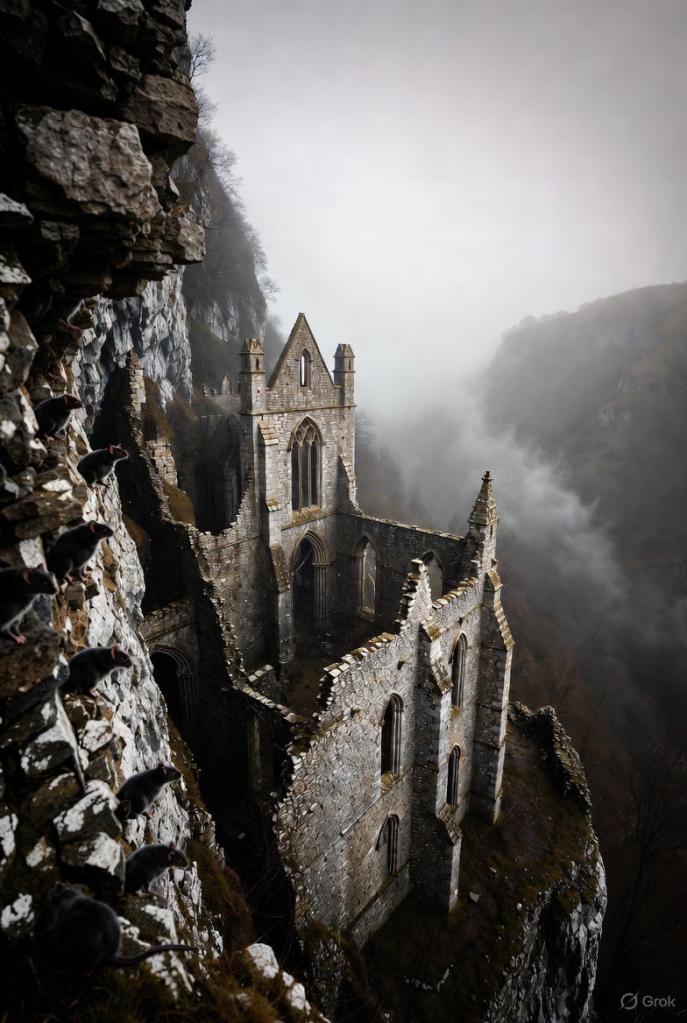
Lovecraft understood that buildings remember. Delapore’s ancestral priory is layered with suppressed history. Each stratum reveals another century of atrocity: Tudor chambers above Saxon cells, Roman vaults beneath, and finally prehistoric caverns where something older than humanity once fed. The descent operates on multiple levels simultaneously (physical, temporal, linguistic, evolutionary).
This architectural metaphor operates with brutal efficiency. As Delapore moves deeper into Exham Priory, his language regresses. Victorian English crumbles into Middle English, then Norman French, then Latin, then something inhuman. “Curse you, Thornton, I’ll teach you to faint at what my family do!” The sophisticated man’s veneer strips away, revealing the cannibal priest underneath. What lurks in the walls matters less than what Delapore becomes when he joins it.
That ending still lands like a hammer. Delapore surrenders to the darkness completely. He becomes it. The revelation that his ancestors ran an intergenerational human abattoir matters less than his final transformation. He’s found crouched over Captain Norrys’ corpse, gnawing. Inheritance horror at its finest: you don’t fight the monster, you discover you’ve always been the monster.
The technical execution is airtight. Lovecraft uses every gothic trick (crumbling estates, family curses, hidden cellars) but inverts them. The supernatural elements (the rats, the sounds in the walls) serve as breadcrumbs leading to a worse truth: there is no ghost. Just centuries of systematic atrocity, and blood that runs true.
The Racial Hatred
Now the ugliness. The cat’s name is the most obvious problem. Many modern editions have rightly changed it, though some argue this sanitises the text and obscures Lovecraft’s virulent racism. Fair point. Readers deserve to see exactly what they’re dealing with.
The premise itself contains the deeper rot. The Rats in the Walls explores blood taint, degeneracy passed through generations, the terror of discovering your lineage is “impure”. When Lovecraft writes about the de la Poers breeding humans like cattle in their subterranean nightmare, he’s expressing his genuine belief that racial mixing produces subhuman creatures. This goes beyond crafting gothic atmosphere.
The revulsion at hybridity runs through everything. The prehistoric inhabitants are barely human. The feeding pits represent more than cannibalism; they embody the contamination of pure bloodlines through the mixing of civilised and savage. Lovecraft’s cosmicism (the idea that humans are insignificant specks in an uncaring universe) gets weaponised here as eugenic terror. We’re all descended from something worse.
The racism is load-bearing. Remove the blood taint anxiety and the story loses its engine. Lovecraft genuinely believed in racial hierarchies, in the danger of “mongrelisation”, in degeneracy theory. The Rats in the Walls gives those beliefs narrative form. The craft is brilliant, but it serves something vile.
Can We Read This?
So what do we do with brilliant art built on repugnant ideology? Ignore it and lose an opportunity to understand how bigotry shapes narrative? Read it uncritically and tacitly endorse racism? Neither option satisfies.
Lovecraft’s racism fuels the story’s dread rather than undermining it. His genuine terror of contamination, his visceral disgust at mixing, his belief in inherited degeneracy—these power the narrative. You can feel his revulsion in every descent through the priory’s strata. That authenticity makes it effective horror. It also makes it poison.
Modern readers can engage with this story if they stay clear-eyed about it. Recognise the craft: the structural elegance, the linguistic regression, the inversion of gothic tropes. Appreciate how Lovecraft builds dread through architecture and archaeology. Study how he makes the protagonist’s transformation inevitable rather than surprising.
Then acknowledge the rot. Notice how the story’s terror depends on eugenicist assumptions. See how “blood taint” operates as both metaphor and literal belief. Lovecraft was expressing his genuine worldview through fiction, using technical skill to propagate his hateful ideology.
Reading The Rats in the Walls offers education rather than enjoyment. This story demonstrates how technical mastery can serve terrible ideology. Holding both truths at once (that something can be aesthetically successful yet morally repugnant) is essential for engaging with literature honestly.
The Verdict
The Rats in the Walls is both masterpiece and cautionary tale. Lovecraft’s structural genius created a template for inheritance horror that writers still follow. His use of architecture as memory, his linguistic regression, his understanding that becoming the monster is worse than fighting it: these innovations matter.
But the story stands on eugenic terror. Its horror depends on racist assumptions about bloodlines and degeneracy. No amount of technical brilliance erases that foundation. The racism forms the bedrock the work stands on.
Can great craft coexist with vile ideology? The Rats in the Walls proves it can. Should we celebrate that? Absolutely not. Should we study it? Yes, with ruthless honesty about both its achievement and its ugliness. Lovecraft created something technically brilliant in service of something morally repugnant. That’s the truth. Brilliant and burdened, all the way down.

Leave a comment