The Latchkey – Part IV
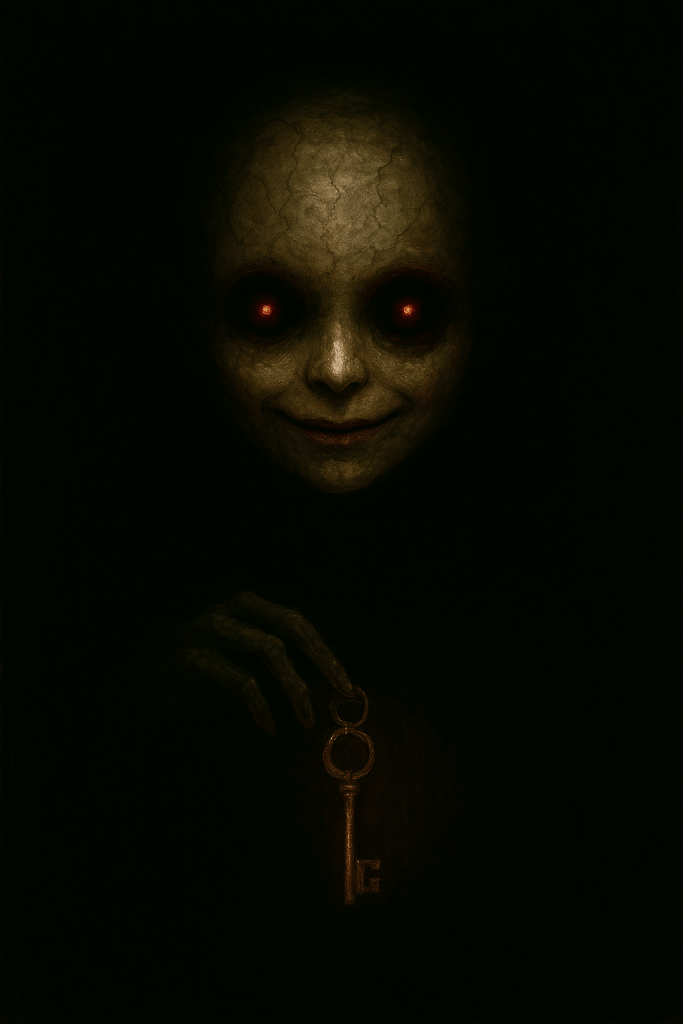
I have served in the Hendersons’ household for seven years, and in that time I have learnt to read the rhythms of the house as precisely as the church bells mark the hours. Mr Henderson takes his breakfast at eight o’clock. Mrs Henderson rings for tea at four. The parlour fire is lit at six, and by ten the house falls silent, save for the settling of old timber and the occasional creak of floorboards as I complete my final rounds.
It was the disruption of these rhythms that first alerted me to the wrongness.
Mr Henderson returned from his business in Manchester on a Tuesday evening in November. I heard the cab arrive, watched from the scullery window as he climbed down, paid the driver, and stood for a moment looking up at the house. Even from that distance, I noticed something peculiar in his posture—a stiffness, as though he were learning to inhabit his own body.
He went directly to his study and did not emerge for dinner.
“Mr Henderson is indisposed,” Mrs Henderson told me, her voice tight with concern. “He requires no disturbance.”
But I could see the light beneath his study door, steady and unmoving, as though he sat perfectly still in the lamplight.
The next morning, I found him in the same position. Through the gap in the doorway—I had knocked three times without answer—I observed him seated at his desk, hands folded, facing the window. He had not changed his clothes. His breakfast tray from the previous evening remained untouched on the side table.
And he was smiling.
Not a natural smile. Not the expression of a man lost in pleasant thought. This was something painted on, stretched too wide, held too long.
“Mr Henderson, sir?” I ventured. “Shall I fetch Dr Morrison?”
He did not turn. Did not acknowledge my presence. Simply sat there, that terrible smile fixed upon his face.
I withdrew and found Mrs Henderson in the morning room. “Ma’am, I believe Mr Henderson requires medical attention.”
She looked at me with an expression I could not quite read. Irritation, perhaps. Or fear. “That will be all, Agnes.”
Over the following days, the wrongness spread through the house like damp through plaster.
Objects appeared in unexpected places. The brass coal scuttle migrated from the parlour to the landing. Mr Henderson’s reading spectacles turned up in the linen cupboard. I found one of Mrs Henderson’s gloves tucked behind the clock on the mantelpiece, though I had seen her wearing both that very morning.
And the marks. Black smudges on the doorframes, on the walls, on the bannister rail. Long and thin, as though something with fingers of unusual length had pressed itself against every surface. I scrubbed at them daily, but by evening they had returned.
Mr Henderson remained in his study. Mrs Henderson began taking her tea there, sitting with him in that dreadful silence. When she emerged, she moved slowly, mechanically, as though forgetting the purpose of each room before she entered it.
It was whilst cleaning Mr Henderson’s study—he had finally retired to his bedchamber, though whether he slept I could not say—that I found the key.
It lay in the centre of his desk, catching the grey November light. Brass, old-fashioned, tarnished with age. I had never seen it before, yet something about it felt familiar. Wrong-familiar. The kind of recognition that makes your stomach turn.
I picked it up.
It was warm.
My grandmother’s voice rose unbidden in my memory, her Yorkshire accent thick with warning: “If t’Latchkey finds thee, lass, tha must run. Don’t stop, don’t look back. It takes the home first, then it takes thee.”
I had been perhaps six years old, sitting by her fire in Whitby, listening to tales I dismissed as fancy. Old women’s stories to frighten children.
The key grew warmer in my palm.
That evening, I found Mrs Henderson sitting in the parlour, hands folded, facing the window. She had not touched her tea. She had not moved for dinner. And she was smiling—that same stretched, painted-on smile.
I packed my bag that night. One dress, my savings, my grandmother’s Bible. I left no notice, no explanation. The morning would bring questions I could not answer.
As I descended the servants’ stairs in the pre-dawn darkness, I heard it: the slow, patient creak of floorboards in the hallway above. Small footsteps. Child-sized, but too measured, too deliberate.
The front door stood ajar—just a crack, though I had locked it myself before retiring.
I ran.
I did not look back.
I dream of the Hendersons’ house. In these dreams, I sit in the parlour chair, hands folded, facing the window. I have been sitting for hours, perhaps days. The smile stretches my face until my cheeks ache. I try to stand, to leave, but my body will not obey.
Then I wake in my narrow bed at Aunt Catherine’s boarding house in Leeds, gasping, my nightdress damp with perspiration. The morning light slants through the thin curtains. I hear the clatter of breakfast being prepared downstairs, the distant call of the rag-and-bone man in the street.
I am safe. I am free.
But there are moments—standing at the washbasin, or folding linens, or sitting to take my evening meal—when I lose track of time. When I find myself in the same position for longer than I intended, hands folded, facing the window.
And in those moments, a terrible thought occurs: what if I never left? What if I am sitting still in the Hendersons’ parlour, dreaming of escape, dreaming of Aunt Catherine’s narrow bed and the rag-and-bone man’s distant call?
What if the dreams and the waking have simply traded places?
This morning, I found a black smudge on the doorframe of my room. Long and thin, as though something with unusual fingers had pressed itself against the wood.
I scrubbed at it for twenty minutes.
It remains.

Leave a comment