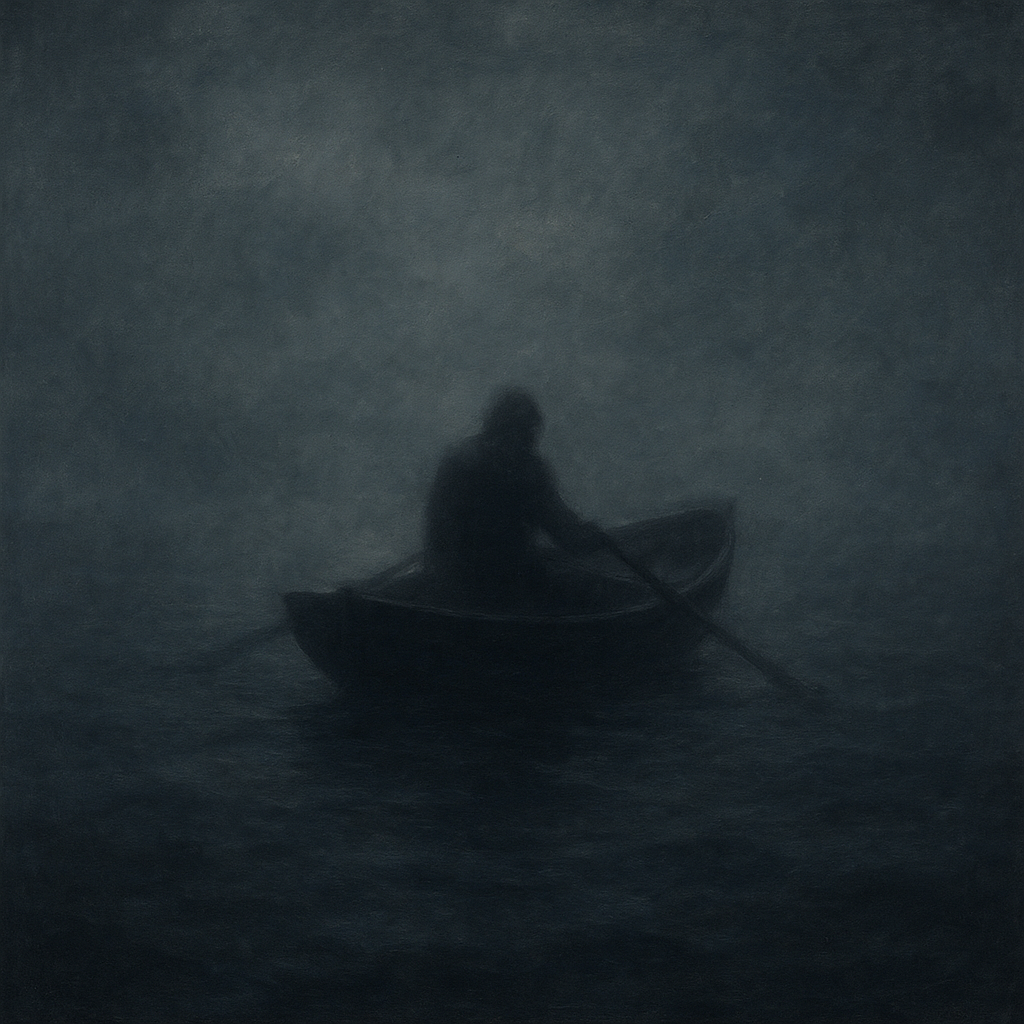
William Hope Hodgson occupies an odd position in the pantheon of early 20th century horror writers. Whilst his contemporaries (Lovecraft, MR James, Algernon Blackwood) remain widely read, Hodgson’s work has largely faded from view. Yet The Voice in the Night, published in 1907, stands as one of the most effective horror stories of its era, a tale that understands something fundamental about fear: the worst horrors are the ones we inflict upon ourselves through inaction.
The story employs the classic frame narrative of maritime fiction. A ship’s crew, becalmed in fog, hears a voice from the darkness: a man in a small boat who refuses to come alongside or be seen. In exchange for food, he tells his story. What follows is an account of survival gone catastrophically wrong, as the narrator and his fiancée find themselves marooned on a derelict ship covered in a strange grey fungus. The fungus, they discover, is not merely growing on the ship. It’s growing on everything. Including them.
The horror operates on several registers at once. There’s the immediate visceral revulsion of the fungus itself (Hodgson’s descriptions are sufficiently grotesque without becoming gratuitous). There’s the psychological terror of slow transformation, watching helplessly as your body becomes something else. And beneath it all runs a deeper existential dread that anticipates Lovecraft’s cosmic horror: the universe is fundamentally indifferent to human suffering, and our bodies are just matter, as susceptible to colonisation as any other organic substrate.
Spoiler warning: detailed plot discussion follows
What makes the story particularly effective is its structure. The frame narrative does far more than provide stylistic flavour; it’s essential to the horror. We know from the beginning that the narrator has survived, but survival here means something worse than death. When he refuses to show himself, when he keeps his boat at a distance in the fog, we understand what he’s become. The story becomes about bearing witness to degradation, about the cost of continuing to exist when existence itself has become monstrous.
Hodgson handles the horror with real skill. He never explains the fungus. There’s no scientific lecture, no convenient exposition. It simply is: a grey, creeping presence that gradually claims everything. The narrator and his fiancée make reasonable, understandable decisions at every stage. They eat the ship’s provisions whilst they last. They avoid the fungus-covered areas. They tell themselves they’ll find rescue soon. But the fungus is patient, and hunger is persistent, and eventually they make the choice that dooms them: they eat the fungus-covered food.
The transformation creeps forward gradually, almost imperceptibly at first. A grey patch on the skin. A strange texture to the flesh. They can feel themselves changing, watch it happening, and yet they continue eating the contaminated food because the alternative is starvation. The story captures something genuinely disturbing about the human condition: our capacity to adapt to horror, to normalise the unthinkable when faced with immediate survival.
The relationship between the narrator and his fiancée deepens the tragedy. Their love survives their transformation: they remain devoted to each other even as they become less and less human. But that devotion turns horrifying in itself. When she can no longer bear to look at herself, he comforts her. When he struggles with despair, she supports him. They maintain their humanity through their connection to each other, but their bodies betray them regardless. It’s a story about the inadequacy of love in the face of physical degradation, about how the things that make us human can persist even when our humanity is being literally consumed.
The ending is perfect in its bleakness. The narrator and his fiancée have finally escaped the derelict ship, but escape means only that they’ll drift until they die, or until the transformation completes itself. The voice fades back into the fog, refusing food now (perhaps the fungus sustains them, perhaps they’ve moved beyond needing sustenance as we understand it). The frame narrative completes itself, and we’re left with the crew listening to the sound of oars disappearing into the night. The horror simply moves on, hidden in the fog, unchallenged and undefeated.
Hodgson trusts his premise enough not to overwrite it. The descriptions are vivid but never purple, the pacing measured without being slow. The story earns its horror through accumulation rather than shock, building a sense of creeping dread that mirrors the fungus itself.
The Voice in the Night deserves to be recognised alongside the best horror fiction of its era. It’s a story that understands that the most effective horror often comes not from external monsters but from the terrible choices we make when confronted with impossible situations. The fungus is horrifying, but even more horrifying is the moment when survival stops being worth the cost, and the realisation that by the time you reach that moment, it’s far too late to matter.

Leave a comment