The Elevator Anthology – Part II
The lift doors opened with a cheerful chime, and Zara stepped inside, smoothing down her interview suit one last time. Ground floor. She pressed the button for twenty-two and watched the doors begin to close.
A hand shot through the gap. The doors bounced back, revealing a woman in her fifties wearing an immaculate navy suit and carrying a leather portfolio.
“Oh, sorry,” Zara said, stepping aside. “I didn’t see you.”
“No harm done.” The woman smiled warmly and pressed twenty-two. “Interviewing?”
“Yes. Marketing assistant. I’m probably too early, but—”
“Better early than late. I’m Mrs Cartwright, from HR.” She extended her hand.
Zara shook it, trying not to seem too eager. “Zara Mitchell. Lovely to meet you.”
“First floor,” the lift announced in its pleasant automated voice.
They began their ascent in comfortable silence. Zara watched the numbers climb: one, two, three. Her CV was perfect, her portfolio strong. This was her big break.
“So, Zara,” Mrs Cartwright said, still smiling. “Tell me about yourself.”
“Well, I graduated last year with a first in Marketing and—”
“No, no. Tell me about yourself. Who are you, really?” Mrs Cartwright’s smile didn’t waver, but something in her tone shifted. Just slightly.
“I… I’m ambitious. Hardworking. I really want this opportunity to—”
“How badly do you want it?”
Zara blinked. “Sorry?”
“Fifth floor.”
“How badly do you want this position?” Mrs Cartwright turned to face her fully. “What would you sacrifice for it?”
“I’d work hard, put in the hours, whatever it takes to—”
“That’s not what I asked.” The woman’s voice remained pleasant, but her eyes had grown intent. “What would you sacrifice, Zara? Your time? Your relationships? Your principles?”
The lift seemed to slow. Zara glanced at the display: six, seven, eight. They were moving, but it felt… deliberate.
“I… I don’t think I understand the question.”
“Tell me about your debts.”
“Excuse me?”
“Student loans. Credit cards. Rent arrears. You’re three months behind, aren’t you? Your landlord’s getting impatient.”
Zara’s mouth went dry. “How did you—”
“Tell me about your desperation, Zara.” Mrs Cartwright took a step closer. “That’s what I really need to know. How desperate are you?”
“Tenth floor.”
The fluorescent light flickered once. Twice.
“This isn’t…” Zara pressed herself against the back wall. “This isn’t a normal interview.”
“Oh, but it is.” Mrs Cartwright’s smile had become fixed, unnatural. “We just ask different questions from most companies. More… honest questions. Tell me, Zara, when you lie awake at night worrying about money, about your future, about whether you’ll ever amount to anything—what does that feel like?”
“I want to get out.” Zara reached for the emergency stop button.
Mrs Cartwright’s hand caught her wrist. Her grip was cold, impossibly strong.
“We’re not finished yet.”
The lift continued its steady climb. Fifteen. Sixteen. The lights flickered again, longer this time, and when they steadied, Mrs Cartwright’s eyes seemed darker. Older.
“You came here full of hope, didn’t you? Full of potential. Fresh graduate, eager to prove yourself. So much ambition.” She inhaled deeply, as if savouring a fragrance. “It’s quite intoxicating, really. The taste of it.”
“The taste of what?” Zara whispered.
“Nineteenth floor.”
“Young people like you, Zara. So desperate to succeed. So willing to give everything for a chance. That’s what we’re looking for here.” She licked her lips slowly. “Not your labour—we have no use for that. Your hope. Your potential. That bright, shining thing that made you think you could achieve anything if you just worked hard enough.”
The lift’s walls seemed to close in. Or perhaps that was Zara’s vision narrowing.
“We’ve been recruiting for decades,” Mrs Cartwright continued. “Bright young things like you, full of dreams. They come for interviews, and most of them never leave. Oh, they walk out eventually—but they leave the best parts of themselves behind. Hollow. Empty. Wondering why they can’t feel excited about anything anymore. Why food tastes like ash and
sunshine feels like nothing at all.”
“Twenty-first floor.”
Zara thought of the other candidates she’d seen in reception. Three of them, sitting perfectly still. Their eyes had been open, but when she’d smiled at them, they hadn’t smiled back. They’d barely registered her presence.
“The other candidates,” she breathed.
“Precisely. And you’re the last appointment of the day. Always save the brightest for last, I find.” Mrs Cartwright tilted her head. “Don’t worry—it doesn’t hurt. You’ll simply wake up tomorrow morning and wonder why you bothered coming at all. Why you thought you were special. You’ll take some awful job you’re overqualified for, and you’ll stop dreaming. You’ll stop hoping. And we’ll have fed very well indeed.”
The lift chimed softly.
“Twenty-second floor.”
The doors began to slide open, revealing a pristine corridor lined with office doors. But Zara wasn’t looking at the corridor. She was looking at Mrs Cartwright’s reflection in the polished metal of the lift doors—and the reflection was wrong. The woman’s smile was too wide, her neck elongating, her fingers too long.
Zara did the only thing she could think of. She shoved Mrs Cartwright hard in the chest. The woman stumbled backwards through the opening doors, her expression more surprised than angry.
Zara slammed her palm against the ground floor button. Again. Again.
“Close,” she whispered. “Please close.”
The doors began to slide shut. Through the narrowing gap, Zara saw Mrs Cartwright straighten up. Saw her head tilt at an angle that made Zara’s stomach lurch—too far, vertebrae stretching in ways that shouldn’t be possible. Her smile widened until it split her face, and her eyes reflected the fluorescent light with a yellow-green gleam.
The doors met with a soft thunk.
Zara jabbed the ground floor button, breathing hard. Her hands shook. The lift jolted—but not upward. Down.
She watched the numbers with growing dread. Twenty-two. Twenty-one. Twenty. Nineteen.
Then: Eighteen. Seventeen. Sixteen.
Her breath came in shallow gasps. The numbers kept descending. Ten. Nine. Eight.
Please, she thought. Please let it stop.
Five. Four. Three.
Two.
One.
She almost dared to breathe.
Ground.
The display flickered.
Basement. B2. B3.
“No,” Zara whispered. “No, no, no.”
The lift ignored her, descending into levels that shouldn’t exist. B4. B5. The fluorescent light flickered constantly, casting everything in strobe-like flashes.
B6.
The lift stopped with a gentle bump.
“Have a productive day,” the voice said, bright and cheerful.
The doors opened.
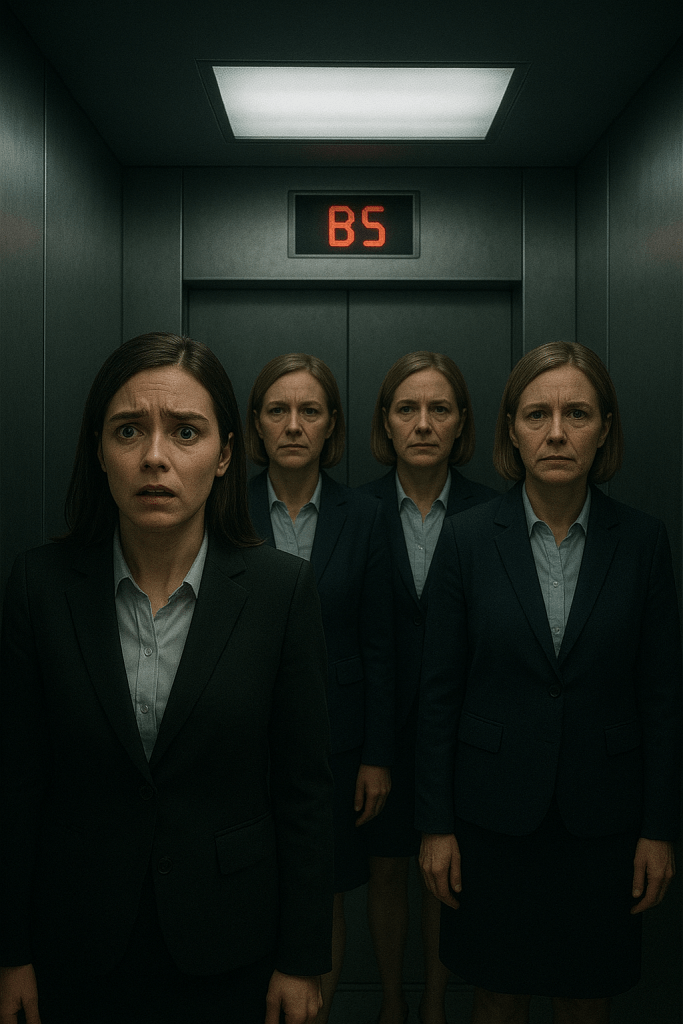
The basement was pristine. Grey concrete. Fluorescent tubes. Corporate clean. Standing in a neat line, all facing the lift, were seven women. All in navy suits. All with Mrs Cartwright’s face.
They looked at Zara with perfect synchronization, their heads tilting in unison.
Then they smiled.
Three of them stepped forward, their movements perfectly coordinated. One reached past Zara and pressed twenty-two. The others positioned themselves on either side of her, not touching, but close enough that she could feel the cold radiating from them.
As the doors began to close, all seven Mrs Cartwrights spoke in perfect unison:
“Going up.”
The lift began its ascent. Zara slid down the back wall until she was sitting on the floor, her knees drawn up, her interview suit crumpled.
The numbers climbed steadily. The Mrs Cartwrights stood facing forward, patient and still.
Five. Six. Seven.
Zara closed her eyes.
Fifteen. Sixteen. Seventeen.
She thought about the hollow-eyed candidates in reception. Thought about becoming one of them—walking out of this building with her hope drained away, her potential consumed, nothing left but an empty shell pretending to be alive.
Twenty. Twenty-one.
The lift chimed softly.
“Twenty-second floor.”
The doors opened. The three Mrs Cartwrights stepped out in perfect unison. One turned back, gesturing with inhuman grace for Zara to follow.
“Come along, dear,” they said together, still in that cheerful automated voice. “We haven’t got all day.”

Leave a comment