When “The Man in the Black Suit” appeared in The New Yorker in 1994, it reminded readers why Stephen King ranks among America’s finest short story writers. This deceptively simple tale of a boy’s encounter with the Devil earned both the O. Henry Award and World Fantasy Award, and rightfully so. The story presents itself as straightforward supernatural horror while operating as a sophisticated meditation on trauma, memory, and the stories we tell ourselves to survive.
The Art of Unreliable Memory
King opens with a masterstroke: framing the entire narrative as an elderly man’s recollection of events from his childhood. This narrative choice becomes the key to everything that follows. The narrator, now ninety, repeatedly insists on his memory’s accuracy whilst simultaneously undermining it.
“I am ninety years old and this is something that happened to me when I was nine, nearly a century ago. It would be unrealistic to expect anyone to believe this story.”
That immediate contradiction (this happened alongside don’t believe it) establishes the story’s central tension. The reader experiences how trauma reshapes memory, how the inexplicable gets processed through decades of retelling, and how truth becomes something more complex than simple factual accuracy.
Childhood trauma rarely presents itself as neat narrative. It fragments, distorts, and reconstitutes itself through the lens of adult understanding. The elderly narrator’s insistence on details (“I know it was sixty-five because that was the year I retired”) feels like someone desperately shoring up the foundation of a story that threatens to collapse under its own impossibility.
The Devil in the Details
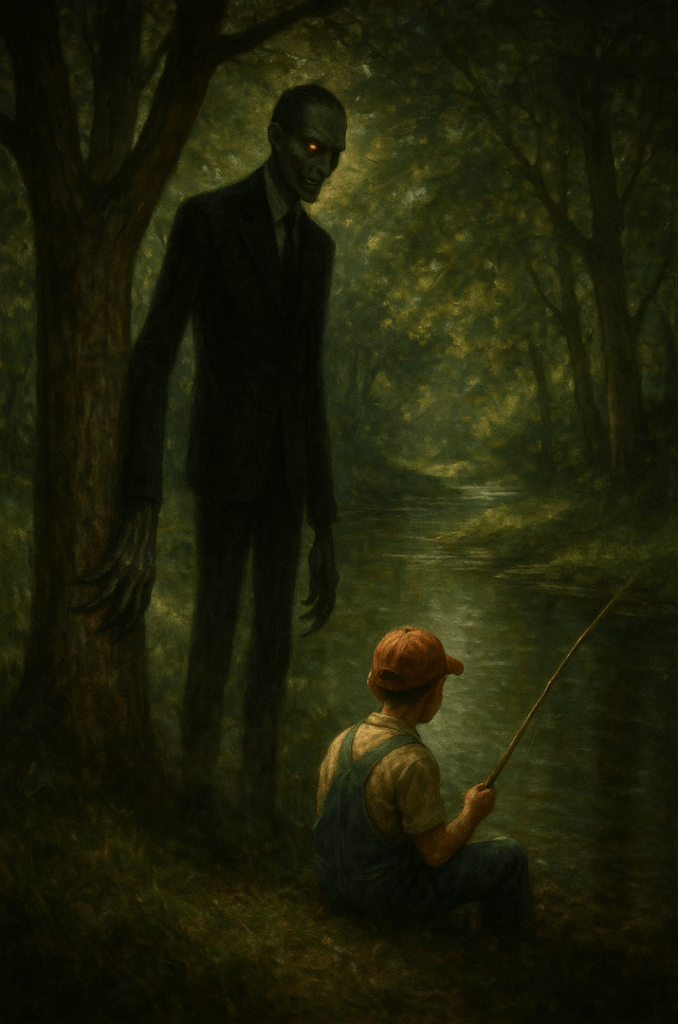
This Devil abandons the theatrical villainy of medieval morality plays for something far more disturbing: a predator who understands exactly how to exploit a child’s deepest vulnerabilities. When he first appears, lounging against a tree and observing Gary fishing, he seems almost ordinary: a well-dressed man in a black suit. It’s only gradually that the horrific details emerge: the burning orange eyes, the split-toed feet, the impossibly long fingers ending in talons.
What makes this figure so terrifying is how precisely he operates. Rather than threatening Gary with abstract damnation, he targets the boy’s specific psychological weak points. He claims Gary’s mother is dead, killed by a bee sting, then describes in grotesque detail how “Candy Bill had licked her dying tears from her swollen cheeks.” This calculated cruelty aims to shatter a nine-year-old’s sense of safety.
The Devil’s knowledge of intimate family details (Gary’s dead brother Dan, his mother’s fears, his father’s character) suggests something more complex than a chance encounter. Whether supernatural entity or psychological manifestation, this figure knows exactly where to strike to cause maximum damage.
Religious Horror Without Preaching
Religious themes run throughout the story with remarkable subtlety. Christian imagery saturates every scene (Gary carries the family Bible, prays desperately, and ultimately escapes through what might be divine intervention), yet faith never offers simple comfort or easy answers. The Bible becomes both protection and burden, belief both salvation and source of terror.
The Devil’s promise that “murdered souls always go to Heaven” represents a particularly twisted form of temptation: evil disguised as mercy. This connects to how trauma can make destruction seem like relief, how a child might convince themselves that death is preferable to facing an uncertain future.
The treatment of faith feels authentic because it acknowledges doubt alongside belief. The adult narrator doesn’t claim definitive supernatural experience; he presents his story as something that might have happened, something that shaped him regardless of its literal truth.
The Psychology of Escape
Gary’s escape sequence (running across a railroad bridge as a freight train approaches) operates on multiple levels. Literally, it’s a moment of pure physical terror as he races the train across the trestle. Symbolically, it represents the transition from childhood to something harder and more knowing. The boy who emerges on the other side isn’t the same one who went fishing that morning.
The train itself becomes a crucial element: massive, unstoppable, offering both salvation and potential destruction. Gary must choose between certain death behind him and possible death ahead: a perfect metaphor for how we sometimes must embrace one terror to escape another.
The description of this sequence is masterful, switching between external action and internal experience, showing us both the physical reality of the escape and its psychological significance. The sound of the train becomes the sound of the world changing, the screaming whistle marking the end of innocence.
The Power of Ambiguity
Maintaining perfect ambiguity about what actually happened may be the story’s greatest achievement. The adult narrator provides rational explanations (he fell asleep fishing, had a nightmare triggered by grief over his brother’s death). His father suggests the same thing, offering the comfort of psychological rather than supernatural explanation.
Yet the physical evidence contradicts this reading. The family fishing rod and creel are found exactly where Gary claims to have dropped them. The ground shows burn marks where the Devil supposedly lay laughing. The giant brook trout that should have been Gary’s prize catch has vanished, fed to something that may or may not have been there.
This ambiguity gives the story its power. We can’t be certain what really happened, and that uncertainty becomes the true source of dread. Whether Gary encountered the Devil or experienced a psychotic break matters less than the fact that something irrevocably changed him that day.
Memory as Horror
The frame narrative serves another crucial function: it demonstrates how memory itself becomes a form of horror. The elderly narrator carries the weight of recounting past events while remaining trapped by them, condemned to carry this story for ninety years without ever achieving certainty about its meaning.
Traumatic memories operate as living things that change with each recollection rather than fixed recordings. Details become more vivid or fade entirely. Emotional truth overwrites factual accuracy. The story we tell about ourselves becomes the story of who we are.
The narrator’s repeated insistence on accuracy (“I know this is right,” “I remember this exactly”) reveals someone desperately trying to maintain control over experiences that threaten to overwhelm rational understanding. When supernatural elements feel rooted in recognisable human behaviour, they become more unsettling than pure fantasy.
Why It Endures
“The Man in the Black Suit” remains compelling because it operates simultaneously as supernatural horror and psychological drama. Readers who prefer literal interpretations can focus on the Devil as external threat. Those who favour psychological readings can view the entire encounter as trauma-induced hallucination. The story provides evidence for both interpretations whilst committing to neither.
It also captures something universal about childhood’s end: that moment when the world reveals itself as more dangerous and complex than we previously understood. Whether through supernatural encounter or psychological crisis, every child eventually faces their own man in the black suit: the realisation that safety is temporary and innocence cannot be preserved.
The prose throughout maintains perfect balance between the elderly narrator’s careful adult language and the underlying emotional reality of a terrified nine-year-old. The voice feels authentic to both ages, creating the sense that we’re experiencing memory as it actually functions, past and present bleeding together, adult understanding layered over childhood experience.
The Craft Behind the Fear
Looking at the story’s construction, every element serves multiple purposes: the fishing trip provides both realistic backdrop and metaphor for the uncertainty of what we might catch when we cast our lines into dark waters. The family Bible becomes protection, symbol, and burden. Even Gary’s dead brother Dan serves as both psychological explanation and supernatural foreshadowing.
Concrete sensory details (the smell of the Devil’s sulphurous breath, the sound of his claws on tree bark, the weight of the family Bible) anchor the fantastic elements in physical reality. These details accumulate to create what feels like genuine memory rather than constructed narrative.
The story’s pacing mirrors its psychological content: long, languid sections of fishing and reflection punctuated by moments of intense terror. This rhythm creates the sense of childhood time, endless lazy afternoons interrupted by sudden, overwhelming experiences that change everything.
“The Man in the Black Suit” succeeds because it taps into the moment when we first suspect that monsters might be real. Whether that monster wears a black suit or lives in our own minds matters less than the knowledge that innocence, once lost, can never be recovered. In about 10,000 words, the story haunts readers with the recognition of their own buried traumas and the stories they’ve told themselves to survive them.
The elderly narrator’s final admission (that he still checks locks twice at night, still fears the sound of footsteps in empty hallways) reminds us that some encounters mark us permanently. Whether we call them supernatural or psychological, some experiences reshape us so fundamentally that we spend the rest of our lives telling their story, trying to understand what happened and what it means.
The story endures because it captures this universal experience with emotional precision. It shows us something we recognise as true about ourselves, regardless of whether we believe in devils or simply in the power of childhood trauma to haunt us forever.

Leave a comment