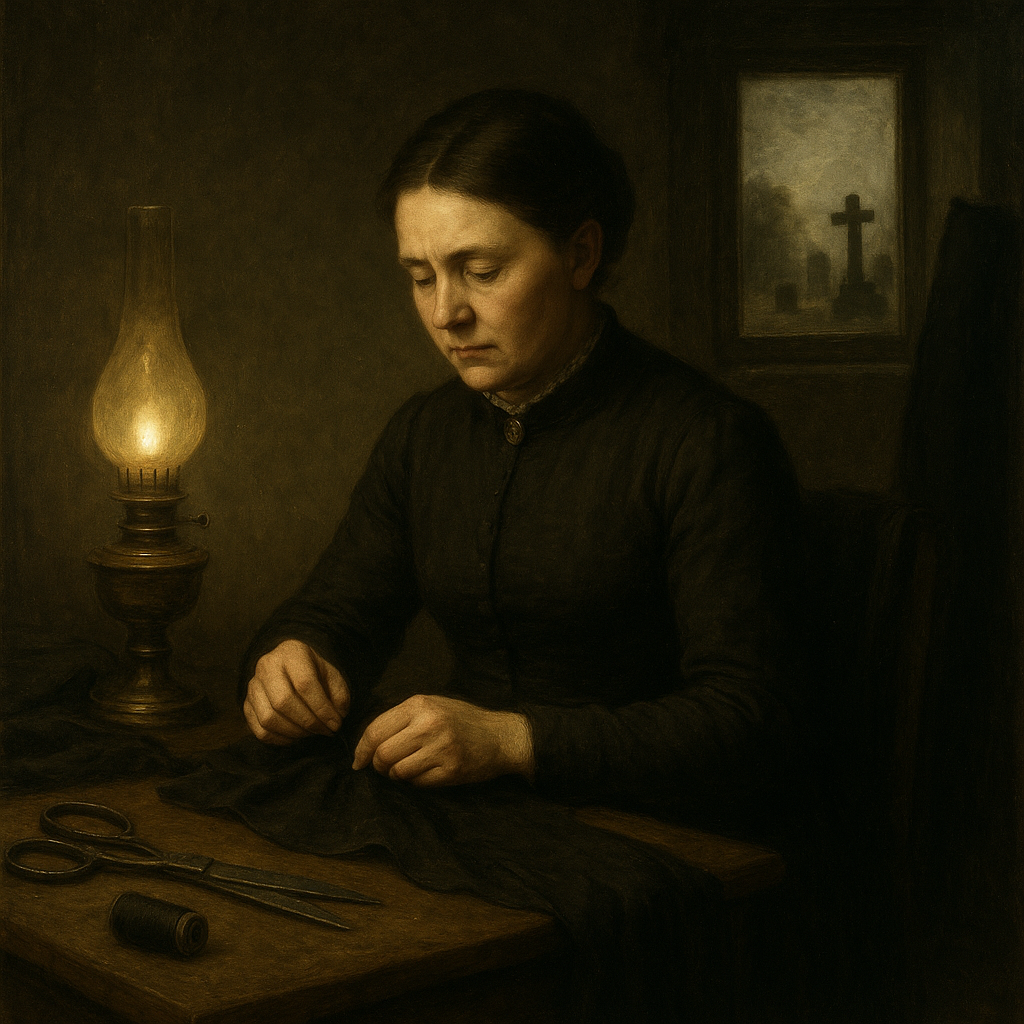
There has ever seemed to me a solemn virtue in black cloth. Crepe, most especially, possesses a character distinct from any other fabric; it does not merely cover, it absorbs, it quiets, it extinguishes the very notion of frivolity, as though silence itself had been translated into a garment. My hands, long accustomed to its weight, know its temper as another woman might know the pages of Holy Writ, turning them daily, reverently, without hesitation. And so it is that when calamity visits our parish—as calamity is wont to do—families look instinctively to me, and I account it both my Christian duty and my sober privilege to provide such garments as befit the mournful occasion.
It has been said—most graciously by the Reverend himself—that I am a benefaction to the community. “In our afflictions,” he observed on one melancholy Sunday, “we find in Mrs. **** not only a seamstress of uncommon skill, but a ministering spirit of consolation.” I blush to record such words, for I am no friend of vanity, yet I cannot but acknowledge their justice. For what would a funeral be, if conducted in disarray, without garments soberly fashioned, without due attention to the dignity of the deceased and the consolation of the living? Disorder, in life as in death, is unseemly; I merely preserve, with needle and thread, that order which must reign even in the shadow of the grave.
It is therefore my custom to keep, in constant readiness, a store of serge, bombazine, and mourning crepe in ample measure. There are those who regard such provision as a sign of morbidity. To my mind, it is prudence.
Affliction comes unsummoned, at its own hour, and it would be a cruelty indeed to delay a bereaved family for want of suitable cloth. It is a kindness, surely, to be prepared.
Through the passing years, I have had occasion to serve nearly every household in our little town. Old Mrs. Henley, whose gentle decline in the winter months seemed almost a falling asleep, was enfolded in a shawl of my design. The Dobson boy, struck down so suddenly by fever, was laid in the earth in a suit stitched at my work-table. Even the venerable Reverend Clay himself, when his time came, was borne to his rest in garments contrived by my own hand. I look upon these recollections not with sorrow, but with a grave satisfaction that I have discharged my office with propriety.
It is true that bridal gowns are sometimes commissioned of me, though with far less frequency. White satin has its admirers, but to my taste it is gaudy, excessive, and speaks too much of worldly delight. Black, in contrast, is a fabric of consequence—sober, enduring, free from ostentation. A bridal gown is an indulgence of a single day; mourning attire, by contrast, accompanies the wearer unto eternity.
Indeed, a walk through the graveyard is as good as a catalogue of my labours. Row upon row, the stones stand sentinel, beneath each one lying some fragment of my craft. The inscriptions weather, the names lose their sharpness, but the stitches—ah, the stitches hold! In moments of quiet reflection, I allow myself to consider that the churchyard is a gallery more lasting than any exhibition hall, and one wherein my handiwork enjoys a permanence denied to most mortal endeavour.
Neighbours will sometimes approach me even before necessity presses upon them. A cough lingers, a constitution falters, and they entreat me for some draught or cordial to ease their burden. It is no trouble. I mix what simples I have, tinctures to soothe the chest, tonics to quiet the restlessness. Yet Nature may prove obstinate, clinging with undue persistence, and in such cases a little gentle persuasion is required to bring matters to their rightful conclusion. The families return thereafter with gratitude, and I ask no payment for the medicine. It would be unbecoming. The garments, however, they settle for willingly, even with a certain eagerness.
Children, too, are drawn by curiosity to my shop, their eyes wide at the glint of scissors, the steady rhythm of needle through cloth. Their mothers chide them for intrusion, but I do not rebuke. It is meet that the young should learn something of order in a disordered world: that with patience, diligence, and a faithful hand, even life’s most ravelled seams may be brought to a fitting close.
It has been asked of me, more than once, whether the ceaseless succession of sorrows does not weigh upon my spirit. I answer candidly that it does not. Affliction is not without its grace, if rightly apprehended. Life is unruly, uncertain, given to unseemly excess; death, by contrast, is decorous, orderly, exact. And order, I think, is the truest language of Providence.
This evening, I make ready a gown for Mrs. Fletcher. She protests her good health, yet I have observed in her a pallor about the cheeks and a tremor in the hands that speaks otherwise. She has not yet discerned her condition, but in time she will. I find comfort in knowing that the garment will be waiting, complete and correct, when it is required.
It is, after all, a kindness to be ready.

Leave a comment