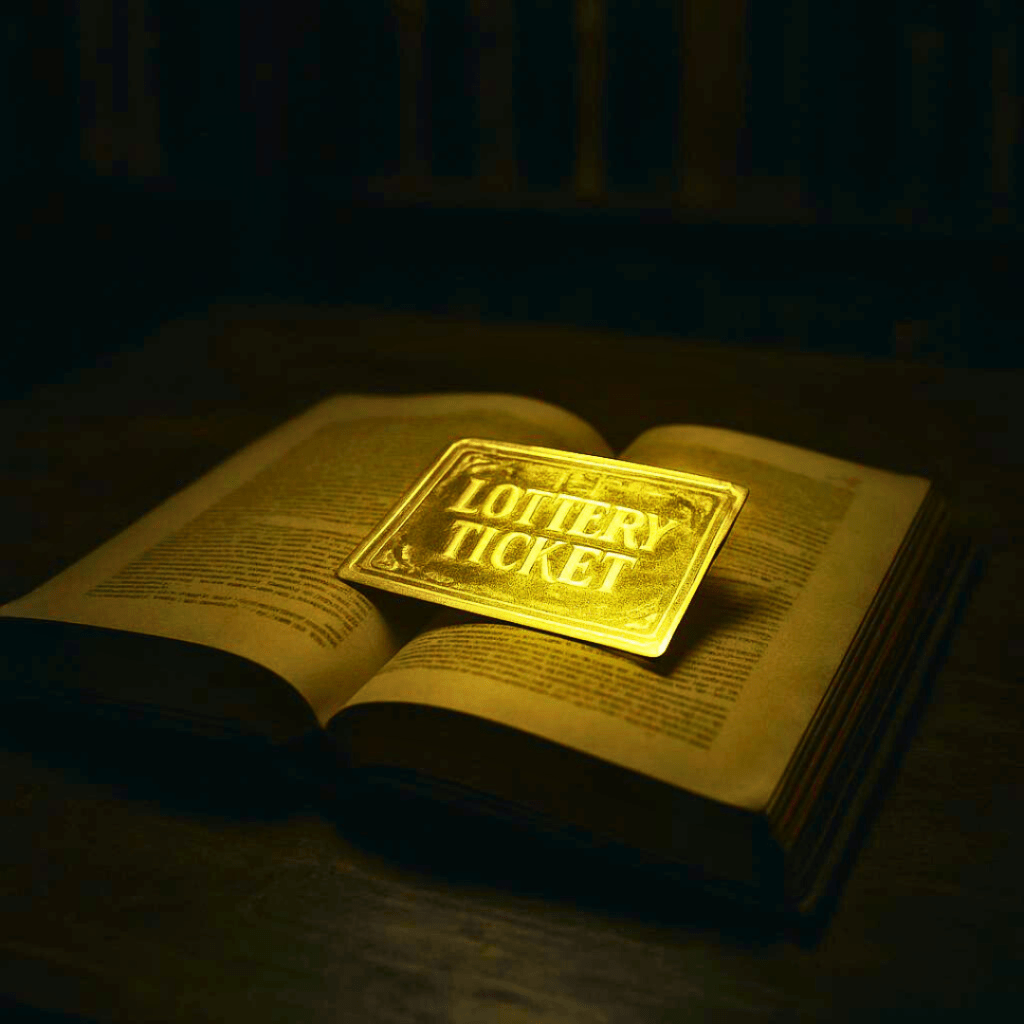
Helen found the ticket wedged between two library books on a Tuesday morning, golden and pristine against the worn spine of Pride and Prejudice. She might have handed it to the librarian—would have, normally—but Richard’s appointment was that afternoon, and her hands were already shaking.
The ticket felt heavier than paper should. The Catch: Where Fortune Meets Consequence, it read in elegant script. Below, in smaller print: All prizes guaranteed. All conditions binding.
She’d heard about The Catch, of course. Everyone had. The lottery that paid out exactly what it promised, down to the last penny, but always with a price that made headlines. The businessman who won fifty million but lost his eyesight. The teacher who gained ten million and spent two years in solitary confinement. Urban legends, surely.
But the ticket was real in her palm, and Richard was upstairs getting dressed for news they both dreaded.
“Ready, love?” His voice drifted down, carefully cheerful in the way that had become habit since the symptoms started.
“Just coming,” she called back, slipping the ticket into her handbag.
Dr Wallace’s office reeked of antiseptic and false hope. Helen held Richard’s hand while the consultant explained aggressive treatments, experimental procedures, costs that insurance wouldn’t touch. The numbers might as well have been spoken in Mandarin—hundreds of thousands, possibly more, no guarantees but without it…
“How long do we have to decide?” Richard asked.
“The sooner the better. These things move fast.”
In the car park afterwards, Richard sat staring at nothing. “We’ll find a way,” Helen said, her voice steadier than her pulse. “We always do.”
But there was no way, and they both knew it. Their modest savings might cover a month of treatment. The house had barely any equity. Richard’s illness had already forced early retirement; Helen’s part-time library work wouldn’t stretch to miracles.
That evening, while Richard dozed in front of the television, Helen looked up The Catch online.
The website was surprisingly professional. Clean graphics, testimonials from winners, detailed terms and conditions that made her skin crawl. Every prize came with a cost, clearly stated, legally binding. Winners had seven days to claim their money, exactly one year to pay their price.
She found the amount she needed: five million pounds. The condition was listed in the same pleasant font as everything else: Winner agrees to termination of life contract, fulfilled exactly 365 days after prize collection.
Helen closed the laptop and watched Richard sleep. His breathing was already more laboured than it had been a month ago.
She submitted the ticket online at midnight.
The call came three days later. A pleasant woman with a slight accent explained the collection process. The money would be transferred immediately upon signed agreement. The termination would be carried out professionally, at exactly 11:47 PM on the anniversary date—chosen, the woman explained, to match the precise timestamp of Helen’s submission.
“Any questions about the terms?”
Helen looked across the kitchen to where Richard was making tea, humming something off-key. “How do I know you’ll actually pay?”
“Mrs Pearson, we have an impeccable reputation. The money will be in your account within an hour of your signature.”
“And if I change my mind?”
“The contract is binding once signed. However, we understand this is a significant decision. You have until 5pm today to withdraw your claim.”
After the woman hung up, Helen sat at the kitchen table for ages. Richard brought her tea and kissed the top of her head.
“Everything alright, love?”
“Just thinking about cousin Margaret,” she heard herself say. “Remember her? From Scotland. Turns out she left me a bit in her will. Enough to get you sorted.”
The lie came so easily it surprised her.
She signed the papers at 4:30pm.
From a house across the street, the surveillance began. Routines noted, vulnerabilities assessed, security measures catalogued. Standard procedure. The target had made her choice; the rest was logistics.
The treatment began immediately. Private consultations, cutting-edge therapy, medications that cost more per dose than Helen used to earn in a month. Richard’s colour improved within weeks. His energy returned. Hope crept back into their conversations like sunlight through opening curtains.
Helen told everyone about cousin Margaret’s inheritance. Just enough to cover medical expenses, she explained. A blessing, really, though she wished they’d stayed in touch before Margaret passed.
The months fell into a rhythm. Richard’s appointments became progress reports rather than crisis management. Helen’s appointments were different—with lawyers, with accountants, with researchers about The Catch whose reputation, she discovered, was indeed impeccable.
The professional across the street noted the pattern. Medical facilities, private hospitals, expensive treatments. Interesting. Most targets spent their windfall on luxury—houses, cars, holidays. This one was buying time. Still had to die, of course, but the motivation was unusual.
She started having dreams about running. Different scenarios, elaborate plans. New identities, foreign countries, changed appearances. In her waking hours, she researched witness protection programmes, witness relocation myths. She learned about people who disappeared entirely, who built new lives from scratch.
The watcher catalogued each escape route Helen researched, noted every contingency plan. Thorough, if ultimately pointless. The contract was binding.
By month six, Richard was in remission.
By month nine, she had three different escape routes planned.
By month eleven, she’d begun to believe she might actually attempt one.
The professional had studied dozens of Catch winners over the years. The businessman who’d traded his sight for millions—pure greed, no sympathy there. The teacher who’d endured solitary confinement for her prize—ambition disguised as altruism. But Helen Pearson was different. Every penny was going to save someone else’s life. Completely selfless.
For the first time in a long career, the watcher made a decision. Helen Pearson had earned something the others hadn’t. The contract could go to hell.
Then, on a Tuesday morning exactly like the one where she’d found the ticket, Dr Wallace rang with new scans.
“I’m afraid there’s been a development,” he said, and Helen felt her world tilt.
The cancer had returned, aggressive and sudden. Not the same cancer—something new, something that suggested the original treatment had suppressed but not eliminated the underlying condition. They needed to act immediately. Different drugs, different procedures.
“How much?” Helen asked, though she already knew.
“Around a hundred thousand. Possibly more.”
There was silence after she hung up. Richard was in the garden, deadheading roses as if his life weren’t crumbling again.
Helen looked at her bank balance. Empty. Every penny of the winnings had gone to keeping Richard alive this long. The house, their car, her mother’s jewellery—all transformed into borrowed time.
That evening, she sat at her dressing table and opened her diary. If the treatment fails this time, she wrote, if I lose him, I can’t see a way forward. I’ve lived my whole adult life loving Richard. Without him, there’s just emptiness. I won’t burden anyone with a broken version of myself.
She closed the book and placed it in the drawer beside other papers she’d been collecting—documents Richard didn’t need to see, arrangements he’d never have to worry about.
In the house across the street, a figure moved away from the telephoto lens. Within an hour, lock picks made quick work of Helen’s back door. The diary lay open to her final entry. The professional read it twice, expression unchanging, then noticed the other documents beneath. Official letterhead, legal terminology, numbered clauses.
The mathematics were suddenly, brutally clear. Walk away, and both would die—Richard from cancer, Helen by her own hand. Complete the job, and only one would die, while the other lived.
The hesitation was over.
She had seventeen days left.
Helen stopped researching escape routes. She stopped having dreams about running. Instead, she planned a different sort of day.
“Let’s go to Whitmore Bay,” she told Richard on the morning of. “Like we used to.”
“Today? But the treatment—”
“Dr Wallace said we have a few days before the next session. Let’s have one perfect day.”
They packed sandwiches and drove to the coast where they’d spent their honeymoon thirty years earlier. The same bed and breakfast, the same clifftop walk, the same bench where Richard had proposed. Helen bought fish and chips from the same shop, now run by the original owner’s grandson.
She watched Richard feed seagulls and felt time slow down. Every gesture became precious: his laugh when the gulls grew aggressive, his hand reaching for hers during the walk, his voice humming their song from decades past.
“This has been perfect,” he said as the sun began to set. “Just like old times.”
“Better,” Helen said, and meant it.
They drove home slowly, Richard telling stories about their early years. Helen laughed at jokes she’d heard a hundred times, held his hand at traffic lights, memorised the way he looked in the golden hour light.
From a discreet distance, the professional watched them arrive home, saw Helen’s choice to spend her final hours in love rather than fear. The perfect day deserved a perfect ending.
At 11:30pm, they pulled into their driveway.
“I’ll put the kettle on,” Richard said, but Helen pulled him close first.
“I love you,” she said against his neck. “More than anything.”
“I love you too. What’s brought this on?”
“Just happy,” she said. “Just grateful.”
She was unlocking the front door when it happened. Quick and clean, exactly as promised. Richard was still laughing about something from their day, still reaching for the light switch, when Helen simply stopped.
The perfect day had been a gift to them both.
The coroner ruled it a sudden cardiac event. Tragic but not uncommon in women her age. Richard, devastated but practical, arranged a simple service. Their friends spoke about her kindness, her devotion, her quiet strength.
Three days after the funeral, Richard sat at the kitchen table opening sympathy cards and official letters. Most he set aside—flowers from neighbours, condolences from old colleagues. Then he found the envelope marked with the insurance company’s logo.
One hundred thousand pounds. Payable immediately upon death certificate.
Richard stared at the letter for ages. Helen had mentioned a small policy years ago, barely enough to cover funeral costs, she’d said. He’d forgotten about it entirely. But this—this was enough to complete his treatment. Enough to live.
He used every penny to fight the cancer. He recovered fully, went back to tending his garden, learned to cook properly for the first time in his life. He never remarried but stayed close to Helen’s sister and their children. He lived another fifteen years, healthy and mostly content, never quite understanding why Helen had seemed so intensely present during those final months.
He kept her pictures everywhere, told stories about their perfect last day to anyone who’d listen. In his telling, it became the culmination of a great love story—two people who’d found their way to complete happiness just before tragedy struck.
He never questioned the insurance policy that saved his life. Some gifts are meant to remain mysteries.
Some policies pay out exactly as intended.

Leave a comment