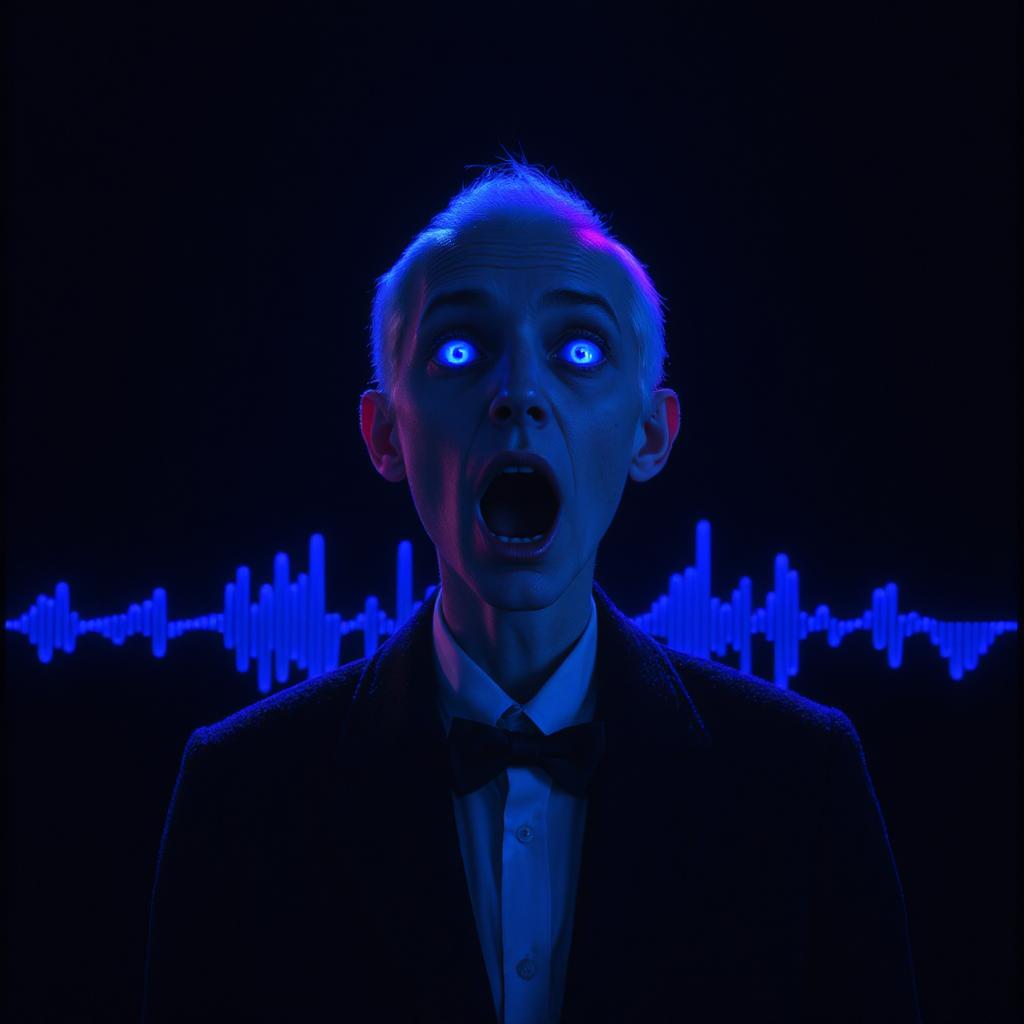
Theo noticed it during the third movement, when the soprano soloist’s voice should have cracked.
Not from strain—he’d mixed enough live recordings to know when a singer was pushing past their limits. This was different. Her mouth opened wider—really wide, in fact— as the note soared higher, but her throat remained perfectly relaxed. No tension in the neck muscles, no flutter of effort beneath her ribs.
He leant forward in his seat, adjusting his hearing aid to isolate the frequencies. Twenty years as a sound engineer had taught him to listen beneath the music, to hear what others missed. Tonight, what was missing was more disturbing than what he heard.
The audience sat unusually still. No shifting, no quiet coughs, no rustle of programmes. Even Mrs Henley from the community centre, who never stopped fidgeting, sat motionless in the front row, hands slack in her lap, eyes fixed on the performers with vacant contentment.
Theo pulled out his phone and started recording, though he wasn’t sure what he hoped to capture. Through the tiny speaker, the choir sounded ordinary—beautiful, but ordinary. Yet in the auditorium, something else moved beneath the harmonies. Not sound exactly, but a pressure that seemed to settle behind his eyes, gently probing.
A notification chimed softly—someone’s phone receiving a text. Then another. And another. But not one person checked. Their phones lay forgotten, screens lighting up like scattered coins, while their owners remained transfixed.
Theo glanced at his own screen. Three missed calls from his ex-wife, two work emails, a weather warning from the Met Office. He switched off the phone and slipped it into his pocket.
The conductor—a thin man whose baton movements seemed decorative—never looked at his singers. They needed no direction, no cues. Forty voices rose and fell in perfect synchronisation, each breath taken at precisely the same moment, each phrase shaped identically.
Too identically.
Theo had recorded the BBC Singers, the Welsh National Opera Chorus, chamber groups that had rehearsed together for decades. Even they showed tiny variations, microscopic differences in timing and tone that proved they were human. This choir had no such imperfections.
When the final note faded, the applause came automatically. Polite, measured, ending at precisely the same moment as if conducted by an invisible hand. The audience filed out with the same eerie synchronisation, faces serene, conversations muted.
Theo waited until the auditorium emptied, then made his way backstage.
The choir members stood in a loose group near the stage door, still in their black robes, speaking in soft murmurs that blended into a continuous hum. No laughter, no post-performance buzz, no complaint about the venue’s inadequate heating. They simply waited.
“Excuse me,” Theo approached the nearest singer, a baritone with prematurely grey hair. “Fantastic performance tonight. I’m a sound engineer—I’d love to know how you achieve that precision.”
The man turned towards him, and Theo’s breath caught. The eyes weren’t vacant exactly, but they gave nothing back. Like looking into dark water.
“We practise,” the singer said, his voice carrying the same measured cadence he’d used during the performance.
“Must be quite some practice routine. How long have you been singing together?”
“We practise,” the singer repeated, identical inflection, identical timing.
A woman beside him—the soprano soloist whose impossible high notes had first caught Theo’s attention—tilted her head slightly. “We practise,” she said, in exactly the same tone.
Then another voice: “We practise.”
And another: “We practise.”
The phrase rippled through the group like an echo, forty voices speaking as one, until the words lost all meaning and became pure sound. Theo felt that familiar pressure behind his eyes again, stronger now, insistent.
He stumbled backwards, suddenly desperate for fresh air.
“Sorry, I should—” But when he looked back, they had already turned away, moving towards the exit with that same unsettling coordination.
Theo followed at a distance, his heart hammering against his ribs.
The choir moved through the empty streets like a dark tide, their footsteps falling in perfect unison on the wet pavement. No chatter, no goodbyes, no peeling off in different directions as performers normally did after a show. They flowed as one entity towards the old quarter of town, past the closed shops and the few remaining streetlights that cast sickly orange pools on the cobblestones.
Theo kept to the shadows, cataloguing details. Their breathing synchronised even as they walked. When one stepped around a puddle, they all adjusted their path identically. A dog sleeping in a doorway whined and slunk deeper into the darkness as they passed.
They turned down a narrow alley that Theo knew ended in a brick wall. He’d lived in this town for fifteen years, knew every shortcut and dead end. There was no way through.
Yet when he reached the alley’s mouth, it was empty.
Theo stood staring at the blank brick wall, his breath misting in the cold air. Forty people couldn’t simply vanish. He walked the alley’s length, checking for doors, fire escapes, any possible exit. Nothing. The walls rose sheer on both sides, windows dark and barred.
He pressed his palm against the bricks where the choir should have met their dead end. The stone felt warm.
Behind him, a voice spoke with perfect pitch and timing: “We practise.”
Theo spun around. The alley stretched empty behind him, but the words seemed to hang in the air like a held note. His hearing aid crackled with feedback, then fell silent.
He ran.
He convinced himself he’d imagined it. Forty people couldn’t vanish through solid brick. The warm stone, the disembodied voice—stress, probably. He’d been working eighteen-hour days on the cathedral’s new sound system, and last night had unsettled him more than he’d admitted.
But the local paper’s events page showed no mention of any choir performance at the civic centre.
Theo drove to the venue. The manager, a harried woman named Carol who’d booked him for countless church services and wedding receptions, looked genuinely puzzled.
“Last night? No, nothing scheduled. The place was dark—I locked up myself around six.”
“But the performance—I was there. The Silent Choir, they called themselves.”
Carol pulled up her booking system on a desktop computer that wheezed like an old accordion. “Nothing here, Theo. Haven’t had a musical event all week.”
He described the performance, the perfect harmonies, the forty singers in black robes. Carol’s frown deepened.
“That’s odd. We’ve had enquiries about a group like that—people asking if we’ve hosted them. But I’ve never actually booked them.” She scrolled through her emails. “Look, here’s one from last month: ‘Wondering if you could tell me when the Silent Choir will next perform at your venue.’ And another: ‘My mother attended one of their concerts but can’t remember when the next one is.’”
Theo felt something cold settle in his stomach. “What did you tell them?”
“That we’d never heard of any Silent Choir.”
That evening, Theo returned to the alley with a proper torch and his digital recorder. In daylight, the dead end looked ordinary—weathered brick, a few weeds, nothing mysterious. But as darkness fell, he began to notice things.
The temperature. The alley was warmer than the surrounding streets, not by much, but enough. And there was a sound—not quite silence, but the faintest suggestion of harmony, so low it might have been distant traffic.
Theo pressed his ear to the wall where the choir had vanished. The brick thrummed with almost inaudible resonance, a frequency so deep he felt it in his bones rather than heard it. He switched on his recorder and held it against the stone.
Through his headphones, the subsonic drone was clearer—not mechanical, but organic. Structured. Like voices singing notes too low for human vocal cords, a bass line that descended into ranges no earthly choir could reach.
His hearing aid began to whine. The high-pitched feedback grew louder, more insistent, until Theo yanked the device from his ear. In the sudden relative silence, he could hear something else: footsteps. Measured, synchronised, growing closer.
But the alley remained empty.
The recorder’s battery died with a soft click. His torch dimmed. And somewhere in the darkness beyond the orange streetlights, voices began to rise in perfect, impossible harmony.
Theo stumbled backwards, then forced himself to stop. Think like an engineer. What did he actually know?
The choir appeared without bookings, performed without permits, and left audience members with fragmented memories. His equipment failed in their presence. The wall retained their resonance hours after they’d vanished. And those enquiries Carol had shown him—people asking about performances they couldn’t quite remember attending.
He needed to find those people.
Searching back issues of the local paper, Theo found no reviews of the Silent Choir, no advertisements, no mention of their performances. But in the letters section, he found traces.
“Could anyone tell me when the wonderful choir will be performing again? I attended their concert last month but seem to have mislaid the programme.”
“My wife has been asking about a choir she heard recently—says it was the most beautiful music she’d ever experienced. Unfortunately, she can’t remember where or when it took place.”
“Looking for information about a choir that performed somewhere in town recently. My husband attended but has been rather vague about the details.”
Rather vague. Theo found twelve such letters over the past six months, all following the same pattern: someone had attended a memorable musical performance but couldn’t remember the specifics.
But Theo didn’t need to track down strangers. He’d seen Mrs Henley at the performance, noticed her uncharacteristic stillness. She lived just three streets away.
Mrs Henley answered her door on the first knock, moving with the same measured precision he’d observed at the newsagent. Her usual chatter was replaced by careful politeness.
“Silent Choir? No, I don’t… well, perhaps. There was something…” Her voice carried that same cadence he’d heard from the singers. “We practise,” she said suddenly, then seemed surprised she’d spoken. “Sorry, what were we discussing?”
Theo’s stomach dropped. “Mrs Henley, do you remember being at the civic centre two nights ago?”
She tilted her head with mechanical curiosity. “The civic centre? I don’t recall. Though I do feel I’ve heard the most beautiful music recently. We practise,” she repeated, and this time she didn’t seem surprised at all.
Theo backed away from the door. Mrs Henley watched him go with that same serene, empty expression, then closed the door with a soft click.
He tried two of the newspaper letter writers next. The first, an elderly man named Arthur Pembroke, gave identical responses. The second number had been disconnected. The third went straight to an answerphone message delivered in perfect, emotionless diction: “We cannot come to the phone. We practise.”
Theo’s hands shook as he hung up.
That evening, he positioned himself on the high street with his best recording equipment—proper microphones, a digital mixer, backup batteries. If the choir appeared again, he’d document everything. But as nine o’clock approached, then ten, then eleven, the streets remained stubbornly ordinary.
Just before midnight, he heard it: that subsonic drone rising from beneath the town. Not from the alley this time, but from everywhere and nowhere. The frequency climbed slowly, joined by others, until the air itself seemed to vibrate with harmonies no human throat could produce.
Car alarms began to wail. House windows rattled in their frames. Dogs howled in the distance.
Then, as suddenly as it had begun, the sound stopped.
Theo checked his equipment. Every device had recorded nothing but silence.
In the morning, he drove through town cataloguing the aftermath. The car alarms had been switched off, the dogs were quiet, and people went about their business with that same serene, vacant expression he’d seen in the civic centre audience.
At the newsagent’s, he bought a paper from a woman whose movements were economical, whose smile never wavered. “Lovely morning,” she said in that measured tone he was beginning to recognise.
“We practise,” replied the man behind him in the queue, apropos of nothing.
The woman nodded as if this were perfectly normal conversation.
Theo’s blood turned to ice. It wasn’t just the choir members. They were spreading.
He drove straight home and pulled out his studio equipment—the serious kit he used for cathedral acoustics, not the portable gear that had failed him. If this was about frequency, about sound waves manipulating human consciousness, then he needed to understand exactly what he was dealing with.
Theo spent the day analysing every recording he’d made, running spectral analysis on the few seconds of audio captured before his equipment had mysteriously failed. Most showed nothing unusual, just standard waveforms. But when he isolated the lowest frequencies and amplified them, patterns emerged.
Perfect mathematical relationships. Harmonic sequences that followed no known musical theory but created interference patterns designed to synchronise brainwaves.
Noise-cancelling headphones worked by generating inverse sound waves. If Theo could identify the choir’s exact patterns, he could create a counter-signal. An audio antidote.
He worked through the afternoon, programming his digital mixer with phase-inverted frequencies, building a real-time filter that would strip away the choir’s subsonic influence. The mathematics were complex, but the concept was simple: for every wave they generated, he’d produce its exact opposite.
As evening approached, Theo loaded his equipment into the van. If his theory was correct, the choir would perform again tonight—they seemed to operate on some kind of cycle, returning when the town’s resistance was at its lowest. He positioned himself in the civic centre car park with his mixer, headphones, and a pair of powerful speakers.
At eleven forty-seven, the subsonic drone began.
Theo’s fingers flew across the mixing board, adjusting frequencies, matching phase inversions to the incoming signal. Through his headphones, he could hear both soundscapes at once: the choir’s hypnotic perfection and his own chaotic counter-melody cancelling it out.
The effect was immediate. Car alarms stayed silent. No windows rattled. And in the distance, he could hear something impossible: the choir singing slightly out of tune.
A soprano soloist wavered on a high note. A bass voice cracked with strain. For the first time, they sounded human.
Then they sounded angry.
The subsonic frequency shifted, climbing higher, becoming audible. Theo’s counter-signal struggled to keep pace. His mixing board sparked, several faders melting under the sudden heat. The choir’s true voice was breaking through—no longer beautiful, no longer human, but something vast and hungry.
Through his failing headphones, Theo heard footsteps in perfect unison, growing closer. Forty voices speaking as one: “We practise. We practise. We practise.”
He had perhaps thirty seconds before his equipment gave out entirely. Thirty seconds to decide whether to run or to broadcast his counter-signal on every frequency he could reach—knowing it might save the town, but almost certainly destroy his mind in the process.
Theo reached for the master volume control.
The footsteps stopped.
In the sudden silence, a single voice spoke directly behind him: “We heard you.”
Theo spun around, his hand still gripping the master volume. A figure stood silhouetted against the car park lights—the conductor from the civic centre, no longer smiling, no longer pretending to be human.
“You understand frequencies,” the thing said, its voice carrying harmonics that shouldn’t exist in a single throat. “You could help us reach more minds. The mobile networks, the radio towers, the digital infrastructure your kind has built. Imagine our song spreading instantly to every device, every ear.”
Theo’s finger hovered over the volume control. His counter-signal was still holding, keeping their influence at bay, but his equipment was failing. Smoke rose from the melting circuit boards.
“Join us,” the conductor continued, stepping closer. “Or watch your town become the first of many. Your Emergency Alert system tests at three pm on Saturday, doesn’t it? Such a perfect opportunity. Every phone in the country, every radio, every television. All playing our song at precisely the same moment.”
The 7th of September. Two days away.
“We have been practising for this,” the conductor smiled, and behind him, Theo could see the rest of the choir materialising from the shadows. Forty figures in perfect formation, their mouths beginning to open.
Theo twisted the master volume to maximum and threw himself behind his van as his speakers screamed his chaotic counter-harmony into the night. The sound was ugly, discordant, magnificently human in its imperfection.
The choir’s formation scattered. Several figures stumbled, their synchronisation broken. For a moment, Theo heard individual voices crying out in confusion, as if forty separate people had suddenly woken from the same dream.
Then his speakers exploded in showers of sparks and plastic.
In the ringing silence that followed, Theo found himself alone in the car park, surrounded by the smoking remains of his equipment. But in his jacket pocket, his phone buzzed with an incoming text.
He pulled it out with trembling fingers. The message was from an unknown number:
“Emergency Alert Test scheduled for 15:00, 7 September 2025. This is a test. This is only a test. We practise.”
The screen flickered and went dark.
Theo’s van roared to life. He knew exactly where the emergency broadcast transmitter was—he’d done maintenance work on the mobile tower’s audio systems two years ago. If he could reach the control room, patch his equipment directly into the transmission array…
The road to the tower wound uphill through empty streets. Too empty. Theo’s headlights swept across drawn curtains and darkened windows, but occasionally he caught glimpses of pale faces pressed against the glass, watching with identical expressions of serene interest.
The tower’s security gate stood open.
Theo parked at the base of the structure and looked up. Forty metres of steel and concrete, topped with arrays of dishes and antennas that could reach every device in the county. Red warning lights blinked steadily against the starless sky.
Inside the control building, the emergency broadcast computer was already active. The screen showed a countdown timer: 39:17:42. Thirty-nine hours until the Saturday test.
But someone had modified the system. New audio files had been uploaded, their waveforms displaying as perfect, mathematical sine waves. The Silent Choir’s song, ready to broadcast at exactly 3pm.
Theo connected his equipment, fingers shaking as he began programming the phase inversion algorithms. He had the frequencies mapped, the counter-signal calculated. All he needed was—
The lights went out.
Emergency power kicked in a second later, bathing the control room in red. And in that crimson glow, Theo saw them. The choir stood in perfect formation around his equipment, having entered without making a sound.
The conductor stepped forward, no longer bothering with its human mask. Its mouth opened impossibly wide, and from deep within its throat came a sound like the universe screaming.
Theo’s hand slammed down on the emergency broadcast button.

Leave a comment