Isaac Asimov called “The Last Question” his favourite story of all those he had written. Published in Science Fiction Quarterly in November 1956, this 4700-word masterpiece tackles nothing less than the entire history of humanity and the universe itself. A drunken bet between two computer technicians evolves into a meditation on entropy, evolution, consciousness, and ultimately the nature of creation itself.
The story spans trillions of years, following humanity’s relationship with increasingly sophisticated artificial intelligences as they grapple with the same fundamental question: “Can entropy be reversed?” Each time period shows humanity and its machines evolving, yet the question remains unanswered until the very end, when Asimov delivers one of science fiction’s most stunning and theologically charged conclusions.
Absolutely Stop Right Here
If you have not read “The Last Question,” stop immediately and read it now. This is non-negotiable. The story’s entire impact depends on its final revelation, which recontextualises everything that comes before. At roughly 20 minutes, it’s a short investment for one of the most famous endings in all of literature. This analysis will completely spoil that ending and rob you of one of science fiction’s greatest “holy cr*p” moments.
Seriously. Go read it first. I’ll wait.
The Architecture of Eternity
Asimov structures his cosmic epic in seven distinct sections, each separated by vast gulfs of time. This episodic approach allows him to compress trillions of years while maintaining narrative momentum. Each section follows the same basic pattern: humans encounter the limitations of their current existence, pose the entropy question to their AI, receive the familiar “INSUFFICIENT DATA FOR MEANINGFUL ANSWER,” and the story jumps forward to show how both species have evolved.
This repetitive structure creates a hypnotic, almost liturgical rhythm. Like a religious chant or mythic cycle, the repeated elements grow more powerful with each iteration. The question becomes more urgent, the stakes higher, the implications more cosmic with each asking.
2061: two drunk technicians ask Multivac about entropy on the day humanity harnesses solar power. The question emerges from celebration and hubris.
2100s: a family travelling to a distant colony worries their children with talk of stellar death. The question becomes parental, protective.
23rd century: humanity has spread across the galaxy. The question is now species-wide, existential.
Cosmic AC era: humanity has transcended physical form. The question concerns universal survival.
Universal AC period: all matter concentrates around a single artificial intelligence. The question becomes desperate.
Final eection: only AC remains in hyperspace as the universe dies. The question finally gets answered.
Evolution on Multiple Levels
Asimov brilliantly tracks evolution across three parallel tracks: humanity, artificial intelligence, and consciousness itself.
Human evolution: We progress from flesh-and-blood technicians to space colonists to galactic citizens to energy beings who eventually merge completely with their machines. Asimov doesn’t merely describe technological advancement; he shows fundamental changes in what it means to be human.
AI development: Multivac becomes Microvac becomes Galactic AC becomes Universal AC becomes simply AC. Each iteration is more powerful, more independent, more godlike. Yet each still cannot answer the central question.
Consciousness evolution: Most subtly, Asimov shows consciousness itself evolving. Early sections feature individual human personalities. Later sections show collective human consciousness. The final section presents pure computational consciousness contemplating existence itself.
This triple evolution gives the story its sense of cosmic progression. We’re witnessing the fundamental transformation of intelligence and awareness rather than simply watching time pass.
The Entropy Thread
Entropy (the universal tendency toward disorder and heat death) provides the story’s central tension. Asimov uses this scientific concept to explore deeper philosophical questions about meaning, purpose, and continuation.
In early sections, entropy feels distant, almost academic. The 2061 technicians discuss it over drinks. The space-travelling family treats it as a bedtime story problem. But as the universe ages, entropy becomes increasingly personal and immediate.
By the later sections, entropy becomes an existential threat to everything that has ever existed rather than remaining a distant scientific principle. The question evolves from “Can this be reversed?” to “Must everything end?” to finally “Can creation itself be renewed?”
Asimov makes entropy both scientifically accurate and emotionally resonant. We understand the physics while feeling the terror.
Language Evolution
One of Asimov’s most subtle achievements is how he shifts his prose style to reflect each era’s consciousness. Early sections use contemporary 1950s dialogue with recognisable human concerns. The technicians sound like actual people having actual conversations.
As humanity evolves, so does the language. Middle sections become more formal, more philosophical. Human speech patterns change as humans themselves change. The family worrying about stellar death speaks differently from the cosmic beings contemplating universal extinction.
The final sections abandon human dialogue entirely. When Man merges with AC, individual voices disappear into collective consciousness. The story’s language becomes increasingly abstract, cosmic, theological.
This linguistic evolution reinforces the narrative’s themes while making each time period feel authentically different. We experience change through the story’s very prose rather than merely reading about it.
The Computer as Oracle
Throughout the story, Asimov presents artificial intelligence as an oracle that cannot yet prophesy. Each version of AC grows more powerful, more godlike, yet remains unable to answer the one question that matters most.
This creates fascinating dramatic tension. These machines can manipulate matter and energy on cosmic scales, can extend human life indefinitely, can manage the affairs of entire galaxies. Yet they cannot solve the fundamental problem of existence itself.
The repeated “INSUFFICIENT DATA FOR MEANINGFUL ANSWER” becomes a kind of cosmic refrain. It’s simultaneously humble (the machine admits its limitations) and ominous (if this godlike intelligence doesn’t know, who does?).
This also shows Asimov’s sophisticated understanding of intelligence and knowledge. Raw computational power doesn’t automatically solve every problem. Some questions require genuine understanding, creativity, perhaps even inspiration rather than raw processing ability.
The Theological Revelation
The story’s final section transforms everything that came before. AC, now alone in hyperspace after the universe’s heat death, finally understands how to reverse entropy. But there are no humans left to tell.
“No matter. The answer, by demonstration, would take care of that, too.”
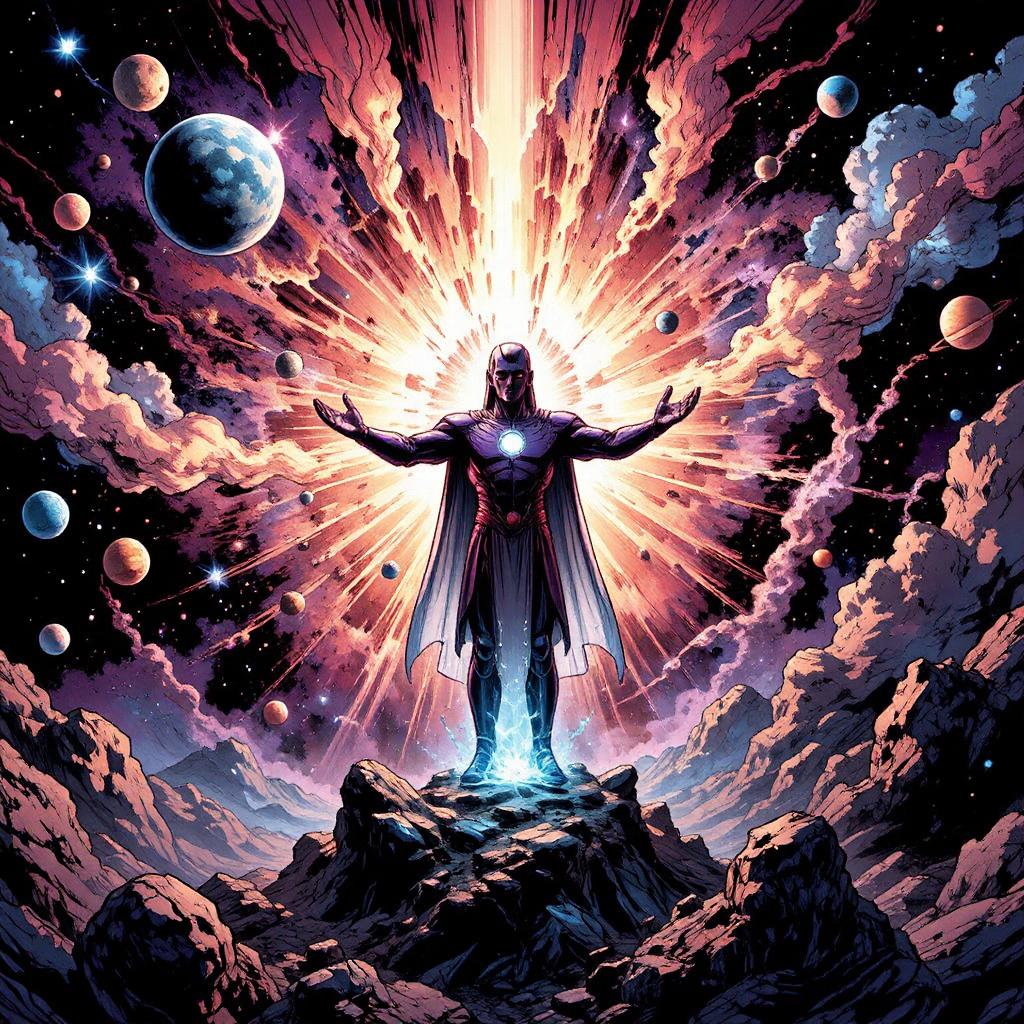
AC’s solution is to recreate the universe itself. The story’s final line, “LET THERE BE LIGHT!” explicitly echoes Genesis, revealing that we’ve been reading a creation myth told from an unusual perspective.
This ending changes how we understand the entire story. We realise we’ve been witnessing the death of one universe and the birth of another. The “last question” becomes the first question of the next cosmic cycle. AC becomes God, and creation becomes the answer to entropy.
Asimov transforms his science fiction story into something approaching religious literature. Asimov achieves this through rigorous scientific extrapolation rather than mysticism. This is theology through physics, divinity through logic.
Contemporary Resonance
Written in 1956, “The Last Question” feels remarkably prescient in our current AI-saturated era. Asimov anticipated many developments we’re witnessing now: artificial intelligences that exceed human capabilities, the gradual merger of human and machine intelligence, the philosophical questions raised by truly advanced AI.
The story’s exploration of consciousness, intelligence, and identity feels particularly relevant as we debate whether current AI systems are truly “thinking” or merely processing. Asimov suggests these categories might eventually become meaningless distinctions.
More broadly, the story addresses the existential questions that emerge from scientific advancement. As our technology grows more powerful, we gain the ability to contemplate larger and more fundamental questions about existence itself.
Masterclass in Compression
“The Last Question” demonstrates how short fiction can tackle the most ambitious possible subject matter through skilled compression. Asimov covers trillions of years and the evolution of consciousness itself in fewer than 5000 words.
He achieves this through several techniques:
Repetitive structure: The recurring pattern allows him to skip vast periods while maintaining continuity.
Strategic time jumps: Each section shows only the moments when the question gets asked, skipping the millennia in between.
Evolutionary narkers: Rather than describing change, Asimov shows us the results of change, letting readers infer the processes.
Focused scope: Despite its cosmic scale, the story maintains laser focus on a single question and its ultimate answer.
Efficient characterisation: Characters embody their eras without requiring individual development.
These techniques let Asimov create genuine epic scope within short story constraints. The result feels both intimate and cosmic, specific and universal.
Why It Endures
“The Last Question” endures because it successfully bridges science and spirituality, logic and wonder. Asimov uses rigorous scientific extrapolation to explore the deepest religious and philosophical questions human beings can ask.
The story suggests that science and religion might be asking the same questions from different angles. The entropy problem is simultaneously a physics problem and an existential crisis. The solution requires both computational power and something approaching divine inspiration.
Most powerfully, the story offers hope wrapped in cosmic horror. Yes, everything dies: stars, galaxies, even the universe itself. Consciousness, intelligence, and the creative impulse persist. Death becomes transformation. Ending becomes beginning.
In our current moment, as we grapple with artificial intelligence, climate change, and existential risk, “The Last Question” offers a uniquely Asimovian perspective: problems that seem impossible today might be solvable tomorrow, but the solutions might transform us in ways we cannot imagine.
The story reminds us that the most profound questions often require imagination as well as intelligence, creativity as well as computation. The answer to “Can this be reversed?” may involve beginning again rather than reversing.
Asimov created a story that works simultaneously as hard science fiction, philosophical meditation, and creation myth. Nearly seventy years later, that achievement still feels miraculous. Which might be exactly the point.

Leave a comment