When Patrick O’Brian published Samphire in 1950, he created one of literature’s most chilling portraits of domestic psychological abuse. This represents a different kind of horror entirely: the much more frightening reality of a marriage where one partner systematically destroys the spirit of the other through relentless, cheerful domination.
The story follows Molly, whose husband Lacey forces her to confront her crippling fear of heights by dragging her up increasingly dangerous cliffs. Seemingly innocent botanical enthusiasm becomes a study in how psychological cruelty can push someone beyond their breaking point.
Stop Right Here
If you haven’t read Samphire, stop now and read it. At about 4,000 words, it’s roughly a 20-minute read. This analysis discusses the story’s shocking climax and devastating aftermath, so make sure you’ve read it, and don’t let me spoil O’Brian’s masterful psychological crescendo.
The Anatomy of Control
O’Brian opens with the couple standing on a precipice, literally and metaphorically. Lacey spots samphire growing on the cliff face and becomes obsessed with pointing it out to his wife. His voice is “high, rather unmasculine,” and he emphasises his words with the insistence of someone who desperately needs to be right about everything.
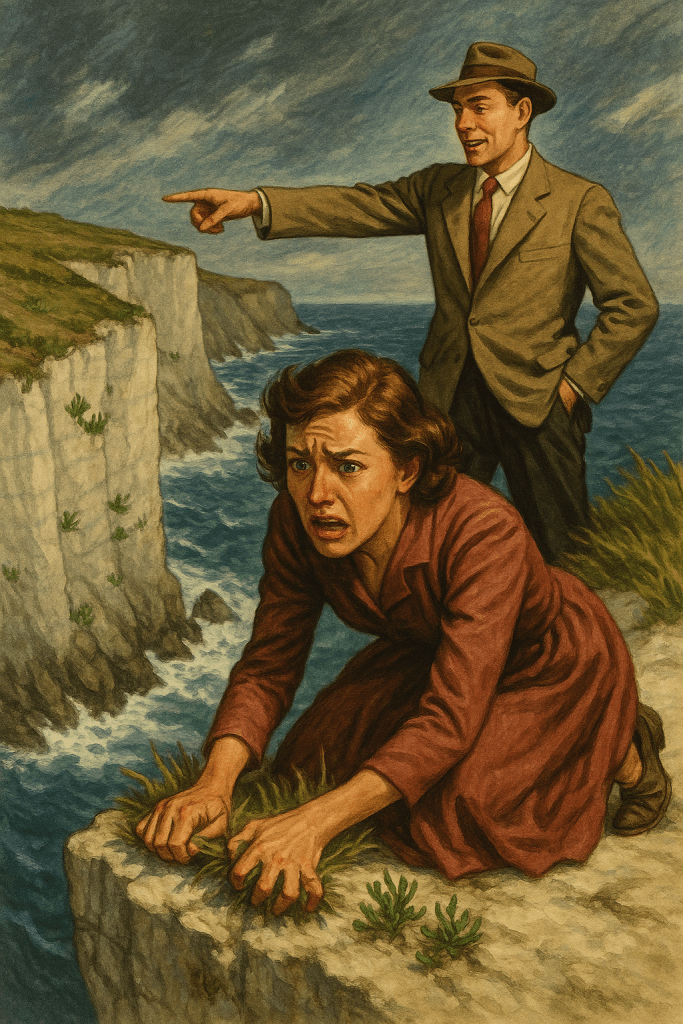
Molly’s response tells us everything we need to know about their relationship. “The round of her chin was trembling like a child’s before it cries: there was something in her throat so strong that she could not have spoken it if it had been for her life.”
O’Brian shows us control disguised as care. Lacey forces Molly to overcome her acrophobia “for her own good.” He’s proud of his success in making her climb higher and higher cliffs despite her terror. He sees this as progress, victory over her “weakness.” We recognise it as clear abuse.
The Cliff as Metaphor
The cliff setting works on multiple levels. Clearly, it represents the danger Molly faces in her marriage. More subtly, it symbolises how Lacey has pushed their relationship to an unsustainable edge. Every conversation brings them closer to a precipice neither of them can see.
Molly’s acrophobia becomes a perfect metaphor for her psychological state. She “clung insanely to the thin grass” when forced to look over the edge. This physical terror mirrors her emotional desperation: she’s holding on by threads in a relationship that terrifies her.
The height also amplifies every sensation. The wind, the crashing waves far below, the vertigo. Everything feels more intense and dangerous up there. O’Brian uses this to show how abuse makes everything feel precarious.
Lacey’s Oblivious Tyranny
Lacey is so chilling because of his complete lack of self-awareness. He genuinely believes he’s helping Molly by forcing her to confront her fears. He calls himself her “lord and master” with playful affection, never recognising the genuine dominance behind the joke.
His enthusiasm for the samphire expedition reveals his essential selfishness. He’s excited about showing off his botanical knowledge. About being right, and about proving his expertise. Molly’s terror is simply an obstacle to overcome, not something deserving genuine consideration.
O’Brian captures this perfectly through Lacey’s speech patterns. He talks constantly, asks rhetorical questions, demands agreement. “You noted the fleshy leaves, didn’t you, Molly?” He wants compliance, never genuine conversation.
The Terrible Intimacy of Marriage
The writer captures how the most devastating abuse can often come from those closest to us. Lacey knows exactly how to manipulate Molly because he knows her so well. He understands her fear of heights, her desire to please and takes advantage of her fundamental goodness.
The most disturbing element of the story is how Lacey weaponises intimacy. He touches her “with difficulty” when she recoils, calls her pet names while ignoring her obvious distress. The marriage becomes a prison disguised as protection.
When Molly finally snaps and pushes him, O’Brian shows us the explosive result of accumulated psychological pressure. The violence erupts from desperation, from being pushed beyond all endurance.
The Horror of Recognition
The story’s climax is devastating precisely because Lacey survives. In that moment when he realises what Molly has done, his entire persona collapses. The confident bully becomes “a very old terribly frightened comforting-itself small child.”
His pathetic pleading (“It was an accident, wasn’t it, Molly?”) reveals the hollow core beneath his bluster. Stripped of his position of dominance, he becomes pure fear and weakness. The very qualities he despised in his wife now consume him completely.
Molly’s response is equally chilling. She walks away in silence, “her dying face turned to the ground.” The attempted murder has killed something in her as surely as if she’d succeeded. She’s crossed a line she can never uncross.
The Aftermath of Violence
O’Brian refuses to provide easy answers about what happens next. Lacey knows what Molly tried to do. Molly knows she’s capable of murder. How do you continue a marriage after that revelation?
This marriage was always heading toward violence. Lacey’s psychological abuse created the very desperation that nearly destroyed him. The cliff merely provided the opportunity for the inevitable.
O’Brian also reveals the tragedy of two people trapped by their own limitations. Lacey’s need to dominate and Molly’s inability to resist have created a dynamic that can only end in destruction.
Why It Still Matters
Samphire remains relevant because domestic psychological abuse hasn’t disappeared. We still see relationships where one partner systematically undermines the confidence of the other, where “help” becomes control and where love is used as justification for cruelty.
The tale shows how this abuse operates through seemingly normal interactions. Lacey never raises his voice or his hand. He uses encouragement, pet names, gentle persistence. The violence is all psychological until Molly finally responds with her own violence.
The story serves as a warning about the cumulative effect of small cruelties. Each individual incident seems minor, just a husband encouraging his wife to overcome her fears. But the pattern reveals something much darker: the systematic destruction of another person’s autonomy.

Leave a comment