The parlour clock had struck nine when young William Fairfax crept through the heavy oak doors, drawn by the promise of forbidden territory. The grand parlour was strictly out of bounds after dinner, but the gas lamps cast such curious shadows through the etched glass panels, and Duchess had been mewing so plaintively from within.
He found the tortoiseshell cat perched upon the horsehair sofa, her green eyes bright with ancient wisdom. William had spent countless evenings in this room with Duchess, and it was remarkable how he always seemed to gain entry without the servants noticing. The cat was the only creature in the house who ever seemed to take any notice of him.
“There you are, old girl,” he whispered, settling beside her on the Persian rug. The gaslights flickered as though disturbed by some unfelt draught, casting dancing patterns across the dark wooden panelling. “Shall we have another game?”
Duchess purred and rubbed against his shoulder. William had always found it rather odd how the household staff, always so occupied with their duties, would walk past without so much as a glance in his direction, even when he stood directly in their path. Mama had grown similarly distant of late, her eyes seeming to look through him during their conversations. But children were meant to be seen and not heard, after all, so he supposed it was merely the natural order of things.
The sound of approaching footsteps echoed through the corridor—several pairs, moving with the measured solemnity of a funeral procession. William’s stomach clenched with sudden panic. If Papa discovered him here…
“Quickly, Duchess,” he hissed, scrambling toward the heavy velvet curtains that framed the tall windows. The cat followed with fluid grace, and together they pressed into the shadowy alcove behind the drapes.
The parlour doors swung open with their familiar creak, admitting four figures dressed in the solemn black of formal mourning attire. Papa entered first, his silver whiskers trembling with barely contained emotion, followed by Mama, who clutched a lace handkerchief with white-knuckled fingers. Behind them came Uncle Theodore and a woman William did not recognise—a thin, severe creature with steel-grey hair and pale, calculating eyes.
“Mrs Blackwood,” Papa was saying, his voice thick with grief, “we are most grateful for your assistance in this matter. The loss has been… considerable.”
The strange woman nodded gravely, her gaze sweeping the room with professional assessment. “The spiritual veil grows thin in places touched by sudden departure, Mr Fairfax. If the lad’s essence lingers in this earthly realm, we shall discover it.”
William frowned at her curious words. What lad? He knew of no other children in the household.
The adults arranged themselves around Papa’s writing desk, which had been cleared of its usual papers and set with a collection of curious objects—candles of black wax, a tarnished silver bell, and what appeared to be a small mirror framed in oxidised copper. Mrs Blackwood took her place at the head of this makeshift altar, her pale hands extended toward the flickering flames.
“We gather in communion with the departed,” she intoned, her voice dropping to a theatrical whisper. “Let all present join hands and open their hearts to those who have passed beyond the veil.”
The circle formed with solemn precision. In the shadows, William found himself holding his breath, though he could not say why. The air in the room seemed to thicken, weighing heavily upon his chest. Duchess drew closer to his legs, her purr vibrating through the silence like a distant engine.
“Spirit of this house,” Mrs Blackwood continued, her eyes rolling back until only the whites showed, “we call upon you to make your presence known. If you hear our voices, if you linger still in this place of love and memory, grant us a sign.”
The candle flames guttered, touched by invisible fingers. William felt a peculiar sensation, as if something had stirred deep within his chest—a flutter like wings beating against his ribs. Papa’s breathing grew laboured, and Mama’s handkerchief trembled against her lips.
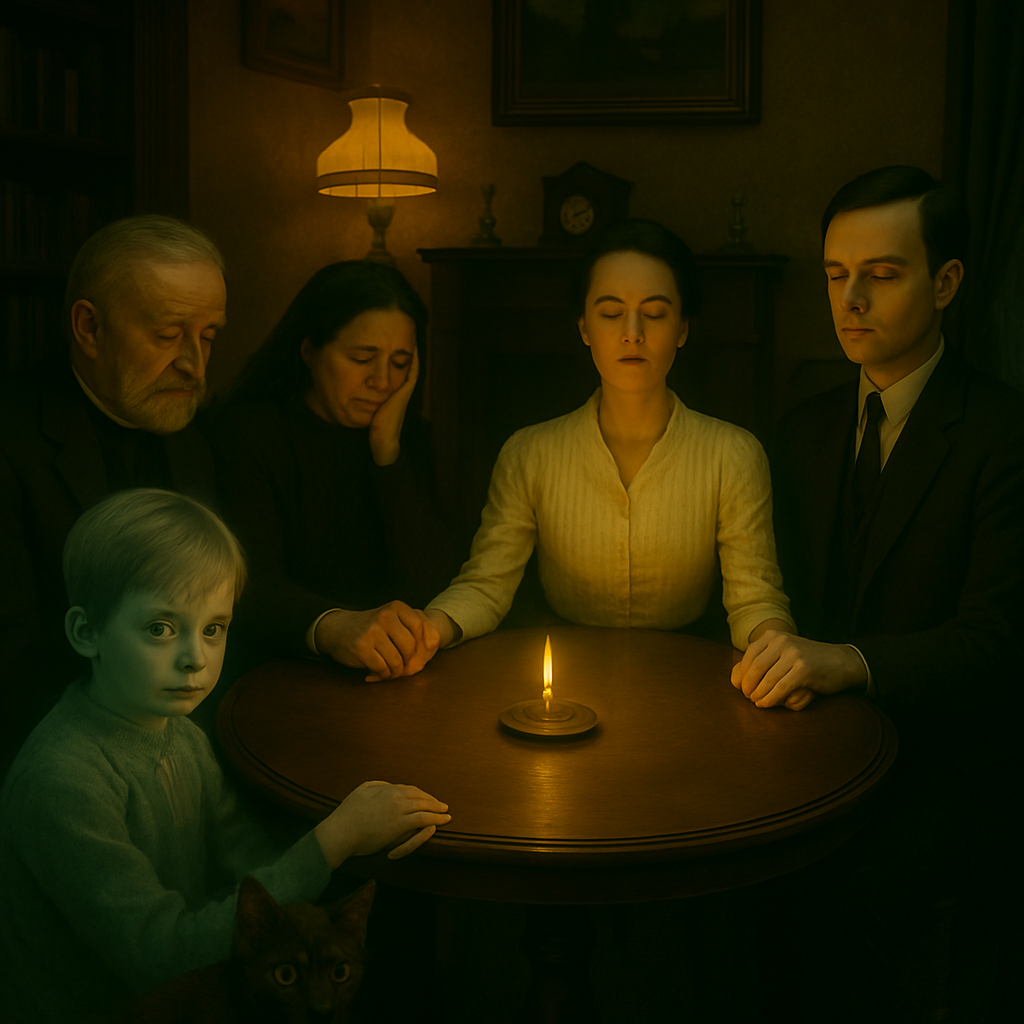
“We seek William Fairfax,” the medium declared, and the boy’s heart lurched at the sound of his own name. “Sweet child, taken too soon by fever’s cruel embrace. William, if your spirit dwells yet among us, rap three times upon the walls of this earthly prison.”
The words struck William like physical blows. Fever? But he felt perfectly well—indeed, he could not recall feeling tired or unwell for… for how long, precisely? The memories seemed to slip away like water through cupped hands.
Mrs Blackwood’s voice grew more commanding. “William Fairfax, I compel you by the bonds of love that tie you to this place—answer our call! Knock three times if you are present!”
A strange compulsion seized the boy, as though invisible strings had been attached to his limbs. His right hand, seemingly of its own accord, curled into a fist. The adults waited in breathless silence, their faces pale and expectant in the candlelight.
William tried to resist, but the force was inexorable. His fist rose toward the wall behind the curtains—once, twice, three times. The sound echoed through the parlour like gunshots, sharp and undeniable.
Mama’s sob broke the silence. “My boy,” she whispered. “My dear, sweet boy.”
In that moment of terrible understanding, William looked down at his own hands and saw the truth written in their translucent pallor. He recalled now the burning fever, the physician’s grave expression, the growing cold that had crept through his limbs like frost. He remembered Mama’s tears, Papa’s broken voice, the terrible stillness that had followed.
Duchess wound herself around his legs one final time, her green eyes bright with ancient wisdom, and William understood why she had been his only companion in this shadowy existence between worlds.
The medium’s voice rang out once more: “The spirit acknowledges us! William, show yourself to those who love you still!”
But William Fairfax was already fading, his form dissolving like morning mist as understanding brought its own release. The curtains stirred gently in the gaslight, revealing nothing but empty space and the lingering scent of jasmine—his mother’s favourite perfume, which she had worn to his bedside during those final, fevered hours.
In the silence that followed, only Duchess remained, sitting sphinx-like upon the Persian rug, her eyes fixed upon the space where a boy had learned, at last, to let go.

Leave a comment