Jo discovered her ability on a Tuesday night in March, dreaming of the Morton Park murder.
She’d been reading about cold cases before bed, drawn to the twenty-three-year-old case of Emily Jameson, found strangled behind the Victorian bandstand. The killer had never been caught. Jo fell asleep with the case file photographs still glowing on her laptop screen.
In the dream, she watched from a distance as a tall figure in a dark coat approached a young woman by the park gates. Jo tried to move closer, to see faces, but found herself fixed in position like a camera mounted too far away. She watched the woman follow the man toward the bandstand, watched shadows swallow them both.
Jo woke with her heart racing and Emily Jameson’s last moments burned into her memory.
The detail felt too vivid for imagination. When she called the police tip line the next morning, she expected to be dismissed as another time-waster. Instead, Detective Inspector Singh agreed to meet her.
“The Jameson family has been waiting twenty-three years for answers,” Singh said, leaning forward across the interview room table. “Emily’s mother is dying. Cancer. She’s got maybe two months left.”
Singh had been a constable when Emily’s body was found. He’d made Mrs Jameson a promise that her daughter’s killer would be caught. Twenty-three years later, he was still trying to keep it.
“I know how this sounds,” Jo said. “But I saw him. Tall, dark coat with distinctive brass buttons—military style. Bald on top with a long grey ponytail. Emily knew him—she went willingly. And he took her shoes with him when he left.”
Singh’s pen hovered over his notepad. “In your dream.”
“I know what you’re thinking.”
“What I’m thinking is that we never released the detail about the shoes. Emily was found barefoot. We assumed the killer took them as a trophy.”
Three weeks later, they’d identified Emily’s killer. Harold Garrett, her university lecturer, found hanging in his garden shed with a suicide note confessing to Emily’s murder. The note mentioned details only the killer could have known.
Mrs Jameson died holding a photograph of her daughter, finally at peace.
“I’ve got another one for you,” Singh said when he called Jo six months later. “Victim’s name was Christine Walsh. 1997. Body found in her flat, sexually assaulted and beaten. No leads.”
Jo had learned to prepare herself now. Light dinner, no caffeine, case file read and memorised before sleep. The ability seemed stronger when she understood the details beforehand.
The first dream visit to Christine Walsh’s murder felt like watching through thick glass. Jo observed from the corner of a cramped bedsit as a man in painter’s overalls forced his way through the front door. She could see the violence unfold, could register the weapon—a hammer from his toolbelt—and the victim’s blonde hair spread across a threadbare carpet. The killer’s face remained frustratingly obscured by shadow.
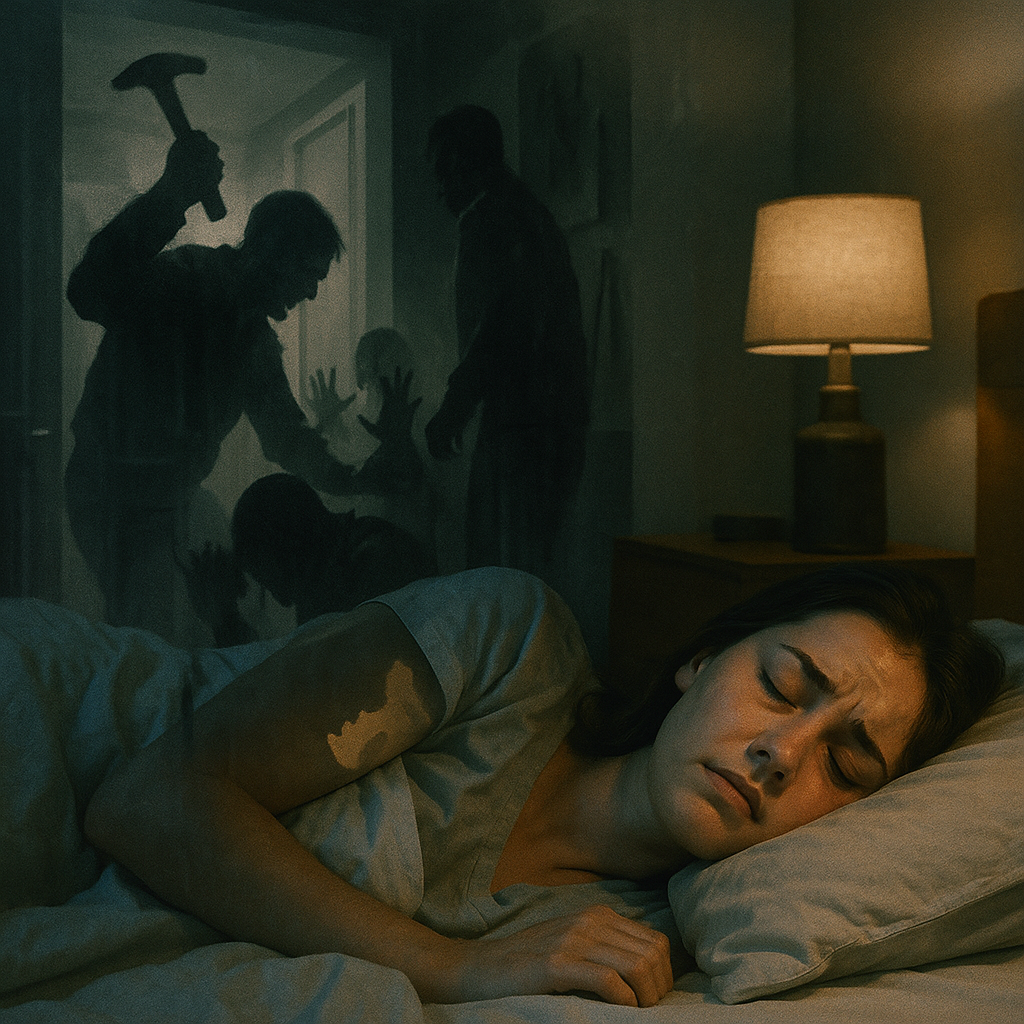
“White male, five-ten, painter or decorator,” Jo reported to Singh the next morning. “Hammer from his toolbelt. Christine let him in—he was there to do work on the flat.”
“That matches what we thought,” Singh said. “But we need more.”
Jo returned to Christine Walsh’s murder the following night. This time, she found herself mobile, able to move around the small flat. She studied the killer’s hands, his clothes, the paint stains on his overalls. She could read “Walsh” written on an invoice pad beside the door. Christine had been expecting him.
Then the killer paused mid-swing and turned toward her corner.
His eyes swept the space where Jo stood, pupils dilated with violence. For several seconds, he stared directly at her, head tilted like a predator sensing prey.
Jo tried to wake herself, clawing toward consciousness. The killer took a step toward her before the dream finally released her.
She woke drenched in sweat, her heart hammering against her ribs.
“He saw me,” she told Singh over coffee that morning. “Or sensed me. Something.”
“Did you get what we need?”
“Invoice pad by the door. Walsh was written on it. He was scheduled to work there.”
Singh nodded grimly. “That’ll help us narrow the search. Council records, trade directories.”
“I’m not going back,” Jo said.
“We just need his company name. Or a face. Something solid for identification.”
“He knew I was there.”
“In a dream, Jo. You were having a dream.”
But Jo knew what she’d felt. The killer’s awareness had been real, immediate, dangerous. Whatever allowed her to witness these crimes was changing, evolving into something she couldn’t control.
Singh called her three weeks later. “We’ve narrowed it down to five contractors who worked the area in 1997. But we need positive identification.”
“I told you—”
“Mrs Walsh has been waiting twenty-six years for answers. Her grandson starts university next month. She wants to see justice before she’s gone.”
Jo found herself back in Christine Walsh’s bedsit that night despite every instinct screaming against it. This time, the killer moved through the crime with predatory confidence. Jo could see his face clearly now—sharp features, prematurely grey hair, small scar above his left eyebrow.
She watched him rifle through Christine’s handbag, memorising his address from the driving licence in his wallet: 47 Maple Street.
Then his head snapped up.
“I know you’re here,” he said quietly.
Jo felt solid now, fully present in the cramped room. When she looked down, she could see her own hands, her own feet on the grimy carpet. The killer turned toward her with terrible certainty.
“Been watching me, have you?” He hefted the blood-stained hammer. “Clever girl.”
Jo ran for the door, but her legs moved like they were underwater. The killer reached her in three quick strides.
“Can’t have witnesses,” he said, raising the hammer above her head.
Jo tried to scream herself awake, fought to break the dream’s hold on her. The hammer descended with inexorable force.
Detective Inspector Singh found Jo’s body three days later when she failed to answer his calls. She lay peacefully in her bed, no signs of violence or distress. The post-mortem revealed no cause of death—heart simply stopped sometime during the night.
On Singh’s desk, a note in Jo’s handwriting: “47 Maple Street. Scar above left eyebrow. His name is Kenneth Mills.”
Kenneth Mills was arrested that afternoon. He confessed to Christine Walsh’s murder within hours, unable to explain how the police had identified him so precisely after twenty-six years.
Mrs Walsh died two weeks later, finally at peace knowing her daughter’s killer would spend his remaining years in prison.
Singh kept Jo’s photograph on his desk beside Emily Jameson’s case file. Two families had found closure because of her gift. He told himself that made her sacrifice worthwhile, even as guilt gnawed at him for pushing her to make that final, fatal visit.
Sometimes, late at night in the empty station, Singh thought he glimpsed a familiar figure in his peripheral vision. A young woman watching from the corners, still helping solve cases, still unable to wake up.

Leave a comment