Most Hollywood blockbusters start as screenplays or novels. But some of cinema’s most powerful films began life as short stories. These compact tales packed enough emotional punch to fill two hours of screen time. Here’s how directors transformed brief fiction into cinematic gold.
1. “The Birds” by Daphne du Maurier (1952) → The Birds (1963)
Du Maurier’s story is brutal and claustrophobic. A farmer and his family barricade themselves inside their cottage while birds attack their small English village. No explanation. No resolution. Just pure survival horror.
Hitchcock took this 20-page nightmare and gave it the full Hollywood treatment. He moved the action to California, added romance, and cast Tippi Hedren as a glamorous socialite. The original story’s bleak ending? Gone. Hitchcock wanted suspense, not despair.
But the core terror remains unchanged. Nature turns against humanity for no comprehensible reason. Du Maurier understood that the scariest horror needs no motivation.
2. “Minority Report” by Philip K. Dick (1956) → Minority Report (2002)
Dick’s original story is a tight philosophical puzzle. Can you arrest someone for a crime they haven’t committed yet? The protagonist discovers he’s predicted to commit murder. Is fate predetermined or can free will change the future?
Spielberg expanded this into a visual feast of 2054 technology. Flying cars, gesture-controlled computers, retinal scanners everywhere. The philosophical questions got buried under spectacular action sequences and Tom Cruise running very fast.
Yet the central dilemma translates perfectly to film. Both versions ask whether knowledge of the future makes it inevitable. Dick would probably hate the Hollywood ending, but he’d admire the way Spielberg made precrime feel absolutely plausible.
3. “Brokeback Mountain” by Annie Proulx (1997) → Brokeback Mountain (2005)
Proulx’s story spans decades in just 28 pages. Two cowboys meet on a mountain, fall in love, then spend twenty years trying to live with that truth. The prose is sparse, almost brutal. Every sentence carries weight.
Ang Lee’s film needed to show what Proulx only suggested. The intimate moments. The family dinners thick with unspoken tension. The slow destruction of two lives lived in secret. Lee filled the gaps between Proulx’s careful sentences with heartbreaking detail.
Both versions understand that love stories aren’t always about happiness. Sometimes they’re about the terrible cost of hiding who you are.
4. “Arrival” from “Story of Your Life” by Ted Chiang (1998) → Arrival (2016)
Chiang’s story is about language and time and the way understanding changes everything. When aliens arrive, a linguist learns their circular language and discovers it alters human perception of time. Past, present, and future become simultaneous.
Denis Villeneuve faced an impossible challenge: how do you film a story about thinking? He solved it by making the alien language visual. Those inky circular symbols became characters themselves. Amy Adams carries the emotional weight while the audience puzzles out the temporal mechanics.
The film simplifies Chiang’s complex linguistics, but it captures something harder to achieve: the sense of wonder that comes from truly understanding something alien.
5. “The Secret Life of Walter Mitty” by James Thurber (1939) → The Secret Life of Walter Mitty (1947 & 2013)
Thurber’s original Walter Mitty is a defeated man whose only escape is elaborate daydreams. Five brief fantasies interrupt his mundane errands. Each daydream gets punctured by his nagging wife or everyday reality. It’s funny and deeply sad.
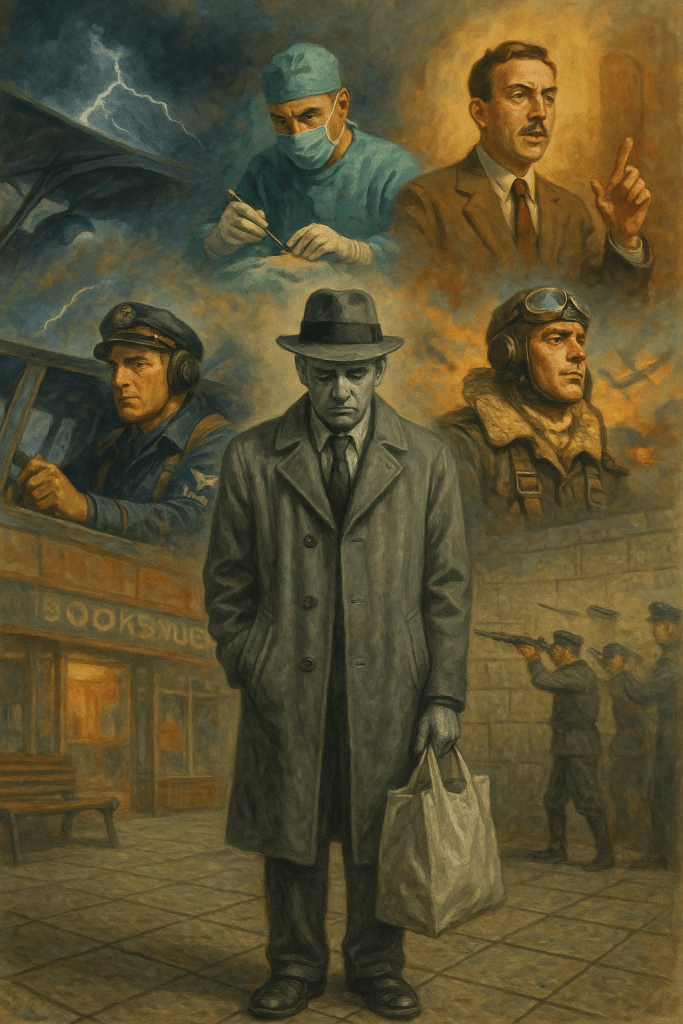
Hollywood has adapted this twice, and both versions missed the point. The 1947 Danny Kaye version turned it into broad comedy. Ben Stiller’s 2013 remake made Walter actually brave, actually adventurous. Both films gave him a happy ending.
Thurber’s Walter never escapes. That’s the whole point. His fantasies compensate for a life unlived. They’re his only refuge from disappointment. The story works because it doesn’t offer false hope.
6. “2001: A Space Odyssey” from “The Sentinel” by Arthur C. Clarke (1948) → 2001: A Space Odyssey (1968)
Clarke’s “The Sentinel” is just 5,000 words about finding an alien artifact on the moon. It’s been waiting there for millennia, probably as a signal to alert its creators when humanity reaches space. Simple premise, massive implications.
Kubrick and Clarke (working together) expanded this into an epic about human evolution, artificial intelligence, and cosmic consciousness. They added the apes, HAL 9000, and that bewildering stargate sequence. The original story’s lone astronaut became a journey through the entire history and future of human consciousness.
Few adaptations stray this far from their source material. Yet both versions share the same sense of awe at humanity’s place in an incomprehensibly vast universe.
The best adaptations understand what made the original work and find new ways to achieve the same emotional impact. These directors knew that sometimes expanding a story means getting to its heart.

Leave a comment