As well as entertaining us, great short stories actually teach us how fiction really works. In Classic Shorts we take a closer look at the stories that have stuck around, not because they’re assigned reading, but because of the emotional impact they had on readers when they first appeared. We’ll explore what makes these tales tick, why they still pack a punch decades later and what modern writers can learn from them.
Classic Shorts aren’t intended to be academic essays. Think of them as conversations about craft, the kind you might have with a fellow reader who’s just discovered something brilliant and wants to share it.
The Lottery
When The Lottery appeared in The New Yorker on 26th June 1948, readers were utterly outraged. The magazine received hundreds of angry letters and subscription cancellations. People demanded to know where these lottery towns existed so they could avoid them. Others asked how to join in! Shirley Jackson had crafted something that felt so real, so plausible, that readers couldn’t tell if it was fiction or reporting. Seventy-five years later, that story still has the power to make your skin crawl.
Stop Right Here
Before we go any further, if you haven’t read The Lottery, go and do it now. Seriously. It’s only 3,500 words, about fifteen minutes of your time. There’s no point reading this analysis if you don’t know how it ends. We’ll be discussing everything, including that final, brutal scene.
Still here? Good. Let’s talk about why Jackson’s masterpiece works so brilliantly.
The Art of Misdirection
Jackson opens with one of the most misleading paragraphs in literary history.
The morning of June 27th was clear and sunny, with the fresh warmth of a full-summer day; the flowers were blossoming profusely and the grass was richly green.
It reads like the beginning of a gentle pastoral tale. Children are gathering in the square, freed from school for the summer. Everything feels normal, wholesome, American.
But Jackson plants her clues in plain sight. The children collect stones, making “a great pile” and guarding it fiercely. The adults gather but keep their distance from that pile. Nervous laughter punctuates conversations. Old Man Warner mutters about other towns giving up their lotteries, calling them “crazy fools.” Every warning sign sits there waiting, disguised as quaint village details.
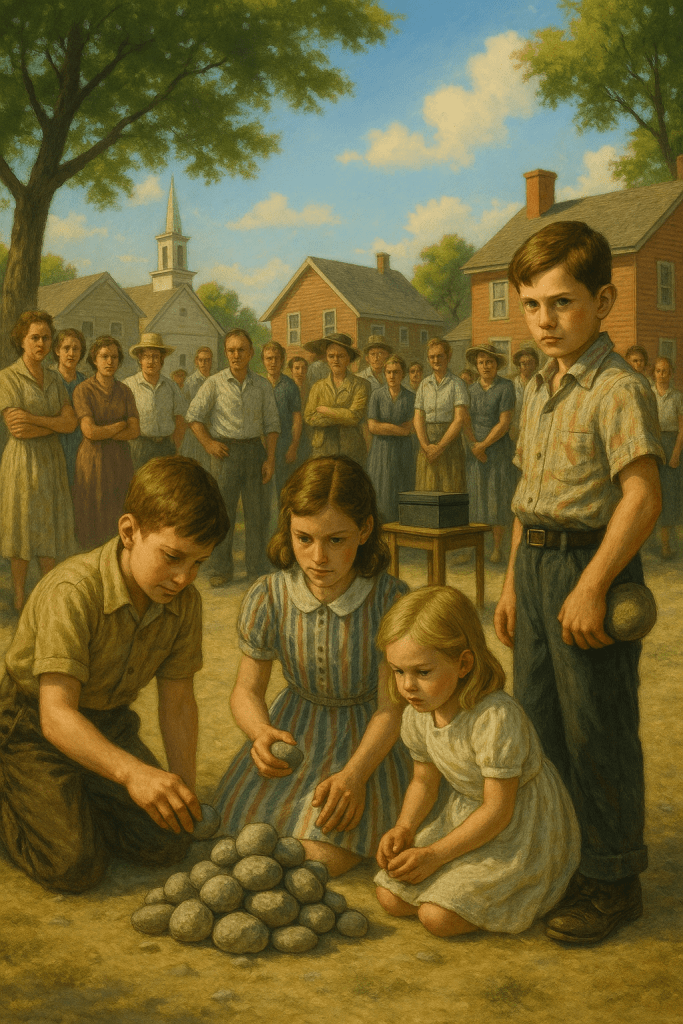
This is misdirection at its finest. Jackson lets our assumptions do the heavy lifting. We see “lottery” and think prizes. We see a sunny morning and expect good things. She uses our cultural conditioning against us, the same way the villagers use tradition against reason.
Names That Tell the Truth
Jackson wasn’t subtle with her character names, but somehow we still miss them on first reading. Mr Graves assists with the lottery proceedings. Mr Summers runs the ceremony. Delacroix (which the villagers mispronounce as “Dellacroy”) means “of the cross”: fitting for someone about to participate in a ritual sacrifice.
These aren’t accidents. Jackson chose names that practically scream their symbolic meaning, yet readers race past them, focused on the unfolding drama. Only on re-reading do you realise how many clues she scattered throughout. Even Mrs Hutchinson’s first name, Tessie, echoes Tess of the d’Urbervilles: another woman destroyed by social forces beyond her control.
The genius lies in hiding these obvious clues behind perfectly ordinary surnames like Martin, Adams and Watson. The mixture of symbolic and mundane names makes the whole community feel both archetypal and absolutely real.
Making Horror Routine
Perhaps Jackson’s greatest achievement is how she normalises the unthinkable. The lottery gets treated like any other civic duty: square dances, the Halloween programme, just another item on the community calendar. Mr Summers runs it because “he had time and energy to devote to civic activities.” The black box is shabby and needs replacing, but nobody can be bothered to make a new one.
This casual bureaucracy amplifies the horror rather than diminishing it. These villagers aren’t cultists or fanatics, but ordinary people following procedure. Mrs Delacroix chats with Mrs Hutchinson about dishes in the sink, then picks up a stone “so large she had to pick it up with both hands.” The transition from neighbourly conversation to ritualistic violence happens without emotional shift, which makes it infinitely more chilling.
Jackson understood that real horror often wears the mask of the mundane. The most frightening evil lacks drama or theatre. Instead, it comes dressed as paperwork and tradition and people doing what they’ve always done because that’s how things are done.
Why It Still Works
The Lottery remains disturbing because the human capacity for violence disguised as tradition hasn’t disappeared. We’ve seen it in genocide, in lynchings, in social media pile-ons where ordinary people participate in destroying someone’s life because everyone else is doing it. The specific ritual may be fiction, but the psychology is devastatingly real.
Jackson forces us to confront an uncomfortable truth about ourselves. We follow traditions without questioning their purpose. We go along with group decisions to avoid standing out. We tell ourselves that maintaining order matters more than individual suffering. We all have the capacity to become villagers.
Those 1948 readers were angry because Jackson had held up a mirror and shown them something they recognised but didn’t want to see. The Lottery isn’t just a story about a fictional town: it’s a story about us, and the things we do because we’ve always done them.
Is the real horror in the stones, or in how easily we throw them?

Leave a comment